Tuesday, July 5, 2016

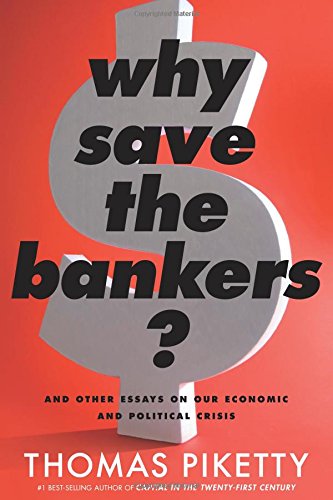
Why Save the Bankers by Thomas Piketty


What a stupid name for this collection of essays by economist Thomas Piketty. One would think it is an entire book of intensely ideological essays dedicated to rumination of whether we should have bailed out a corrupt financial industry. Instead, the reader is greeted with a series of opinion pieces written for a leftist French Magazine from 2008 - 2015. Written with both brevity and the authority given to a man whose career revolves around the study of capital as it pertains to major world powers, each piece offers insight on questions of inequality, globalism, taxation, trade, and even topics like terrorism or reparations for slavery.

The best part about reading WSTB was the timing I had in picking it up. Reading Piketty make plea after plea for a government that steps in to bail out citizens who are inevitably left behind by global capitalism (that global capitalism leaves many people in the lower and middle classes behind is an indisputable fact at this point, thanks largely in part to Piketty's work in Capital in the Twenty First Century) AND watching those citizens rebel against global capitalism with phenomenons such as Trump or the Brexit, offers unique validation to everything he was saying in real time. It's almost like reading a countdown to dangerous nationalist protectionism. What's more interesting is that Piketty's tome Capital in the Twenty First Century was long thought to be an arm of the far left, but it seems that Piketty believes in bailing out the banks, free trade agreements, and rapid technological advancement with the caveat that there must be strong social governments that work to redistribute the subsequent gains from global economic growth. After realizing that our world governments, for the most part, have been doing the opposite of what Piketty suggests doing at the time, it is amazing to look around and see everything he warned would happen if they don't; booming economic inequality, nationalist protectionism, distrust of governments, xenophobia, anti-globalism, and terrorism (which is actually the weakest piece, but the point is compelling and worth looking into at length).


The worst part about this books is mostly likely the decisions made by the publisher. The title and the exception of depth. If you're looking to read snippets as to why we might be where we are as an international community while maybe restoring your faith in a capitalism that could work for everyone, then this is a great and gratifying read. But if you're looking for depth, data, and a longer, more detailed timeline you should do yourself a favor and actually read Capital in the Twenty First Century all the way through. Then, ideally, publishers won't feel the need to push a sparknotes version like Why Save the Bankers.

Sunday, June 19, 2016

Purity by Jonathan Franzen

"He settled down to write the big book, the novel that would secure him his place in the modern American canon. Once upon a time, it had sufficed to write the Sound and the Fury or The Sun Also Rises. But now bigness was essential. Thickness, length." (186)

"So many Jonathan's. A plague of literary Jonathan's. If you read the New York Times Book Review you'd think it was the most common male name in America." (207)


Purity is the latest novel by Jonathan Franzen and the third book I've read of his. Like Freedom and The Corrections, Purity features a cast of characters set against a familiar cultural backdrop all striving to become the virtue the title of the novel extols; free, correct, pure. Naturally human nature gets in the way of this, but the resulting read is always fascinating. Frankly, I didn't think Purity was as good as the Corrections and certainly not better than Freedom. The volume of characters and the amount of bloat that Franzen dedicates to filler characters makes it harder to feel anything for the really important and interesting ones. Subsequently it took longer to really reel me into the larger story. Nevertheless, Purity is essentially Franzen and essentially good.

While there is never exactly a main character in Franzen's novel there is usually one that the theme and plot circle around. Pip, whose real name is Purity, is a young millennial riddled with millennial problems; saddled with 100k + in student debt, socially conscious working for corporate America, higher education promising high and a real world delivering low, the product of a single parent. We meet Pip as she is talking to her megalomanic mother about her need for money and imploring her to disclose who her real father is. The adventure that follows this opening scene sees Pip getting involved in a Wikileaks like organization called the Sunlight Project and an investigative journalist organization called DI, but not always through the perspective of Pip. We get backstory and context that ranges from life in East Berlin in the 1980s to New York to Bolivia. This is all coupled with Franzen's characteristic inclusion of current events; Julian Assange is there, the NSA, Google, Obama, feminism, the Californian drought, Snowden, Facebook, they are all there along side their predecessors in the 1980's. Whether Franzen, making a larger point about the world around us by putting a microscope on his characters, is looking to explain the modern political climate or document its effect is difficult to determine, but it's fun to think about and read into.

At the same time, this is where Franzen has always been the most tedious. I would never criticize a book for being long unless it is so unnecessarily. Franzen's Purity can be excessively self-referential; anything from his career as a writer (see the above quotes) to his political views is found far too often and far too obviously. A work of fiction that paints characters into a larger political tapestry has to avoid the pitfall of becoming a dumping ground of opinion. Franzen fails to resist this urge too many times. The clarity and moral turpitude with which Franzen's characters perfectly summarize any ideology such as feminism or socialism, capitalism or journalistic integrity, punctuates the narrative with protruding, unrealistic sound bites. He might stop short of turning his character's into Ayn Rand like mouth pieces for a deeper philosophy, but the inconsistency distracts from an otherwise great story. Watch as what was good dialogue devolves into Franzen opinion;
"I could tell your mother a thing or two about corporations" Anabel said darkly
"But the alternative doesn't work, either. You get the Soviet Union, you get the housing project, you get the teamsters union. The truth is somewhere in the tension between the two sides, and that's the sphere the journalist is supposed to live". (365)
This, and many other sections like it, are not complicated enough, too one sided. Not even 10 pages after this exchange we see the same characters battling it out over whether or not a man should have to sit down when going to the bathroom. The exchange is messy, but real. Manufactured messiness is a gift that Franzen uses well, we get flawed logic ("but I have to sit down") and manipulation; "she proceeded to cry torrentially. The only way I could get her to stop was to become, right then and there, a person who experienced as keenly as she did the unfairness of my being able to pee standing up". It seems that Franzen himself works best in the tension between two sides, it's when he explicitly takes one when you wonder what the hell he is doing.

I've always thought that Franzen should worry less about expressing himself and spend more time existing in the complicated. Part of the fun is extrapolating the themes from his novels and the flawed characters, fun that is spoiled when we're given the right answer. At its heart, Purity is about secrets, how the existence of secrets make up our identities and yet we have an obsession with appearing pure, of looking like we have none. It's a difficult subject to explore through fiction. When Franzen is on, and he is on through most of this novel, his exploration is fun, emotional, and thought provoking. He should be given more credit as a world builder, even though he works within the world we already know, few living fictional authors better capture what it means to live in it (assuming, of course, you're white...). It's no secret this book is a modern take on Great Expectations (Pip?), but whether this is Dickensian or not, there is no living author quite like Franzen. We should all look forward to his next attempt at the great American novel.


Monday, May 30, 2016

A Heartbreaking work of staggering genius by Dave Eggers

Dave Eggers is a Titan within the contemporary lit industry. Chances are you've come across one of his introductions, or a magazine or collection he's edited. Eggers has been on my radar for awhile, never as an author, more as a literary force for organization, I'm especially partial to the Best American Non-Required Reading series that he edits. As far as a Heart Breaking Work of Staggering Genius is concerned, I could not have picked it up at a better time. It is a great work of autobiographical fiction that requires a lot of its reader, I don't know if I would have been up to it had I read this book say 2 years ago, or even 2 years from now.

That's because this book can be a work of staggering genius, but it definitely appeals to a niche type of reader. Eggers is writing himself as a character in his early twenties within his own, true story. This means that Eggers in tone, style, and characterization is a quintessential 20 year old in all their annoying and insistent duality. He is both arrogant and self-eviscerating, young at heart and jaded, sentimental and cold, entitled, "owed", attention seeking, but cripplingly self-conscious and undeserving. Eggers explores this range of 20 something identity in a way that makes this essential reading for any 20 year old who constantly thinks about what it means to be 20+, how truly formative these years can be. Eggers' story is truly full of heartbreak too; losing both parents, assuming guardianship and having to raise his little brother with a sense of normalcy. The reader watches Eggers struggle on two fronts: as a character in his own story trying to raise his little brother (7) responsibly while also trying to be a normal 23 year old with a life and as the author of his own story constantly questioning his right and ability to tell it. The constant battle painted with Eggers' calculated brush strokes gets at the heart of being young, requiring both an interest in the topic and an understanding of what it means.

And at 22 I wouldn't have gotten why Eggers was so impossibly annoying, arrogant, and constantly terrified of his life ending, but now, at 26, I see that Eggers is annoying because of his desire for positive reinforcement never reaped from his parents (whether this is true or not is open to interpretation but 22 year old Eggers' perception of it is definitely not), his arrogance is a mask to hide something much deeper down, and his constant fear of mortality is actually a fear of being forgotten. And there is a lot more here. Eggers keeps his writing interesting, spanning the events of his early 20's poetically, humorously, and offering a clear look into the depths of his insecurities. But so what kind of reader is going to like this book? One could be of any age, but being closer to 22 helps because one could remember their inner thoughts better the closer they are to that age. Either way, to appreciate AHWOSG it is required to be aware of who you most likely were when you were 20 - 25. You would have to remember the masks you wore in front of your friends and family but recognize that underneath you had no idea who you were or wanted to be, maybe you still don't. You'd have to acknowledge your fear of attention falling away from you, of never being great, the ever present fear that eyes are both on you and at risk of being off you. Then you'd have to imagine yourself in Eggers' situation; orphaned, raising a sibling as a son. This requires cognizance and making difficult realizations about yourself, if the reader does not meet these requirements they will not 'get' this novel. 

One of the manifestations of not getting it, you will find if you peruse the Internet for people's opinions of this book, is a major criticism of tone. People will find it self-indulgent, far too referential, and irreverent to the reader. That's because it requires a closer look, it requires one to read the hilariously long acknowledgements section before the novel even starts. It features Eggers clear outline of the themes presented in this book (plus a drawing of a stapler), the irony here is, of course, that the close reader who would take the time to read the 15 page acknowledgements in the beginning is not the same reader who needs the themes spelled out to them. They likely already know that when Eggers calls his work "Staggering Genius" it is not real arrogance, but manufactured. In fact, everything in this book from the copyright page, to the table of contents, to the narrative style is manufactured to create a better sense of a nagging character telling the story as opposed to the author. The reader receives constant reminding that they are reading the thoughts of a manufactured narrator NOT the thoughts of Dave Eggers, author of a Heartbreaking Work of Staggering Genius. 

The major reason I know, and you should know, that Eggers is not writing as Eggers aged 33 or whatever, is that he will often step into the narrative and take the place of a character to savagely cut down the way in which age 20 Eggers is telling the story. This is a truly great and wholly unique literary technique, somewhat meta but artfully worked in, not out of place. It usually starts with a casual conversation between Eggers and his little brother Toph (sometimes it's his ailing friend John, but mostly it's Toph) not unlike many other sections of the book, so it always comes as a hysterically funny surprise, making these moments some of the most memorable portions. Eggers will be telling Toph goodnight or about some idea he has for a magazine. Toph would start out responding as a 7 year old, but then, out of the blue, Toph will launch into a critical diatribe about a portion of the novel; "to be honest, what I see is less a problem with form, all that garbage, and more a problem of conscience...you struggle with guilt both Catholic and unique...your father being in AA was not to be spoken of, ever, while he was in and after he stopped attending. You never told even your closest friends about anything that happened inside that house. Now you alternately rebel against and embrace that kind of suppression". This is obviously not Toph, it is author Eggers entering the narrative to continue conversing with character Eggers, both winking at the reader to remind them of the distinction between author and narrator but also to close some gaps opened by the unreliable narration of character Eggers. It is Eggers breaking in to remind his reader that they are reading fiction, not biography. This happens maybe 4 or 5 times and it is ridiculously fun and smart. It is a shame it is often lost on his readership. 

Again, reading this book as an aware 20 something is important. Coming face to face with your insecurities, trying to put your finger on what it is deep down that brings out the worst in you is an opportunity often only available to you at that age - not always, but I'd imagine doing it with kids would be hard and unworthy of your time. So delve into this book knowing what you're getting into, that at the end of the page you're reading fiction. And cut Eggers some slack, his work is genius after all.
Thursday, May 12, 2016

Wolf in White Van by John Darnielle


Songwriting is not easy. If anyone could write a good song then we wouldn’t have enough accountants and there would be a lot more music out there to listen to. Song lyrics have to be both poetic and musical, the best ones often tell a story. This is how John Darnielle, the singer songwriter for the Mountain Goats, writes his songs. They often tell stories that are rarely autobiographical, feature a discernible character, and almost always offer a clear and poignant narrative of immense pain. From what I’ve heard, he always focuses in on characters that are hyper aware of themselves, usually expounding on their weaknesses or their dark situations with a cheery and uplifting tune; there is always something profoundly positive in the delivery. This mismatch of light hearts and dark minds is exactly the way in which Wolf in White Van, Darnielle’s debut novel, is written.

That is to say that Wolf in White Van is very well written. The reader is invited into protagonist Sean Phillips head in what is presumably his present day life. We learn instantly that Sean is a likeable person; he is very human in the way he talks to us, very kind to the people around him, and his life seems peppered with very light hearted moments of intimate human contact. He’s a Conan fan, he’s very funny, he reads scifi religiously, and he has a cool job writing mail-in role playing games. We also know that Sean is horribly disfigured due to an accident in his adolescence*. He spends a lot of time in his head too, and he’d like you to believe it is because of this accident, but as we travel back to times before the incident it is obvious he was always this way. This is important because the reader is often exposed to some very dark things whether in Sean’s past or his present thoughts. We travel back with Sean to traumatic moments, he was a tortured teen that grew up to be a tortured individual, his mind can go to some very disturbing places. This play between the dark depths of Sean’s mind and the very beautiful, touching moments he has with people (often strangers) serves to strengthen the emotional drive in each moment. It also makes Sean a very real and relatable person, he isn’t just a tortured man and he isn’t the bastion of humanism. This is possibly everyone’s story, but - probably like everyone - Sean feels his disfigured face makes his trauma and anger his own and the beautiful connections he forges with others, including the reader, speak to an interconnectivity that perhaps is over Sean’s head. This makes for a very empathetic read, one that is at once ridiculously fun and funny and thought provoking. Not unlike a Mountain Goats song.

It’s hard to say much more because so much of this novel is discovering Sean and the terrifying places he has been both outside and inside his mind. What makes this book so devourable is a sense of mystery; what was the accident? Who is this person he is alluding to? What lawsuit? Darnielle is laying out breadcrumbs; crafting an openness and a willingness in Sean that make what’s behind the great big closed vault doors even more tantalizing. This is true talent that I doubt will disappear as Darnielle continues to write. I can’t wait to see what he does next; musically or otherwise.

*Do yourself a favor and don’t read any plot synopsis on like Wikipedia before you read this book. Part of the reason this narrative is so powerful is the gradual way you learn what happens to Sean. I would say not to even read the back of the book.


Wednesday, May 4, 2016

Book Review: The Big Short


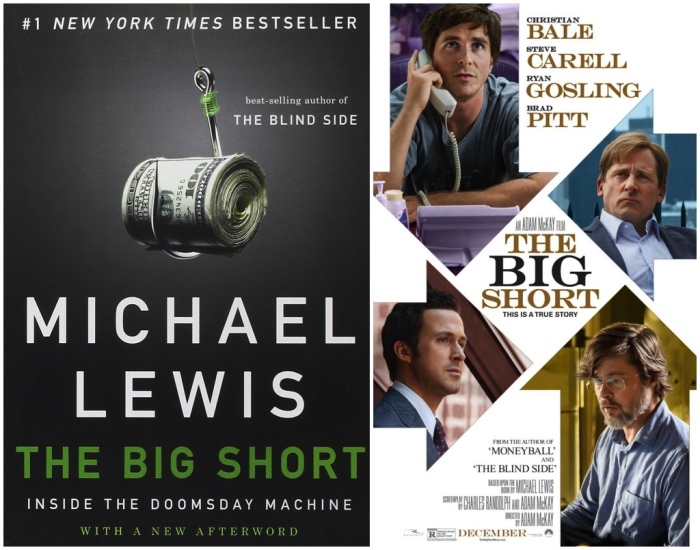
There are plenty of movies I find better than the books they are based off of; the God Father, There Will Be Blood, a Clockwork Orange, the Shining. The Big Short by Michael Lewis was freshly added to that list. Which isn't to say the book was bad, in fact, it was fascinating. Reading about the collapse of the the entire market and its subsequent bailout from the perspective of a few insiders is the chance of a lifetime and Michael Lewis orchestrates this well enough to make the Big Short entirely worth it. That said, there were frequent enough causes for eye rolling that make me wonder if picking up another Michael Lewis book is entirely worth it.

Lewis is constantly on the lookout for tough guys in tough times and his characterization of these financial insiders - Michael Burry, Steve Eisman, Greg Lippmann, or Jamie and Charlie - is pretty flatly that. Their perspectives on the numbers they discovered or their reaction to the market is ridiculously fun and insightful, but these are not Lewis' invention so much as his organization, which he did very well. What are less well done are the characterizations that Lewis strives for; Burry and Eisman (and Eisman's team) are cast as dark, cynical, and so meticulous it is off putting, almost unbelievable. Tortured white guys steeped in tragedy who dared look into the void of the US financial market only to become more dark and cynical and tortured. OK, but this narrative style is not only getting old, but it either isn't a fit for this story or Lewis doesn't piece it together well, I can't tell which. I don't mean to quibble, I know it is a true story with real perspective from real people, but I find it difficult to believe Lewis couldn't have been a hair more diverse. In fact in the prologue he talks about Meredith Whitney, an analyst who turned him onto the entire story and introduced him to Eisman, but Whitney disappears completely from the novel. Why is this important? Because I can't help but think the Lewis' characters are bad ones. All the work of humanizing them by hearing their stories told directly in quotes is abolished by Lewis' own attempt to deepen them. Vinny is a member of Eisman's team and is consistently skeptical of the market, a quote from him is a real treat. But Lewis's insistence on inserting things like "Vinny was from Queens, so his view had to be a little bit darker" flat and confusing...what does being from queens even mean? Or Burry and Eisman's reaction to their anticipation of complete market failure boiling down to hot flashes and spiked blood pressure, this is an incredibly weak reaction considering how many people lost their homes, and it deafened their actual voices with actual poignant and humanizing emotion in favor of obvious literary tradition blindly applied. Not only is diversity humanizing, but the inclusion of more character's might have left less room for Lewis's fantasizing….poorly.

A possible exception to this is Jamie Mai and Charlie Ledley. Two younger guys who were not really in the big time trading, making them the most outside of the outsiders, but also giving them a fresh and more naive view to start. Eventually they delved into the sort of cynicism Eisman, or Lippmann, or Burry wear on their sleeves, but in the beginning they are ambitious and doubtful of their own abilities. Again, this is less of Lewis's doing, but that he included them proves the point; diversity is humanizing. Ledley and Mai add humor and empathy, their real life story adds to their development as characters in a book, which means Lewis doesn't add much to them. Their sections were fun and the best of what Lewis's other sections were; pure perspective from fascinating people. They were a breath of fresh air in a story that was surprisingly and frustratingly lacking empathy.


Which truly is the most disappointing thing about The Big Short. It loses itself very quickly and will most likely lose most readers. It isn’t a great non-fiction book, it doesn’t delve into the corruptibility of the entire financial system, it doesn’t link it with the formative Bush years or economic inequality, there are no harrowing stories of everyday citizens losing their homes. All of these things would have given The Big Short a humanizing thesis, or at the very least, a sense of direction. As a work of fiction these stories would have added depth. Not to mention, all of the material was there! Look at this gem that Leley gives Lewis towards the end of the novel; "At the top of [my] list of concerns, after Cornwall Capital had laid its bets against the subprime loans, was that the powers at be might step in at any moment and prevent individual American subprime mortgage borrowers from failing". That is a truly eye opening thought to be explored; was this entire catastrophe preventable? Why weren’t the people saved before the banks even went under? What did it mean that they weren’t? But does Lewis doesn’t go anywhere with this, he just advances what did happen (the bailout etc). I think Lewis might forget at times, even after the subjects have given him brilliant insights to work with, that his readers lived through the bail out. They come to The Big Short for an inside look, but they really only get to eavesdrop. What they hear has the potential to blow their mind, but only because of the stories they already lived.


Friday, April 15, 2016

Beloved by Toni Morrison


If Senator John Conyers ever gets H.R. 40 passed, a law he raises every senate session that allocates money to the study of the legacy of slavery and an assessment of reparations, Beloved by Toni Morrison should be at the top of the reading list.

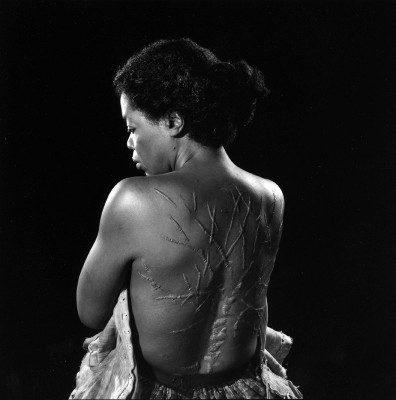
Yes, Beloved is entirely fictional, though the story is loosely based off a bit of American slavery legend; a woman faced with returning to slavery because of the fugitive slave act, decides to kill her children rather than give them up. The legend is often alluded to as the stuff of rebellion, the ultimate rebellious act in the face of slavery; the destruction of one's own children in an effort to prove they belonged to no man. It's a story for martyrdom referenced in pop culture, from Nina Simone to Talib Kweli. Yet Morrison explores this idea, shattering the mythos of the martyr in favor of a far more haunting and vulnerable story. She delves into the narrative; humanizing both the mother, Sethe, and victimized child, Beloved, in a novel essentially about belonging.

While Sethe and Beloved are the center of the narrative, it is essentially about a community of former slaves escaped to Ohio, who are nothing but haunted by their former bondage. And Morrison knows how to haunt her characters. It's obvious slavery consumes all as the book drifts from present plot points and conversations into glimpses of perverse images - a man burning, a mentally broken slave, a hanging woman - all images of a former life at a Kentucky plantation called Sweet Home. If a character is walking or talking, deep in reverie or simply cooking a meal, the scene quickly devolves into vivid depictions of abuse, escape, and the pain reserved only for survivors of the very worst genocides history has to offer. The potency of these memories is proof enough that Morrison can write in a stunning and unrivaled way, she may be the only writer capable of truly humanizing the legacy of slavery. At any rate, she accomplishes something no non-fiction book on the topic could ever really do.
One of the demonstrations of Morrison's ability is the way she makes belonging a central theme. It is only later that we realize the burning man is a friend, the broken slave a husband, the hanging woman, a mother. The reason we, the reader, aren't greeted with these facts immediately is because Morrison is exploring what slavery teaches about belonging (it is no coincidence the villain in Beloved is named Teacher, the chief overseer at Sweet Home). If this book were non-fiction the thesis would essentially ask what happens to one's sense of belonging when they belong legally to another person. There is so much helplessness in Beloved, an eager desire to own oneself, the product of one's labor. Even the word beloved is used to refer to a cherished and treasured individual, someone who belongs to us. While this seems like it could quickly break down into common sense, to the obvious notion that slavery was bad for the individual slave psyche, it is Morrison's complete mastery of storytelling, of painfully interrupting the reader that keeps the reader entrapped.

And it isn't always violence the way many stories of slavery and racism must almost necessarily be. Morrison has proven it is possible to use imagery alone to jolt the reader, remind them that they are never in a safe space. One of my favorite examples of this is when Denver, one of Sethe's daughters, the only one born free, is at the home of a Dutch brother and sister who are considered "good whites", true champions of abolition. Denver is there asking for a job, but before the reader can feel too comfortable:

"Denver left, but not before she had seen, sitting on a shelf by the back door, a blackboy's mouth full of money. His head was thrown back farther than a head could go, his hands were shoved in his pockets. Bulging like moons, two eyes were all the face he had above the saying red mouth. His hair was a cluster of raised, widely spaced dots made of nail heads. And he was on his knees. His mouth, wide as a cup, held coins needed to pay for a delivery or other small service, but could just as well have held buttons, pins or crab apple jelly. Painted across the pedestal he knelt on were the words 'at yo service'"

This is all we see of the doll, but Morrison doesn't arbitrarily place it in the house of the only friendly whites in the novel. It is a simple yet vivid reminder that racism penetrates everywhere. This image isn't for Denver to see, but the reader. We are all familiar with the sambo, the helpless and stupid black boy that needs the white man to lead them. We know the depiction of sambo is the bulging white eyes and the red mouth. The isolated sentence describing him on his knees and the simplistic 'at yo service'. This was meant to haunt the reader even as something good starts developing for a truly lovable character.

Beloved is deeply disturbing, it's uncomfortable, it's unbelievability is unsettling and doesn't detract from the power with which Morrison writes. Many critics compare her to Faulkner in style, this is true and she compounds on it elegantly. But in content, Toni Morrison is truly one of a kind, writing humanity into a horrifying moment in history and shaming us deeply for forgetting it was ever there.


Thursday, March 24, 2016

Brief Interview with Hideous Men by David Foster Wallace


Picture David Lynch directing, not whole episodes, but single snatches of Seinfeld dialogue, and you've got the gist of David Foster Wallace's title story Brief Interviews with Hideous Men. It peppers this book of short stories, leaving off and picking up with different "subjects" (interviewees) as the other stories end. The reader, who it's presumed stands in for the interviewer, is represented by just the letter 'Q' in between large swaths of interviewee (these are allegedly the hideous men) monologue. There are intense layers of ironies amidst narratives ranging from graphic and disturbing to witty and downright hilarious. They sets the tone for all of the stories in the book, inviting the reader into an interrogation room and forcing them to ponder difficult questions about moments of growth or beauty or togetherness in the presence of intense trauma.


While the theme seems to be relatively consistent, these stories have extraordinary range in style. Even though each story is drastically different there is something so obviously David Foster Wallace persistent in each, that binds them together. Like DFW temprament is the One Ring or something. It also makes it difficult to point out any one story that stands out. Sure, there is truly intricate and beautiful prose like in Forever Overhead or Church Not Made with Hands, two stories that made me literally despair at how well they were written (the contemporary world of literature lost one of the true greats). Or there is the essential neurotic Wallace in The Depressed Person or Dantum Centurio, whose incessant repetition and over-technicality felt both hilarious and aggravating. In Octet you're met with Wallace's distinct brand of Meta-fiction, which at its worst could probably put any Woody Allen movie to shame; the way it teeters between begrudging self degradation and endearing honesty is refreshing for a style usually reserved for smugness or cynicism. And finally there is Wallace as just a really good story teller. For the reader who values plot over all else I'd give them Adult World, On His Deathbed, Holding Your Hand, and above all else; Signifying Nothing. Each with a radically disturbing element; fierce, hidden guilt about that disturbing element; and a coherent, linear plot the three stories are written the way short fiction should be written. Signifying Nothing is particularly artful at both pushing you way outside of your comfort zone and then comforting you there, possibly expanding something deep inside you, all in the course of a few pages.

Which is what makes this book of short stories so great. It is an introduction to Wallace's special kind of fiction, without delving into massive projects like Infinite Jest or the cripplingly sad (and long) Pale King. DFW believed vehemently that good fiction should disturb the comfortable and comfort the disturbed, a line I believe he borrowed from another author. Regardless, nothing speaks more to his dedication to this idea than Brief Interviews with Hideous Men. If you're looking for Foster Wallace fiction, or you're looking for the standard with which all short fiction should strive, this should be at the top of your list.