Ever since I read The New Prophets of Capital by Nicole Aschoff (one of the first socialist texts I've ever read, the journey into a full-blown leftist and a better writer has been long lol) I have been skeptical of so-called "reluctant billionaires" who claim to manifest a different breed of capitalism aimed at doing both well and good. So as soon as I read the recent news of Patagonia owner Yvon Chouinard giving the company ownership away to an environmental stewardship trust and all future profits to a non-profit network I knew precisely what would come next.
The letter to his customers - more accurately described as a press release - by Chouinard claims to "turn capitalism on its head by making earth our only shareholder". This phrase was published unchallenged into headlines at outlets like CNBC, Fortune Magazine, and People. Other major news outlets like NPR, the NYT, and the BBC are also all but lauding the move, parroting the company's talking points about responsible business practices. Not a single media company even vaguely questioned the premise that a billion-dollar garment company could possibly reverse the damage it's done to the environment.
We would all like to believe that if massive corporations simply behaved the way Patagonia behaved, we wouldn't be facing the existential crises of climate change. It's very pretty to think so, however one of the best things you can do for the environment as a human being is to not create a massive garment corporation. I would argue that every person who doesn't create such a company is far more worthy of celebration than Chouinard, who still set his company up "to operate as a private, for-profit corporation based in Ventura, Calif., selling more than $1 billion worth of jackets, hats and ski pants each year".
Microplastic pollution is a great example. Patagonia helped fund a major study on this issue, showing that synthetic jackets are releasing a massive amount of this pollution into the water system with terrible ecological effects. While Patagonia and many outdoor companies use recycled synthetic materials to reduce waste overall, the microplastics still wind up in water ways, food supplies, and the ocean. One might applaud Patagonia for funding the study on this issue, but given their market share of synthetic outdoor clothing, we should not be lauding the company for leading the way on this issue.
That's just one illustrative example of the issue with these relatively ethical operations. Under capitalism, what Patagonia is doing with sustainability and its new ownership structure might seem relatively good and ethical. Yet it's clear that Patagonia still operates on a destructive model of commerce and continues to prop up and legitimize an industry with even worse practices.
At best, Chouinard is worthy of praise relative to other billionaires. Relative to the rest of us, his damage as a billionaire clothing manufacturer has been done. Rather than singing his praises, we should expend our media bandwidth questioning whether or not billionaires can even exist alongside a healthy and sustainable planet. As David Sirota put it in his Lever News piece titledTo Save the Planet, We Must Choose;
"[Those in power] insist we can have billionaires and shared prosperity, legalized corruption with democracy, lower inflation plus corporate profiteering, and a livable planet alongside a prosperous ExxonMobil. You name the crisis, and we are infantilized to believe the world is an all-you-can-eat buffet and that either/or choices aren’t necessary."
Back in college, I had a book of writing tips from renowned crime writer Elmore Leonard. It featured 10 sort of unconventional tips for writing fiction that I thought was interesting. Leonard admonished Steinbeck several times in the book, but almost always about his novel Sweet Thursday. It's been on my list for some time.
Sweet Thursday is the post-war sequel to Steinbeck's earlier novel Cannery Row, which I didn't realize and so have never read. What's interesting is Steinbeck's acknowledged style change between the two novels. In the prologue to Sweet Thursday, Steinbeck features a fictional monologue from one of the characters Mac about the writing in Cannery Row:
“I like a lot of talk in a book and I don’t like to have nobody tell me what the guy that’s talking looks like. I want to figure out what he looks like from the way he talks. . . . figure out what the guy’s thinking from what he says. I like some description but not too much of that. . . . Sometimes I want a book to break loose with a bunch of hooptedoodle. . . . Spin up some pretty words maybe or sing a little song with language. That’s nice. But I wish it was set aside so I don’t have to read it. I don’t want hooptedoodle to get mixed up with the story.”
Steinbeck makes the transformation of his fiction a central part of the novel. The plot, a sort of mundane love story between an eccentric amateur marine biologist and a rough-edged wayfaring young lady helped along by a goofy cast of characters, takes a back seat to process. None of his characters or settings are given much description aside from a couple of chapters titled Hooptedoodle 1 and 2, but Steinbeck succeeds in crafting dialogue that carries a description of the character in the reader's head, which is hard to grasp while you're reading but once you catch that you're using queues from the dialogue to imagine what the character looks like, it's pretty impressive.
It's also interesting Cannery Row takes place prior to World War 2 and Sweet Thursday is after. Himself serving as a wartime correspondent in the UK, for Steinbeck, the nature of writing is forever changed. He doesn't put out another major work of fiction after Sweet Thursday. Steinbeck's main character Doc is non-fiction, academic writer, observing marine creatures and writing about their psychology. While all of the characters in the novel are adrift, it is Doc the writer who is in existential crisis.
Finding a whole cache of baby octopi Doc sets about the task of documenting their psychological condition under extreme stress. Spoiler alert: the octopi all die, leaving Doc unable to finish his paper and left to engage in the frivolities of the novel's love story. It's not hard to imagine Steinbeck himself struggling with the death of his various subjects and characters, torturing his writing style in uncharacteristic experimentation in form until throwing away the already aimless plot for an equally uncharacteristically uninteresting love story.
If Sweet Thursday is Steinbeck's crack at the postwar novel about adrift and listless characters looking for meaning it's almost as though he's speaking to his fellow writers. Welcoming them to the meaningless world of postwar fiction.
A review of The Ministry for the Future by Kim Stanly Robinson
Climate change and environmental degradation have always been important issues to me but the urgency has never felt greater than when I became a father. Watching my young toddler's immense love of nature and wanting her to have a fulfilling life has driven the point home.
As Martin Hagglund says; "Our ecological crisis is a stark reminder that our lives depend not only on the fragile self-maintenance of our material bodies but also on the fragile self-maintenance of the global ecosystem to which we belong."
I picked up Kim Stanly Robinson's the Ministry for the Future on Audiobook, it had been on my radar for some time after a great interview he gave to the podcast Chapo Trap House. The novel takes place in a not-so-distant future in which the climate catastrophe has worsened and a range of organizations, nations, and individuals pitch in to try and save the planet.
I've also noticed the novel has received mixed reviews from climate activists and the literary community. Because the Ministry of the Future is a work of fiction it's going to have some shortcomings in what it's going to be able to contribute to the climate movement. It's also flagrantly ideological and intensely interested in offering all it can to the climate movement, so it's going to subsequently blunt its literary edge at times.
I can see the frustrations as someone who loves both language and political activism. That said, where I think a novel should be able to deliver for the climate movement, the Ministry for the Future delivers. Incidentally, this is exactly where KSR's writing is at its most beautiful.
I've always liked the quote by David Foster Wallace that suggests the role of fiction is to "comfort the disturbed and disturb the comfortable". This is exactly what fiction can offer the climate movement and what KSR does with the Ministry for the Future. KSR's framework of the immediate future is heavily detailed, acutely covering a range of possible scenes as though engaged in a type of world-building. Except the world is our world in another couple of decades.
Since KSR's forte has always been science fiction he really excels here. When he imagines the climate catastrophe it is deeply disturbing; a lot of literary critics point to the opening chapter about a heat wave that strikes rural India while one of the novel's protagonists is there and describe it as harrowing. Seems like an understatement, the first chapter is horrific. I was listening to it while on a jog and had to stop because it was literally making me feel ill. Talk about disturbing the comfortable. The Ministry of the Future is full of tragedy that feels so incredibly real and possible, those passages alone could do more to encourage action on climate change than any white paper could hope to accomplish. But KSR's world is also a comforting one, reading about recovering eco-systems just as well-researched and possible as the tragedies can inspire a lot of hope. Something I think the climate movement has a hard time getting across is the reality of what even the immediate future can hold for us. The Ministry for the Future paints an incredible world of possibilities that can only serve to engage readers in - at the very least - thinking about which world they want their children to inherit.
If imagining the future as a type of world-building is where a novel is going to excel, the detailed logistical transition for how to achieve this future is going to be where it suffers most and indeed this is where the Ministry for the Future falls flat on its face. While KSR has done his research as to potential planet-saving technologies and philosophies, how we watch society transform is entirely vacant and improbable. The entire time I found myself asking a pivotal question: where are the mass movements?!
If one were reading Ministry of the Future as a guidebook for how to change the world their key takeaway would be either outright bloodsheding terrorism or top-down technocratic maneuvering. People need to stop flying in gasoline-powered airplanes so there is a massive terrorist attack that conveniently ends the industry entirely. Rather than the governments of the world responding with a grotesque anti-terrorism effort they...comply? Seems to be an imaginative blindspot. A new bomb technology renders the militaries of the world useless and therefore primed to pick up the mantel of environmental protection and clean-up, which they do instead of being deployed to wage war over the rest of the world's resources because....reasons.... Central banks implement a new crypto-currency that incentivizes carbon sequestration. Governments implement job guarantees and lift entire towns to make room for animal corridors without the slightest inclination of political struggle. The list goes on.
Not only are these transition passages improbable, but they're also terribly written. Forced and unfathomable monologues, Sorkin-esque diatribes that at some points felt like a left-wing Ayn Rand novel. Head of the Ministry for the Future and one of the novel's protagonists Mary Murphy gives a multi-page speech to the world's central bankers that I literally cringe through, but that "works" nonetheless. The monologues by people in other countries or climate refugees or townspeople being evicted could get cartoonish and even offensive at times (though some are beautiful and written in a totally realistic voice). Scenes of local organizing, movement building, political revolution, and democratization are entirely absent. The beautiful future KSR imagines is accomplished because it is clumsily rolled down the hill at us by technocrats and terrorists.
Despite all of this, it's still really important to read the Ministry for the Future. Ultimately fiction is mostly going to fail in helping us understand how to build a better future, organizing our communities, and engaging with one another to impart real change. But it can, as I believe KSR does, demonstrate what is at stake; what can be lost and what can be gained.
"There is no such thing as ethical consumption" is a phrase you'll hear often particularly as a response to people trying to affect large systemic changes using their personal consumption habits. For example, Business Insider recently posted a piece about No Buy July which featured people trying to withhold money from the economy or undesirable companies in the wake of Roe v Wade being overturned. This is obviously ridiculous; we cannot bring back Roe v Wade or eliminate judicial review or pass a federal abortion bill by growing our own food or refusing to shop at Hobby Lobby.
The term has also transformed into a sort of annoying rhetorical crutch as well. Any insistence of changing consumptive habits will be met with comments about how individual consumption will hardly register as a blip compared to the scale of what corporations and the wealthy can accomplish with all of their power. This is annoying because even though the phrase is speaking to an innate powerlessness to consumption itself, there obviously is such a thing as ethical - if even just more ethical - consumption.
The phrase seems to enjoy the most airtime in debates about climate change. Addressing climate change and environmental degradation will require behavioral change. Yet at the recommendation of going vegetarian or buying an electric car, the response is a hostile reminder that corporations are destroying the planet at a pace and scale beyond our individual actions. This often ignores the fact that corporations often destroy the planet because of our behavior. Beef processors are responsible for a large amount of greenhouse gas emissions, some of the worst actually. Pointing to this fact without acknowledging the reason the emissions occur is our beef consumption habits seems to obfuscate the issue. While an individual being a vegetarian will not bring down global temperatures, it is in fact a more ethical way to eat as far as the planet is concerned. Not only that, but to meaningfully address climate change will necessarily mean people will have to consume meat differently, meaning they'll certainly have to eat less of it.
On one side of this debate, ethical consumerists will often point to the success of boycotts. On the other side, you have the ethical consumerism deniers who are clear that behavioral changes are not enough to make change. The flaws in both these arguments stem from a lack of context around organizational power.
Take the famous Montgomery Bus Boycott the ethical consumerists will often point to. This was a mass movement that had a component about ethical consumption but also required real organizational power to ask people to make the sacrifices necessary to stop consuming (using) a racist bus system. It's also worth noting that this was a local-level organizational effort. Ethical consumerism deniers are right to point out that consumption itself does not have power, but organizing does and can be paired with consumption behavior that can deliver on serious demands. Famous hunger strikes, the BDS movement, the Delano Grape Strike, boycotts of companies like Nike over their labor practices, all had a component in which an organized group made changes by, among other things, changing their consumption habits.
The real notion we need to abandon is that we can do anything as an individual. While giving up meat is an admirable life choice and is certainly an important one, encouraging friends, family, and co-workers with relational organizing, fighting for vegetarian meals in the workplace or school campus, hosting informational events with a local organization, or even just encouraging others to try your delicious vegetarian cooking is far more powerful that quietly engaging in the behavior alone.
"Those looking to tell a positive story about the world that ambitious climate policy can build have mostly, until recently, had to tell a story about the future. But there’s no substitute for getting a taste of that yourself. A long holiday weekend is a glimpse of what a world with a four-day work week might feel like. Using an efficient metro system to breeze around a dense, pleasant city loaded with parks and other public amenities is a better sales pitch for ditching car culture and suburban sprawl than the best communications strategist could muster. If people can experience aspects of a lower-carbon world themselves, they may well be open to fighting for more of them."
While I am not a lifelong activist I’ve probably been around protests more than an average person. I have led protests and attended as a participant, I have been a liaison to the police and I have actively avoided them, I have planned protests and been a part of vehement strategy debates.
These were always a minority of voices and they were always roundly rejected. Most argue that violence is not an effective tool for protest and even if it is in the short term (IE it could get you thru a locked door), it is morally wrong and damages long-term movement building.
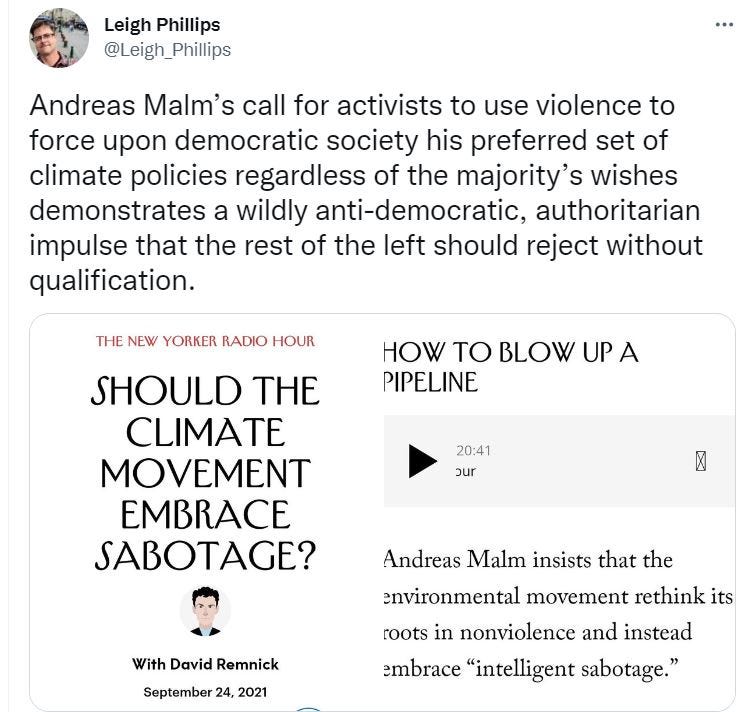
Andreas Malm seeks to turn these arguments completely on their head in his book How to Blow Up a Pipeline. Which is sort of an odd title since Malm doesn’t really offer any complex instructions about how to sabotage a pipeline, but instead takes the pacifist hard-liners in the environmental movement to task. The book would be more aptly called “Why to Blow Up a Pipeline”
To Malm, our hands are forced, we’re in self-defense mode as humans who inhabit this earth. How to Blow Up a Pipeline centers on three distinct arguments: the first is a rejection that the success of non-violent movements in the past suggests they should serve as our singular strategy in the present, the second is an argument for why widespread destruction and sabotage of private fossil-fuel property is necessarily strategic and ethical, and finally, there is a concise argument for why apathetic despair is the true movement damaging mantra.
We Love MLK, Don’t We Folks?
The first section of How to Blow Up a Pipeline is dedicated to Malm’s complete rejection of pacifism as an exclusive tactic. Realizing the bulk of the argument for non-violent resistance comes from lessons taken from successful movements of the past, Malm spends much of this section breaking these historic moments down into the sum of their more complicated parts.
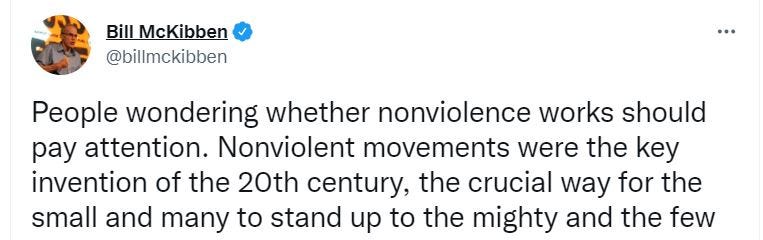
Backing up a bit, Malm’s main complaint is with climate activist veterans such as Bill McKibbon whose admiral civil disobedience activities take non-violence as a mission statement. Explicitly calling on inspiration from past movements like abolition, the enfranchisement of women, and the civil rights movement these activists believe non-violence is both a “spiritual insight” and strategic in that they believe “violence committed by social movements always takes them further than their goal”.
Malm’s point that reactionary violence was a very real and very effective tool for social change rings true even with just a cursory glance at the history. The abolition of slavery is a perfect example; “slavery was not abolished by conscientious white people gently disassembling from the institution…As some recall, slavery in the US was terminated by a civil war, whose death toll still remains close to the aggregate from all other military conflicts the country has been embroiled in”. By this measure, it would seem bizarre for hardline pacifists to claim this historic moment as a win for their tactic. It would be like claiming Hitler was defeated by pacifism by ignoring the entirety of military action in WWII.
A lesser-known history is the women’s suffrage movement. Quoting extensively from historians like Diane Atkinson and her book Rise Up, Women!Malm points out that reactionary violence was so drastic it’s hard to imagine it didn’t play a role in enfranchisement; “suffragettes forcing the prime minister out of his car and dousing him with pepper, hurling a stone at the fanlight above Winston Churchill’s door, setting upon statues and paintings with hammers and axes, planting bombs on sites along the routes of royal visits, fighting policemen with staves, charging against hostile politicians with dogwhips, breaking the windows in prison cells. Such deeds went hand in hand with mass mobilization.”
Of course, the real crux of any pacifist argument is going to stem from the civil rights movement of the 1950s, 60s, and 70s. Malm acknowledges the successful non-violent strategies of the time as “the better case”. Far from being put in the corner, this is where Malm develops his actionable thesis; that singular strategy enforcement is the problem and constructively violent wings of the movement shouldn’t be condemned.
The theory drawn up is one that comes from analysis of the civil rights movement. “Radical Flank theory”, coined in the bookBlack Radicals and the Civil Rights Mainstream by Herbert H Haines, points out that radicalism and violence when accompanying non-violent resistance to systemic violence is more effective than either strategy on its own. As Malm puts it; “the civil rights movement won the act of 1964 because it had a radical flank that made it appear as a lesser evil in the eyes of state power”.
There were hundreds of violent riots in the late 60s, many of which leveled entire city blocks. The risk of this widespread devastation to property and human well-being was precisely what bolstered the voices of the many nonviolent protesters, quoting Haines directly; “nonviolent direct action struck at the heart of powerful political interests because it could easily turn to violence”. The double pincer of reactionary violence and strategic nonviolence is put forward as the reason for the success of the civil rights movement.
Malm concludes that “Non-Violent civil disobedience caught on because it worked - better than the alternatives, such as guerilla warfare against the state - and was appreciated precisely as a tactic, rather than as a creed or a doctrine”. After concluding that the true lesson of history is an uncomfortable embrace of violent resistance as a possibility if not at times a preferred method, Malm is ready to make his case for what to do in the face of planetary destruction.
Kill Your Local Oil Baron(‘s Stuff)
Before the second argument comes in full swing, Malm reiterates; “non-violent mass mobilization should (where possible) be the first resort, militant action the last; and no movement should voluntarily suspend the former, only give it appendages”
At long last, Malm lays out what exactly he thinks the climate movement should do:
“so here is what this movement of millions should do for a start: announce and enforce the prohibition [of new C02 emissions]. Damage and destroy new C02 emitting devices. Put them out of commission, pick them apart, demolish them, burn them, blow them up. Let the capitalists who keep on investing in the fire know that their properties will be trashed…if we can’t get a prohibition, we can impose a defacto one with our bodies and any other means necessary.”
Essentially Malm calls for widespread private property destruction, sabotage, and physical prevention of extraction. Some might argue that property destruction is not violence, but because many in the climate movement believe it to be, Malm proudly adopts the description.
This is the most controversial aspect of Malm’s work and has gotten him a lot of heat from various pundits. While the first section deals with any arguments suggesting the strategy of violence itself has always been ineffective, the second section fields arguments against the deluge of comments that claim what Malm is suggesting is immoral.
Yet Malm treats violence towards fossil fuel extraction or carbon burning property as a complex rule for self-defense. If the property was a person and was doing the same level of harm to your person and life, violent action would surely be morally justified. Since the entire planet, atmosphere, and biosphere belong to all of us, this property is in fact doing damage to, not just our personal but our life-sustaining property and we are within our right to react accordingly.
Drawing the distinction from killing - which Malm is swift to say is never justifiable as a tactic - How to Blow Up a Pipeline puts property violence on the following gradient; “one type of property destruction that approaches killing and maiming, [is] that which hits material conditions for subsistence like poisoning someone’s groundwater for drinking…at the other end of the spectrum is the blasting of a superyacht into smithereens”. Taking this logical approach means we are being killed by the owners of private property and are being chastised for damaging that property.
Imagine being shot and before the shooter can finish you off you grab the gun and destroy it. The charge leveled at you however is that you damaged the personal property of another and therefore acted immorally.
Still, violence is only justifiable, it is not always the best tactic, as Malm states over and over again. Yet there are constantly charges of violence being leveled at activists doing the property destruction, even at Malm himself for inspiring it. The charges come from all around, the property owners themselves, the brokers of the status quo like industry figures or media pundits, and even from other environmentalists in the movement.
This anger is hard to reconcile considering the scope of harm that the property itself is doing. We’re not talking about breaking the windows of a local bookstore or fire-bombing a progressive church, we’re talking about sabotaging pipelines, decommissioning coal mines, and preventing construction equipment from deforestation among other things. If we’re forced to go through the mental gymnastics of considering the property damage as violence worthy of condemnation, surely the violence the property was engaged in is far more deserving of our action.
In addition, if we as a society are truly concerned with the violence that How to Blow Up a Pipeline could be instigating, our best bet is to rapidly adopt climate and environmental policies that prevent fossil fuel and carbon-emitting property from doing much if any damage. Radical Flank Theory at work.
Never Give Up, Never Surrender!
If Malm believes there is a detrimental stance the climate movement can take its apathy. The idea expressed by modern literary figures like Jonathan Franzen is that the damage is done so we should just clutch our loved ones. Malm also seems to put those who criticize the violence of the radical flank in this same bucket.
If strategic pacifists argue that we’re not at the point where widespread sabotage is warranted, they’re really no different than the fatalist who claims the damage is done and activism is useless. To Malm' “Fatalism of the present holds defeated struggles of the past in contempt, and so does strategic pacifism: if someone raised a weapon and lost, it was because she raised that weapon…In the universe of strategic pacifism, only the winners deserve praise”.
So while the hardline pacifists of the movement claim, with some validity, that violence does damage to the movement as a whole, Malm would argue that this unpopularity can be weaponized rather than allowed to turn the movement into something the public despises.
Malm understands that violence is not for everyone and even seems to relent that the majority of the climate movement will not necessarily participate in hostile engagements with law enforcement. However, should the activities of the radical flank arouse public condemnation, the strategy is for the less radical, bureaucratic arm of the movement to leverage the moment for systemic change.
This is where Malm seems to lose the thread. There is no question that violence, even if we can make an air-tight case for its heroic justification, is going to draw criticism and unpopularity towards the movement. Charges of terrorism have been leveled at eco-activists engaged in this work before and we must never forget that the government has a powerful War on Terror propaganda apparatus that can quickly be adapted (something Malm seems to forget as much of his movement focus is out in Europe where beat cops aren’t even armed). Malm is correct to justify violence against property destroying the earth, but the inspirational and/or deleterious effects on the movement are impossible to determine.
Even if you’re not going to drop your protest sign in favor of a monkey wrench, even if the idea of destroying something that isn’t yours, even something that is itself incredibly destructive and destroying everything you love, there is no disagreeing with Malm that the fight matters and we all need to be engaged in it somewhere:
“The alpha and omega of the science of the cumulative character of climate change run contrary to the axioms of fatalism. Every gigaton matters, every single plant and terminal and pipeline and SUV and superyacht makes a difference to the aggregate damage done.”
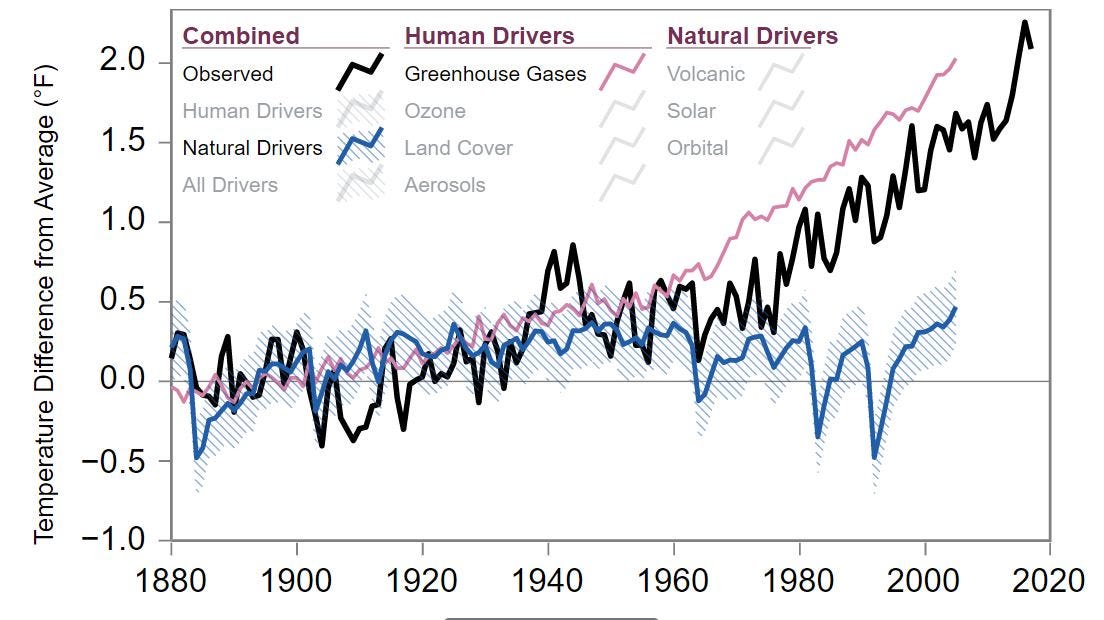
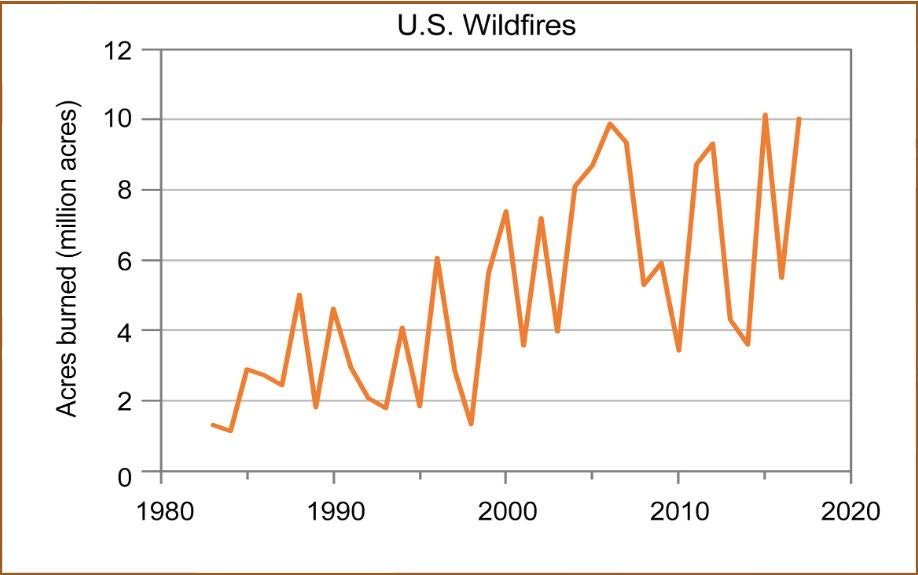
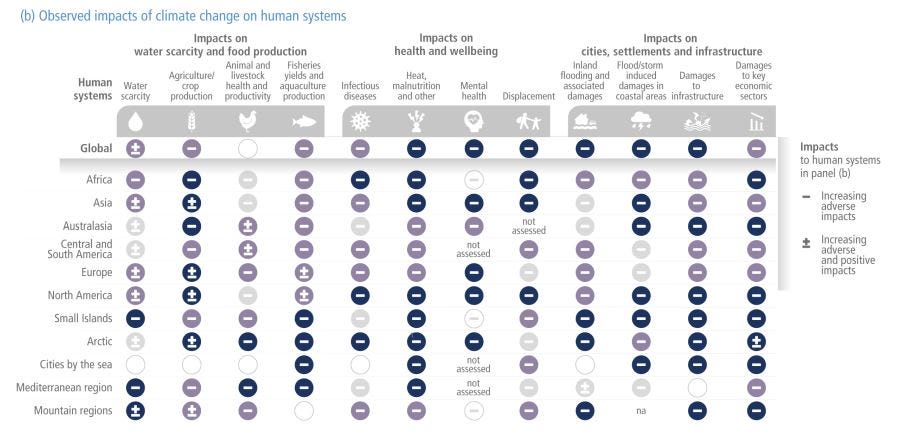
*All images from the 6th IPCC Report and the 4th National Climate Assessment
Matt Yglesias is often at the forefront of discourse as it's put forward by pundits. He is somewhat respected as a liberal contrarian with opinions that - whether you agree with them or not - do represent a general consensus amongst other liberals in power. He's also an asshole.
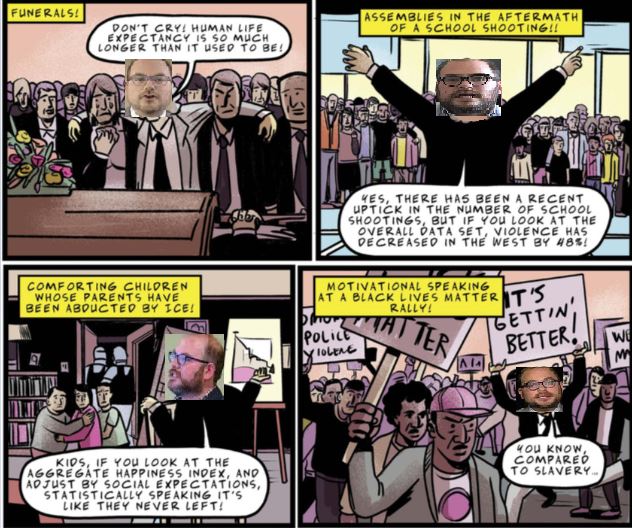
It was truly shocking to see his tweet the other day, the day in which 18 **school children** were gunned down in Texas, which ultimately defended the United States as The Place to Be in spite of its problems. Even setting aside the fact that the message is so poorly timed it borders on evil, it's not hard to point out the myriad of ways this sentiment, though obviously not an uncommon one, is wrong.
Yglesias was likely seizing on the deluge of Tweets and commentary all extolling some version of "This Is America" or "this is a uniquely American Problem" or "This was entirely predictable here in America". He ultimately decided that everyone using this unimaginable tragedy to discuss the regularity of such tragedies in our country was illogical and it was important to set the record straight.
To Yglesias, the USA is a good country. Why? Two main reasons; some elusive measure of all of human history (life expectancy maybe?) and the fact that people around the world want to live here.
Both of these clauses make for a favorite rhetorical move for pundits in the Take Factory. Simply take a couple of objectively true statements like higher quality of life measurements or the fact that some immigrants want to live here and then extrapolate a premise that doesn't necessarily stem from the true statements: America is therefore good and we should avoid criticizing it as a bad place where uniquely bad things happen.
Yet even the apparently true statements Yglesias banners around have some problems. Consider the "all of human history" comment. This could very well be true, Modern America is certainly a better place to live than 14th century Spain by any metric. The question is why this is important to bring up. Measuring quality of life based on how someone might have lived in the past isn't useful because that person could never exist in the past. The true measure would be how many people are living the best possible life now, which means considering the lives of people relative to the lives of other people who exist.
Two great examples of this are mass shootings and the uninsured. It's preposterous to look at someone who is uninsured or the victim of a masshooting and tell them that if they existed in in another time period they would be more likely to be uninsured or killed. Imagine telling an uninsured person that insurance didn't even exist in the 1920s so they should be thankful it's at least a possibility! The real point to understand is that there are people all over he world that do not suffer these things because they do not have the problems that America has. You could take school children or working adults with identical conditions in America and put them in other countries and they would not suffer the same issues they suffer here.
So "anywhere in human history" is an irrelevant and unnecessary measuring stick. But to be fair, Yglesias also brings in the more relevant point when he says "all over the world". We're unsure what he's referring to as he doesn't mention any particular metric. He would be incorrect if he were referring to a whole host of things from gun violence, to paid maternity leave and the maternal mortality rate, to the rate of uninsured and outcomes in healthcare, to the number of incarcerated citizens etc etc where the US lags behind many, many other countries.
Yet people do clamor to move here! Of course no one cites our mass shooting or terrible healthcare outcomes as they reason why, generally they're moving here for "opportunity". This can mean different things for different people, opportunity for wealthy Northern/Western countries could be harder to pinpoint than countries in the so-called "global south" whose residents who want to move here are looking for a better life.
For the former, it's not likely our lack of free university education or dwindling public education institutions, it isn't likely our for-profit health financing industry, it's not our affordable housing, it's not our lack of violence and public safety. It's most likely because of their employment or because they married an American citizen spouse. Which there is of course nothing wrong with, but one would hardly call a country the best place to live because it has interesting places to work and Europeans find the love of their lives here.
The latter portion of people who want to live in the US are coming from countries that do not have the same material conditions or rights. Yet this seems a strange metric as well since someone's desire to move to a place with better material conditions or freedom should not logically matter when the best material conditions and rights aren't delivered. The US has treated people who want to come to this country - people from countries like Haiti or El Salvador - with flagrant abuse. Those that come here to work - legally or not - remain one of the most exploitated labor forces in the country. What's worse, many of the countries where people are fleeing totalitarianism or poor standards of living have those things because of an active or passive role the US played. Even countries like India or China where people come to work in tech on H1B visas for better pay still have to enter a beauracratic hellscape where being forced to uproot isn't uncommon.
Which is all to say that comparing a life in Modern America to a theoretical life in human history or another part of the world fails to imagine what that life would be like if the US didn't exhibit such a horrible set of unique problems. It's exactly because we can and should imagine an America in which children are not murdered in school that we critize the version we're currently living in where this is a terrifyingly common occurence.
In short, we should not be measuring someone's life around what that life would look like in the past or in another place on earth, but what that person's life should look like if the society they were in treated them with dignity.
When I heard about this mass shooting in a school hundreds and hundreds of miles away I clutched my daughter close and listened to her heartbeat in a state of pure despair. Amazingly, Matt Yglesias telling telling me Modern America was better than any time period or place I could theoretically exist offered no comfort.
I recently listened to Dune on audiobook after being thoroughly impressed by the movie. The action/thriller sci-fi novel depicts a sort of Gulf War in space. Where oil is the essential commodity here on earth, powering our entire society and forcing unending conflict due to its finite nature, "spice" is the resource at the heart of Dune. It's what makes space travel and cosmic civilization possible, the parallels are uncanny.
So in some sense, you can almost imagine an obnoxious allegory taking shape; the spice is mined on the desert planet of Arrakis (hard not to hear in all its audiobook glory as pronounced like "Iraq - is"), which is inhabited by a fanatically religious desert people known as Fremen (get it, like Free MEN), who are leveraged against a Soviet Unionesque former hegemony society and ultimately against the very embodiment of imperialism itself; the emperor.
So...yes, it's the Gulf War in space.
Yet there is a lot to make Dune more interesting than the sum of its borrowed political plot. The action in Dune is truly exhilarating. Action scenes in books have been hard-pressed to excite since movies got extremely good at them. Yet the various fights and battles in Dune don't disappoint. The cast of combatants has a range of often discussed reputations, very Game of Thrones reminiscent, that has any reader looking forward to the eventual clash.
The other really interesting component of the action in Dune is how all of the fighting is done entirely with knives, not swords; knives. There is zero explanation for why this is the case, but it works. The fighting is intimate and Herbert writes riveting engagements whether they're one on one duels or epic skirmishes between armies. I feel like a kid again writing about this, but it really is fun!
The politics of Dune is also more interesting than the Gulf War it's modeled after and the lesson is far from a contrived regurgitation of the status quo. Protagonist Paul Atreides; a prodigal son trope who eventually leads the Fremen in their "Jihad" (actual word used) against the empire, clearly struggles with waging a holy war and it's not very clear at the end of the novel that he has made the right choice, a quandary the reader is likely to share.
The Fremen are also written in a refreshingly complicated way. Many of their brutal traditions are unforgivable, even as you're forced to acknowledge they're born from a life in an almost uninhabitable, incredibly hostile desert planet. But they also have ecological ambitions, hoping to turn Arrakis into a green planet, which would likely mean an end to spice production. The dynamic political conflict that's ultimately set up is the Fremen raging against the empire's colonial rule, desiring to end their extraction of finite resources so they can reverse the destruction of their planet on one side and Paul on the other trying to harness this power with the reader guessing if he's helping the Fremen, using them for his own revenge, or just accidentally causing untold destruction/bloodshed/end of civilization.
Herbert works intricately to dismantle the reader's usual reliance on the idea that the protagonist, even a "chosen one", is always right. Imagine if Luke Skywalker's destruction of the Emporer caused inter-planetary economic devastation and unleashed bloodthirsty Ewoks who committed eco-terrorism to protect their forest planet. Imagine if, in Avatar, society could not function without unobtanium, and Sully + the indigenous population of the planet caused cataclysmic destruction by preventing people from mining it.
This makes Dune a complicated anti-war, ecological-focused novel, one that assures us the victor in any war, whether their cause is to justly protect their lands or greedily prevent societal collapse, is still only the victor of a war. Paul and the Fremen must balance between the liberation of land and resources (especially water, which the Fremon ironically hold in much higher regard than spice) to be used for the good of all people or complete destruction so a few may no longer profit. The message then is that transforming society is a collaborative effort. A thin strain of possibility exists for this outcome in the novel, the reader is certainly hoping for it by the end.


.jpg)