Thursday, May 14, 2026

But the union makes us strong


"Name a single country where socialism has worked."


Since I realized I wanted to explore and eventually hold a belief in socialism, I have gotten bolder in calling myself one. Usually in casual political conversations, maybe after someone calls like...Nancy Pelosi a Marxist or communist, or maybe just in a statement of support for the UAW presence in my workplace. Most people who don't agree or have sympathy for the position hit me with this question. 

"Name a single country where socialism EVER worked."

The question, unfortunately, often puts you on the back heel. There are, of course, countries that were nominally socialist that failed; the USSR is a massive example. You either hear horror stories of collapsing economies or murderous dictatorships, or you hear stories of collapsing economies WITH murderous dictatorships. The basic narrative around socialism that grows in the mind of most Americans is that it fails and/or devolves into totalitarianism.

As a rhetorically argumentative question, "name a single countery where socialism ever worked" is effective exactly because it relies on this basic narrative and forces the person fielding the question to have to frantically begin trying to define what terms like "socialism", "a socialist country" or "worked" even mean, or sputter out something about China so they can be peppered with questions about human rights abuses.

It is not a question I struggle with because it has not inspired any doubt in me; I can define the terms, however it is a question I struggle to answer in these spur-of-the-moment conversations.

That is, until I finished John Nichols' book The S Word. From now on, the answer to "Name a single country where socialism actually worked" is simply "the United States of America".

Nichols' history of socialism in the United States is one of a deeply successful movement despite never holding power in a way one traditionally might think about. There has never been a socialist president, for example, but Nichols reveals influential, self-identified socialists in the administrations of Lincoln, Johnson, and even Woodrow Wilson.

By exploring the United States' socialist journey, we discover a practice not devolving into dictatorship but rather standing in opposition to the most evil and undemocratic institutions in the nation's history. A movement pushing policies that need to be expanded, but have provided a shared wealth and public expenditure system that has become foundational to our country.

The S Word makes the argument that Socialism should not be a bad word in America. Each chapter flows through the history of our country, centering on socialists' standing for and building our greatest institutions and pillars of human rights. Thomas Paine and other socialists influenced the end of monarchy, the most fervent anti-slavery activists and writers who brought about abolition were socialists, the sewer socialists who wrote the blueprint for effective municipal government, socialists who wrote our welfare state (to the extent it exists) into existence, A. Philip Randolph (avowed socialist) and the civil rights movement...the book is rather expansive.

Obviously, I had heard of and was a big fan of folks like Eugene V Debs, who I was expecting the book to be about primarily. Debs was certainly present throughout Nichols' work, but he never got a standalone chapter. Instead, I found myself more acquainted with socialists I'd never heard of, folks like Christian socialist Francis Bellamy, who wrote the Pledge of Allegiance, or the socialist mayor of Milwaukee, Frank Zeidler. 

It was the chapter about Zeidler and the Milwaukee "Sewer Socialists" that intrigued me the most. Especially reading it in the wake of democratic socialist Zohran Mamdani's victory to become New York City's mayor. "I was elected as a socialist, and I will govern as a socialist," Mamdani said in his victory speech. The history of Frank Zeidler not only illuminates what that means, but is itself a rich history of Socialism working in the United States. Sewer socialism laid the groundwork for effective municipal governance, building highly effective and beloved public services and institutions. Across US cities, it's anything from running fire departments to opening public pools to making the buses run on time. Wonders of public transportation or education or even just water works - thank a socialist.

To be honest, I found myself wishing that Nichols spent more time on chapters like this, the actual socialist policies that made a difference in people's lives. A good portion of the book focuses on either socialists driven to defend human rights because of their beliefs, OR liberals who were so impacted by socialists that they took more radical approaches to the human rights crises of their time. This is obviously very important and impacted people's lives in meaningful ways, but Nichols wasn't specific enough when it came to calling out the actual structure of ownership (capitalistic or social) that was driving these crises in the first place. 

When people ask you to name a country where socialism has ever worked, you can say the United States, because state/public-owned institutions have and continue to work. We have universal k-12 education, we maintain complicated systems of mail delivery and vehicle registration and licensing, and we have near universal access to potable water, electricity, and internet. We have Universities and weather facilities that do life-changing research. The United States government is the country's largest employer. This is socialism "working" every day. While we have our share of human rights abuses, it's generally in the service of private property.

The argument will, of course, shift. Rather than "name a country where socialism has ever worked", you'll hear "name a socialist country that worked." The goal posts will move; one can't define the US as entirely socialist (or any country for that matter, nor can you call any country entirely capitalist). But Nichols' book still helps; socialism is not a bad word. By identifying as one and believing in the propensity for socialist institutions to work, you are connecting to a rich history of abolitionists, free speech warriors, labor union activists, the people who ended child labor and won social security. We're not the ones who should be afraid of "the S-Word"; they are.


Tuesday, March 24, 2026

We Are All in 2005's Crash

Photo by Andrew James on Unsplash
                                    
Whenever I finish a book or experience a piece of media or literature that particularly engages or touches me, I always go on a full press tour for that thing, recommending it to everyone around me, even those who are marginally interested. For the most part, most people ignore the recommendation. This is fine. Obviously, in an ideal world, they would take the recommendation, and I have someone I can gush with because they loved it too. But I would rather the recommendation go wholly ignored than have it be picked up only for the person to hate it.

I recommended the Overstory by Richard Powers to some friends in the group chat, one of whom wasn't impressed. "It's just 'crash' for old tree-hugging white hippies" was what I got back. I loved the Overstory, but this response got me thinking about the trope of interconnectedness as a storytelling trope. It DOES seem to be particularly relied on and cheap. Have we really been dunking on this since 2005?

Woven stories are a good way to blend form and content. In the case of the Overstory, which was largely about trees, the connected narratives mimic tree branches growing together in the forest like- you guessed it -an overstory. I happened to think this was neat at the time, but I can see where my friend was coming from. When Crash came out it was kind of a stupid and unbelievable concept that wore itself out quickly because the dumbest people you know thought they were geniuses for Figuring It Out. 

Which is all to say that I'm getting weary of interconnectedness as storytelling, so when I approach a novel like Tommy Orange's There There, it's on uneven footing. I enjoyed Orange's writing; there were parts of his novel that felt Faulkneresque: complicated and even sinister family dynamics, chapters from points of view of a cast of characters that shift the narration style between them, and some truly beautiful prose writing - particularly in the intro and in Thomas Frank's first chapter. 

And then there is Tommy Orange's point of view, which is very present, something I rarely welcome from an author. The originality of urban native stories can't be overstated; it was thought-provoking but not in a stifling way. The book does a great job of featuring the concept as a backdrop, not as a takeaway. This also takes a degree of skill to do as a writer.

So with excellent writing and perspective in There There, what's not to love? Basically, everything else. Orange can craft beautiful sentences, but his characters felt hollow, and the story felt forced. All of his character plotlines interconnect and crash (heh) together at the end. But that's just it, the narratives seem frantically mashed together, to the point that the cross sections are unconvincing, even eye-rollingly unbelievable at times. 

Some of the characters and plot points in the novel build, but a lot of them fail to go anywhere or elicit any sympathy. One of the novel's female characters, Blue, has a singular chapter devoted to her escaping a domestic violence situation. There was some real weight to the chapter but it was also incomplete. It was hard to bring myself to care about Blue again and again when her connections to the other characters in the novel were unbelievably tenuous and her origin story, which WAS harrowing, was hardly a blip on the timeline. I wanted to care about this character, but I could not get the sympathy meter to sustain. I shouldn't have to work so hard to care for your characters!

No spoilers per se, but sympathy is something you need an abundance of at the end of this novel for the "punch" to pack anything. Which is another thing, the ending was wildly unconvincing, violence for the sake of it. And again, I'm not spoiling anything, the ending was increasingly predictable and equally observable as about to be really bad. Like watching a car crash in slow motion, I kept thinking there was no way Orange was about to do what I thought he was going to do. When the book finally ended, I couldn't imagine Orange expected the reader to feel as stoic as I did. 

I don't want to hate There There. I think Tommy Orange is a great writer and has incredible things to say. I'm mostly disappointed in the way the characters and plotting of the novel just didn't do justice to the author's style. Maybe I just need a break from the loosely connected characters colliding in the universe. Although I'm sure it'll find me again soon. 


Thursday, March 12, 2026

Socialism's Editor in Chief

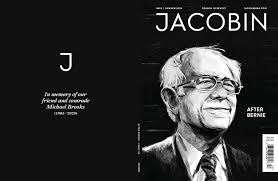
Jacobin magazine updated their cover photo. - Jacobin magazine

When Bernie Sanders launched his presidential primary bid in 2016, my worldview was totally transformed. Prior to his campaign, I was a liberal and a Democrat who spent an admittedly unhealthy amount of time arguing with friends, family, and strangers on Facebook about this or that issue. So much so that I deleted my Facebook at one point. I remember one of the last things I watched on Facebook was Hilary Clinton’s campaign announcement.

As interested in politics as I was, I had never really seen a politician like Bernie. He lacked a lot of traditional, charismatic style, but his insistent messaging about class politics combined with his willingness to go to the mat on policies that were bigger, more ambitious, and more impactful than the usual parade of polices you saw out of democrats instantly hooked me.

I was all in on Bernie, but what frustrated me was that the usual outlets I was subscribed to did not take his ideas or his campaign seriously. At the time, I remember being subscribed to the New Yorker, the Atlantic, and the NYT. None of the barrage of articles disparaging Sanders as a crank or painting his policies as unrealistic were all that convincing; they seemed about as compelling as some of the unconstructive Facebook arguments I used to engage in. I needed something else.

My friend Mike and I had always been sort of nominally interested in socialism since high school. I won’t speak for him (he is much smarter than I am), but I didn’t really know all that much about it beyond its capacity to piss off my fellow suburban classmates. At around the tail end of the Bernie campaign, he handed me a copy of a publication called Jacobin Magazine that he found at Barnes and Noble. I read it cover to cover the second he handed it to me. He ended up letting me keep it.

I’ll never forget the first piece I read: Thinking Small Won’t End Poverty. It was an effective argument about the limits of private, community-led philanthropy. The next week, I became a lifetime subscriber.

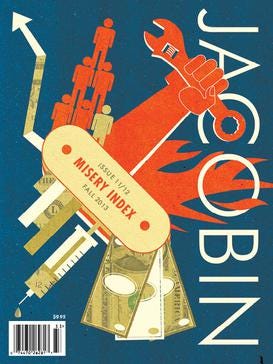
Jacobin (magazine) - Wikipedia

Jacobin has taught me a lot about the world and introduced me to new writers and thinkers. I often stocked up on books advertised throughout the issues, entry-level books on socialism by Danny Katch. With her book The New Prophets of Capital, Nicole Aschoff (also a Jacobin editor) was singlehandedly responsible for throwing off my classic liberal slobbering appreciation of ethical capitalists like Oprah and Bill Gates and establishments like Whole Foods. I became a single-payer activist largely because of pieces I read from healthcare writing power couple Adam Gaffney and Natalie Schur.

It would only make sense then that this year, when I want to reflect on my ten-year journey as a socialist, I start with Jacobin Editor Bhaskar Sunkara’s book The Socialist Manifesto. Ten years later, he is still teaching me things about what it means to be a socialist and what socialism means for society as I know it.

Written in 2018 after Bernie’s first loss but before the Corbyn flop, the Socialist Manifesto is separated into three parts: a conceptualization of socialism in the future, a history of what socialism has looked like in the past, and a few notes on what socialists should be doing in the present.

Most socialist writers I’ve encountered generally do a poor job conceptualizing a future under socialism, and I genuinely have to hand it to Bhaskar, he probably does one of the best jobs. The reason his hypothetical depiction seems so much better is centered on what I think the whole premise of the whole book is: that socialism is a process.

Sunkara is an editor, so his framing of socialism this way is very fitting. His depiction of a socialist future in the US asks the reader to imagine themselves working in a hot sauce bottling facility, making gains under social democracy, then transitioning towards socialism with a greater union presence, turning the factory into a worker-owned co-op, working towards a way to exist free of the need for profit.

This is far from the utopian dreams of technology-fueled, post-scarcity futures depicted elsewhere. The future Sunkara imagines, you (the reader) never see fully actualized Communism, but you do lead a dignified life free of economic burden as part of the journey towards socialism.

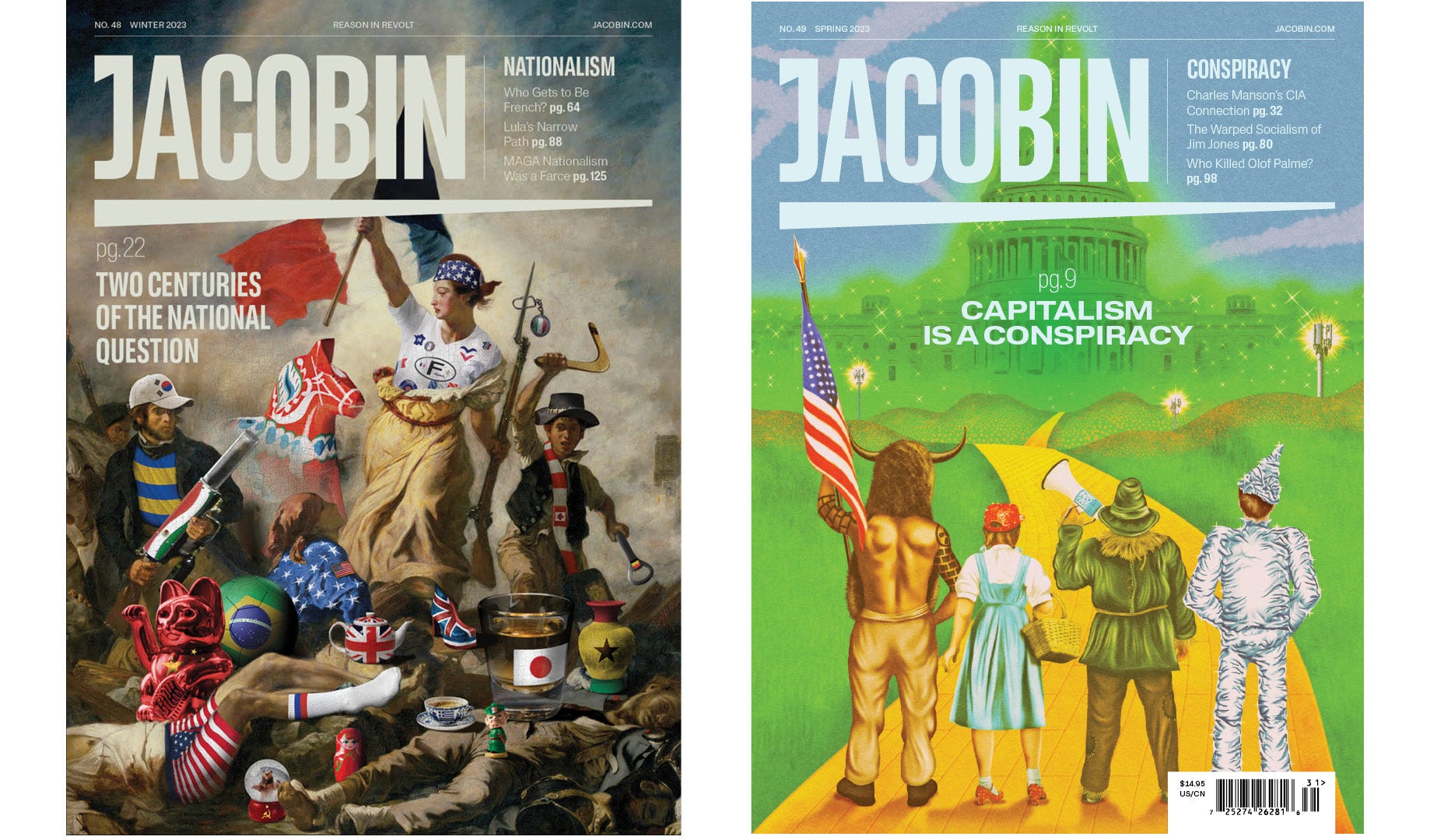
Jacobin – Schick Toikka

Similarly, in the larger section that runs the history of socialism in Europe, the global south, and the United States, Sunkara extolls the gains made by the world’s poorest people and the victories against imperialism that happen as the left begins fighting and advocating for social democracy; a better and more inclusive welfare state, decomodified basic needs, union workers and sectoral bargaining, and much more.

The really valuable lesson in the Socialist Manifesto is for every socialist at any given time to be thinking about how they can work to advance toward socialism, rather than fussing and infighting over the ideals of their imagined endgame. His last section about what socialism means today is all about how to get involved, how to talk to our neighbors about and generally socialize socialism.

The more I think about it, the more this tracks with my experience as an organizer. I led the Medicare for All group. At our most effective, we had everyone from anarchists to slightly left of center Democrats coming together to protest and host town halls and birddog politicians. It didn’t matter if single-payer was “socialism” from an anarchist or Marxist lens (it arguably isn’t either); what mattered was that we were advancing the plot.

This is socialism; a constant state of class struggle, a work in progress. All the more reason to wear it proudly.

Saturday, January 24, 2026

By Any Other Name


Over the years, I've hosted a handful of Town Hall events spotlighting Medicare for All to various communities across the state, from unions to universities. One of my favorite speakers to get when I could was Dr. Abdul El-Sayed. He was knowledgeable and was absolutely electric talking about the issue. He always fired up the crowd.

I was similarly fired up when I saw he was entering a primary race to be Michigan's next senator. For years, I have birddogged his opponent, Haley Stevens, to sign onto the House M4A bill (she never has), and while Mallory McMorrow is a political talent, El-Sayed was clearly stepping into the progressive lane; declaring support for Medicare for All, calling out genocide in Gaza, and demanding we abolish ICE.

This is all to say I'm an El-Sayed supporter and likely voter, but after the last few days, he needs to clarify his position on Medicare for All.

McMorrow recently posted a snippet of an interview El-Sayed gave in which he made the claim that "if you like your employer insurance or your union insurance, those will still be there for you". She pointed out that this was more akin to a public option, which is what she has consistently supported over Medicare for All and been criticized by El-Sayed for.

I was willing to give El-Sayed the benefit of the doubt. It was very possible that he was saying coverage was going to be there regardless of losing your job, but not necessarily the specific private plan.

But then he further muddied the waters when he replied to McMorrow's tweet. He posted a snippet from his book with the last line highlighting to suggest that under Medicare for All, private insurance could exist and duplicate coverage with Medicare.


This is not a good response. The House and Senate M4A bills explicitly do not allow for duplicate coverage. They are single-payer policies, meaning the only possible private insurance would be supplemental, covering things expanded Medicare would not cover (IVF, for example). By definition, if private insurance exists and is providing duplicative coverage to the public insurer, it is not a single-payer system.

This isn't a post about the virtues of M4A, but rather to say Abdul seemed dangerously close to bailing on the policy, the way we watched almost every Democratic primary contender in the 2020 race abandon the idea, exactly because it would eliminate people's private insurance.

He was then asked to clarify his remarks, and unfortunately, not only was he more unclear, he seemed to be implying that McMorrow was just inexperienced or unintelligent on the matter. The tone itself invited a lot of dunking, but I'm concerned about his quote on the policy in which he says, "I don’t have a problem with private insurance offering some of the same services to folks, or covering some of the same services." And then adds the incoherent "It’s public guaranteed, private option." (???)

Some pundits are saying this is basically Pete Buttigieg's Medicare for All Who Want It. This is wrong. Mayor Pete's plan would have put up a new plan on the ACA exchanges for people to buy into that was like a publicly owned insurance option (this was a stupid policy). But El-Sayed defenders like Ryan Grim are also wrong in that this ALSO isn't Medicare for All. What El-Sayed seems to be alluding to and, honestly, McMorrow is supporting, is what the Center for American Progress calls Medicare for America. This is a true public option that exists to be the insurance of default for people who fall off of or simply don't/can't have employer-provided insurance. It's frankly not that bad of a policy; it's just not as good as Medicare for All.

Not to get in the weeds, but here is just a quick note on why Medicare for All is a superior policy. Even the liberal policy critics can really only serve up the political difficulty of passing it as the major problem with it (because it eliminates private, employer insurance). It solves problems in healthcare that a public option doesn't: it stops insurance churn, it ends the administrative burden of switching coverage, and reduces the cost of care with single risk pools and monopsony power over drugs. 

To be fair, Abdul also says he supports the current iteration of Sanders' M4A bill, but then he tries to imply he's middling because "we don't have the votes for that right now".

This is getting dumb. No one, even supporters like me, expects or thinks El-Sayed is going to go to Washington and make Medicare for All happen any more than McMorrow supporters think she will be able to make a public option happen. When you say you support Medicare for All, you are signaling your values. You are open to radically changing the status quo, disrupting a model that isn't working at a fundamental level. When you support the public option over M4A, you are signaling that you are compromising with the status quo. El-Sayed could simply say he would vote for the Bernie bill and his opponent won't; that is the key distinction. I would rather he lose the primary than prove even our chosen progressive champions are too chicken-shit to support it.

If this seems unfair, it's because I expect better of El-Sayed. I want to see him make the case like I have so many times at town halls, in stirring debates, and on national television. Tell people, Yes: your private insurance plan will go away and be replaced with an objectively superior plan that cannot go away by virtue of losing your job or the divine writ of your employer. This is unequivocally good and better than a public option. That is the bold El-Sayed I want as our next senator.


Sunday, December 28, 2025

Eventually all things are known. And few matter.


Before I went off to college, I read Gore Vidal's Burr. I had read a friend's review of it and loved the idea of a book that really takes it to the founding father hagiography. Of course, at that time, I was very stupid, though, and I sort of thought that the book reflecting the enlightenment pioneers of the revolution as just massive pieces of shit was good enough. Like Leo's character in One Battle After Another, I sort of gestured to the founding fathers and said things like "he was a slave owner, you know". This struck me as brilliance.

You can imagine an early college student clinging to this concept, trying it out on all sorts of people so they could laud me for how smart I was. One day I tried it on a friend, an upperclassman majoring in US history; "the founding fathers were terrible people, obviously the fabric of our country is deeply corrupted, incomplete," etc. He shrugged. Retorted that just because they were bad people didn't mean their ideas were bad. So ended my deployment of what I thought to be Vidal's core point. So ended the utility of the novel Burr.

As I was weighing what all I wanted to reread this year, it originally didn't make the list, but I decided to revisit Burr almost two decades later because, beyond anything I remember it teaching me, I remember it being a really enjoyable read. Nothing has changed there; Vidal is hilarious, capable of believably transforming lauded historic men of philosophy into the pettiest of bitch. Normally, I roll my eyes at classical or literary writers who slip in jokes about asses or farting (thinking of Melville), but Vidal writes about things like George Washington's ass in poetic flurries; it fits, it's funny, and it's quick. I genuinely laughed out loud several times. Particularly when he was tearing apart Jefferson.

But the utility of a novel like Burr has also been transformed. I'm no longer trying to IRL shit-post arguments with anyone and everyone; reading in my early 20s was about leveraging books in a way that made me look cool, reading in my 30s is about understanding the world. And Burr ended up being a perfect read to understand what feels like a uniquely hideous moment in American politics.

As Vidal's protagonist Charlie navigates the election between Van Buren and Harrison, he also works on the memoirs of Aaron Burr, one of US revolutionary history's notorious villains. Vidal's portrayal of Burr is incredible: he is biting and has dirt on everyone; no one is safe. The pockmarked, powdered, familiar faces are there: Jefferson, Madison, Monroe, Washington, Benedict Arnold, Hamilton, and more. While only Hamilton was physically killed by Burr it feels like he murdered all of them; the pace and timing of these insults truly keeps this book feeling so alive.

You can tell Vidal pieces the narrative together with primary sources, weaving in effortlessly with characterization and dramatization that is intense in its believability. Vidal's choice not to write a work of non-fiction is an important one and not just for entertainment. The novel feels contemporary in a way that lends itself to making it abundantly clear that our political moment is not unique. American politics was born partisan; politicians have always been empty vessels of power, they have long abandoned or adopted positions or even entire belief structures to simply win elections and gain/keep power. I was wrong in that our founding fathers might have had correct ideas in spite of being terrible people, the right lesson to take is that terrible people will get into politics and lie about having the correct ideas.

I find this comforting in a way. You are not only reading about Thomas Jefferson you are experiencing him as a character. The way we experience Donald Trump is as a character.

And this may make people mad, but reading about Jefferson as a character doesn't feel that dissimilar from reading about Trump as a character. Jefferson was an attempted agricultural mogul who was better at branding himself as such than doing the work; for Trump, it's the same, but with real estate. Both fancied themselves men of the arts; they were both credibly accused of rape and pedophilia. Both are wildly egotistical. Jefferson had Monticello, Trump had Mar-a-Lago. Jefferson, no doubt, was a better writer, but he was also a pamphleteer; Trump is a tweeter. Jefferson wrote eloquently and spoke of the rights of man while owning slaves, Trump button mashes about the working class while shitting on a literal gold toilet.

This is all to say that we are not living in the worst of times. Everything is dark, but familiar. Burr is a fantastically entertaining ghost of Christmas past; demonstrating the depravity of our present politics is not new. And there are no more quick or cute arguments to be made, the ultimate takeaway from Burr is to kill the heroes in your head, Aaron Burr can be your second 🔫.


Thursday, November 27, 2025

Everything was Beautiful and Nothing Hurt


By total accident I finished Slaughterhouse 5 on Veterans Day, so it especially sank in as a great anti-war novel. This was my second reading of the book by Kurt Vonnegut and yet another exercise in rereading books that I only read in my youth to make me look cool.

The story is told by a US serviceman who was a prisoner and survivor of the bombing at Dresden, though he is primarily narrating the life and times of Billy Pilgrim; who himself was there at Dresden. We watch Billy's life in fragments, because as an alien abductee he learned to time travel. From the sci-fi writer Kilgore Trout to the alien Tralfamadorians, Billy learns that our conception of time is self limited, and to really experience time is to be in all moments at once.

So suffice it to say that Slaughterhouse 5 certainly made me feel like I looked cool, and more importantly that I thought about things in a cool way. I read it in college, and was taken by a lot of the overt text. Back then, the book actually didn't register as a work of anti-war to me, instead I would quote the lines about never dying, riff on the conceptions of time, and would talk about some of the fun sections like when they play the war movies backwards and they look like a massive clean up operation. I approached the novel as though it were written by Kilgore Trout; which is to say I ignored subtext and took it on the nose.

What started as a reread quickly transformed into a realization. Over a hundred-thousand killed at Dresden, most of whom were civilians, and this was America's heroic war. Vonnegut writes the tragedy as inescapable; while time travel is real in the universe of this novel it cannot change the course of things that happen. For all the niceties of the Tralfamadorians who believe no one is ever truly gone and Vonnegut's famous refrain "so it goes", every portrayed death in this novel is still shattering. Because the reader knows this is not how you really experience time, it is only how you experience novels. 

The "cool way of thinking about time and our existence in it" was a parody; that we cease to exist when we die is the reason why horrific acts like Dresden are considered crimes. Vonnegut's Slaughterhouse 5 is concise, it is itself a Slaughterhouse of a book; an efficient conveyor of death. Even the much vaunted "so it goes" after every death starts to sound mechanical. There are no truly great lines of dialogue or even entirely compelling characters (Billy Pilgrim himself is hardly endearing in any meaningful way), but as a work of fiction it is moving and impactful. 

As you travel through time with Billy and the Narrator, you move through a perverse range of settings; war torn Germany to pleasant, upper class American Suburb to a human zoo on an alien planet. You start to get the sense that Vonnegut, despite the misery and death, is having fun. A true "comforting the disturbed and disturbing the comfortable" type of novel. I'm grateful I returned to it, I probably will again and again.

Thursday, October 30, 2025

God Keep Me from Completing Anything

 "For small erections may be finished by their first architects; grand ones, true ones, ever leave the copestone to posterity. God keep me from ever completing anything. This whole book is but a draught - nay, but the draught of a draught. Oh, Time, Strength, Cash and Patience."

I've mentioned before that when I was younger, I struggled to read books in a way that wasn't just playing them as movies in my head. I think this is the natural default setting a lot of people operate under when they read. Which is actually fine, but if you are only reading for plot and character, you are closing off an entire experience of the art form. The book I credit with teaching me how to truly engage with text as a work of art, which is why it's my favorite book, is Moby Dick.

I first read the book in my senior year of high school. A classmate and I had chosen to read it from a list of books you could read and write a critical theory essay on in our AP Literature class. This is a class I had struggled in exactly because I wasn't grasping that I needed to read for form over content. 

Knowing this, I should have hated Moby Dick. Instead, I found I loved it. While the plot and characters were sparse, sprinkled between large walls of technical writing about whale ships or scientifically postured (and incorrect) musings on whales, I found it endearing. I didn't understand everything I read but I could gather that I was engulfed in some truly great writing as a craft. Which is not to say there are no enjoyable plot elements either; I distinctly remember standing up, reading the last three chapters of the book (having re-read it, these chapters hold up, absolutely incredible action-packed end, think of when you finally saw the dragons in action in the penultimate season of GoT). I did really well on my essay; the teacher nominated me for student of the month for challenging myself with a difficult book, doing well on the essay, and just generally turning my trajectory around in the class.

At that time though, I couldn't articulate why I liked it. I knew many others who did not. A really formative American Lit teacher I had despised the book, said it was boring and violent. When I got to college a year later, I became an English major right away. I signed up for an American Lit class taught by Professor Jeff Insko. 

Insko was, and I imagine is still to this day, a titan in the classroom. He could take a group of students who were already passionate enough about literature to show up to class and get them thinking about what they were reading in ways that never occur to even the most avid readers in their entire lives. His favorite book was also Moby Dick.

This is why in making 2025 the year of my reread journey, I have not only chosen to read Moby Dick, but to read the version with an introduction written by Jeff Insko. Reading his intro transports me back to his office hours, the first one I attended, I asked him about Moby Dick. I told him I loved it, but was confused why exactly I did, why other readers I really respected did not (like my HS American Lit teacher). The sentiment he expressed was exactly the same as he writes in his introduction to the text: Moby Dick is "a love letter to the English language".

Insko taught us that when approaching a work of literature, understanding it was an act of war. You must research the time the piece was written in for crucial context. You have to engage with the form; how is it written, what tools of the craft have been employed and why? It was important to close-read sections; unpack metaphors, think about why grammar and punctuation were used formally or informally. Torturously think over the use of a given word. 

Moby Dick was the perfect conduit for learning how to love the learning of a text. The book is densely poetic, it is packed with the political and social contexts of when it was written and allusions that might as well be lost to history, and can be read as a response to similar fictional novels of its time that would try to appear real with a copious amount of minute detail. It is a challenge to read. This is why I love it, because it is not easy. It is not like "watching a movie in your head", it forces you to dwell with the actual words on the page. Some chapters take small physical objects - a cup of chowder, a piece of rigging, a gold coin - and blow them up to massive philosophical proportions. As Insko says, while tedious, these are often the most enjoyable parts of the book.

To demonstrate, I picked a chapter at random: 69. The Funeral. As far as plot action goes, the only thing happening in the chapter is that the crew cuts loose a dead whale's body after extracting the oil from it. Yet the description of this action is two pages long. The first is a deep description of the action; "The peeled white body of the beheaded whale flashes like a marble sepulchre; though changed in hue, it has not perceptibly lost anything in bulk....Slowly it floats more and more away, the water round it torn and splashed by the insatiate sharks, and the air above vexed with rapacious flights of screaming fowls." It goes on like this for at least a page talking about "beneath the unclouded and mild azure sky, upon the fair faceof the pleasant seas...that great mass of death floats on and on, till lost in infinite perspectives".  And it's not over; once thoroughly described, a thing or an action is then philosophically mused on at length. The chapter concludes with a wriff on ghosts, clearly haunted by the visage of the whale carcass and the "horrible vulturism of earth". 

And here I am in 2025, over 15 years since I first read it (I've read it twice in between), 3 small children, a challenging and mentally taxing white collar job, reading it again. Yes, I was dragging ass and losing focus while reading it, but then there were times - usually I'm sitting by my two-year-old's bed waiting for him to fall asleep or rocking my 6-month-old - where I would be feel incredibly moved by the language. Not even so much what was being said, but just the combination of words used to say it.

A writer and podcaster I admire once said that writing is just trying to pick the most beautiful words to say what you're going to say. And Melville does not miss. Reading books like this is important. We are all constantly consuming content, much of it video-based, and especially now in the age of AI where social media sites have turned into baby YouTube for adults, algorithms have curated easy viewing programmed to trigger chemical addictions in your brain. So to be moved by written words again, even as difficult as it can be to fully engage after a full day of life, feels refreshing. Like getting out of a cold plunge pool.

I'll always be grateful to educators like Insko for gifting me not simply an appreciation for words, but a ravaging passion for truly understanding what I'm reading.