Sunday, October 15, 2017

The Fire Next Time by James Baldwin


On the hundredth anniversary of the Emancipation Proclamation James Baldwin sits down to write two letters; one is to his nephew and the other to no one in particular. These two searing essays are combined into one brief collection titled the Fire Next Time. In it, Baldwin ruminates on the nature of freedom and the imperative task of confronting white supremacy, suggesting there can be no true former without the latter.

“My Dungeon Shook”, Baldwin’s letter to his nephew, could read as a shorthand form of Ta-Nehisi Coates’ Between the World and Me. Aside from the brevity, the major difference is Baldwin sees white supremacy something to combat with constant struggle, Coates sees it as immutable. While there is certainly plenty of foreboding language, Baldwin ultimately entreats his nephew to “make America what America must become” (which is a great counter phrase to MAGA). And what America must become is free; no longer dependent on oppression. His tone is hopeful and his candid yet elegant conversation with his nephew is nothing short of heartwarming.

“Down at the Cross” reads like Marx’s brief critiques of religion, except where Marx sees religion and nationalism as a way to cope with the atrocities of capitalism, Baldwin sees them as a way of coping with white supremacy. The piece has two focal points; Baldwin’s own religious upbringing and his brief run-in with the Nation of Islam. Early in his life, Baldwin would come to choose between falling in with the church or with the streets, since these were the only choices America gave him. Baldwin loved the church, but ultimately its insistence on living for the afterlife and perseverance was too passive an approach and did not deal with reality. Baldwin was also unable to rationalize the existence of a higher being in the face of such stark inequality. The Nation of Islam seemingly juxtaposes the church with its fiery rhetoric and call to action (the segregation of an all-black society), but Baldwin effortlessly argues that civilization itself cannot accommodate even the most utopian of segregated societies because the toxicity of white supremacy demands the destruction or subjugation of the inferior. As the title implies, America cannot continue to survive while white supremacy still courses through its most sacred institutions and there is no true freedom until the decadence of America is no longer built on the backs of others. If we (Baldwin demands action from both whites and blacks, men and women) continue to fall into organizations that do nothing but distract from the painful realities of white supremacy or if we continue to do nothing but live our daily lives, then America will forever be a place that depends on suffering.

I recently read a Facebook exchange between two high school classmates. Evidently, someone they went to school with is currently an active member in an unabashed white supremacist group. This individual is a fourth-grade teacher. One classmate was of the opinion that this person needed to be outed, preferably fired, but certainly exposed for their beliefs. The other classmate felt this was bullying, that it would only drive the individual further into their hateful views and that we shouldn’t take action until we know their views are causing real harm. It is important to note that many Americans likely agree with what they imagine is the level-headed response of the classmate advocating the cautious approach to the white supremacist teacher. It is also important to note that these Americans are trying, perhaps (and even most likely) unknowingly, to preserve a country built on racism. To them, a rational society must tolerate viewpoints, even intolerance itself. The Fire Next Time serves as a warning should we decide not to confront this very thinking. If we ever want the abolition of racism, we can never allow it a moment's comfort.


Tuesday, August 29, 2017

Killers of the Flower Moon by David Grann


“We have a few old mouth-to-mouth tales, we exhume from old trunks and boxes and drawers letters without salutation or signature, in which men and women who once lived and breathed are now merely initials or nicknames out of some now incomprehensible affection which sound to us like Sanskrit or Chocktaw; we see dimly people, the people in whose living blood and seed we ourselves lay dormant and waiting, in this shadowy attenuation of time possessing now heroic proportions, performing their acts of simple passion and simple violence, impervious to time and inexplicable” – William Faulkner

The atrocities committed by the United States against its indigenous people is not an unfamiliar story. Only the scariest of blind patriots would deny that this nation has done wrong by the native populations and are likely denying something in themselves by doing so. Given the depravity of the systematic removal, war, and genocide carried out, reading about the Reign of Terror – committed against the Osage tribe in the early nineteen hundreds – shouldn’t be more affecting than any other historical account. From this context leaps Killers of the Flower Moon by David Grann.
In his meticulous and riveting retelling of the Osage County Murders, Grann is both poetic and informative. His descriptions of the Osage County countryside show a true knack for writing that can be sorely missed in historical recounts and his carefully crafted research manifests itself in into a landscape of storytelling, each piece is woven into the larger picture, as opposed to a bullet for bullet recitation of sources. Grann is cautious in telling the Osage story to avoid portrayal of a mere documentation of butchery, what sets this story apart is that it is deeply personal. This makes Killers of the Flower Moon a uniquely unsettling book.  

The Osage tribe was essentially forced from their land by western expansion, moving to a virtual wasteland. When oil is discovered on the infertile lands, the approaching industrial revolution turns the reservation into a boomtown. The Osage Indian Tribe becomes impeccably wealthy with every oil operation having to pay handsome dividends to members of the tribe. Had this land been owned by white people, we’d know their family name today like we know the Bush family name or other old money oil families. In the case of the Osage, they were met with a murderous plot, the size and scope of which is truly astounding. Stretching across every branch of government, industry fat cats, law enforcement, medical professionals, pastors, and renown criminals it seems every sect of America could be indicted as a key player in the plot to terrorize, murder, and rob the Osage Tribe out of its headright.


Eventually, the FBI is born and takes the Osage as its first case. These sections show Grann at his worst. The Bureau seems too lionized (Hoover’s own human rights violations are relegated to a single sentence, referring to them as “scandals”) and the agents on the case archetypically cartoonish. When you learn the murders themselves were carried out by people who spent nearly their entire lives getting close to the Osage, treating them like humans in a nation that thought them uncivilized dogs, your stomach will literally turn. Which is far from a spoiler, the real suspense doesn’t come from the mystery of who might be killing the Osage tribe, but how a human being can be capable of doing so. Grann documents, even further than the newborn FBI did at the time of the case, the vast conspiracy to systematically destroy a group of people for simply living on land they were forced to own through oppressive western expansion. It should be taught in every school.


Wednesday, July 19, 2017

The Political Economy of Racism by Melvin Leiman

“The scholar who accepts no harsh judgment because it does not do justice to the entire complex truth can really accept no judgments about society because all are simplifications of the complex. The result is scholarly detachment from the profound ethical conflicts of society and from that human concern without which scholarship becomes a pretentious game” - Howard Zinn


Having taken me a thoroughly long time to read, I finished The Political Economy of Racism the same day I went to the Macomb Juvenile Justice Detention Center to workshop some poetry with the students attending the facility’s subcontracted school. These were young men whom the system had failed at every level of their lives, regardless of the scope of their “crimes”. Some of these students were going to go straight to prison to serve 20 years, 30 years, or life and they were 14 -16 years old. There is not a society on earth that can deem itself a success while condemning children to lifetimes in prison. What can a book as dense and academic (not to mention a terrible “summer read”) as Melvin Leiman’s offer in the face of utter societal failure?

A lot.

Leiman’s is a challenging read, making this a hard book to recommend, but what he has to offer is critical. He works out two distinct lines of discourse; 1) a hard look at the economy of discrimination ranging from slavery to redlining (the book was written in the 70s so mass incarceration was really only starting to ramp up) and 2) an absolutely savage Marxist takedown of any school of thought that avoids branding capitalism as public enemy number one.

In his first line, Leiman makes it very clear his interest does not lie with the petty racism of individuals. While he feels any degree of racism is grotesque, it is obvious he places the emphasis on systems designed to hold African Americans down for any number of reasons. Slavery was, after all, an institution of value that was justified by evoking the perceived inferiority of black people. The argument is that racism maintains the underclass necessary for capitalism. It is a smart line to take, some Marxists receive criticism because they feel that racism would disappear if capitalism was toppled. Leiman makes no such guarantee, but he is very adamant that racism can never be abolished under capitalism as it is far too necessary; we need to justify exploitation by labeling those at the bottom as deserving of their place in society, the best way to do this is fostering the idea of race based inferiority. While this underlying premise seems obvious, Leiman’s scope is complicated (and arduous). He covers monopolistic economies where companies rely on disadvantaged communities - ones that may be ravaged by over policing and redlining - for cheap labor (think of Wal-Mart or McDonald's) and competitive economies where discrimination and racism help keep wages low across the labor market. And that’s just the tip of the iceberg. Every dissection is thorough and complete with hard numbers and analysis. Have I mentioned this book was dense?

The second half of the book examines radical critiques of racism, Orthodox critiques of racism, and hybrid positions such as Black Nationalism or Black Capitalism. To many, taking on the conservative school of thought is the easiest to swallow. Libertarian and conservative ideologies often pay lip service to a certainly palatable repulsion to discrimination and racism, but will not endorse government intervention to prevent it. The idea is that discrimination does not benefit the participants of a market system in the form of profits, stock prices, and/or publicity, in fact, it may harm them. Even where that is true, libertarians and conservatives fail to address the larger political economy that benefits more generally from the existence of an underclass perpetuated by systemic discrimination and racism. These were among some of the most buoyant and fun sections to read, Leiman’s take on liberalism and class-centric leftism are more complicated but no less crucial. The orthodox liberal ideology - say, of your Clinton variety - warrants criticism because it is a full endorsement of a class based system with a welfare state to mitigate the condition of the lowest classes. It attracts well-meaning people who don’t believe suffering should be so prolific but doesn’t truly offer them an answer for eliminating its necessity for America to maintain its decadence. Every examination of critical theory on racism that Leiman explores is vital for understanding the limitations of our system as a whole.

It is important to understand the persistence of racism in America, why the students I taught poetry in Juvenile Detention live in an entirely different world than the students I teach in the suburbs. This divide is entirely manufactured. Leiman’s solution to toppling capitalism is black and white labor unity, something he feels racism is also employed to stop. There isn’t a single element of racism that Leiman cannot prove the absolute utility of in his book. It’s worth stating again; the decline or abolition of capitalism will not guarantee the the decline or abolition of racism, but there will be no such thing under capitalism. Reading The Political Economy of Racism can help elevate the conversation against racism to much needed heights.


Wednesday, May 31, 2017

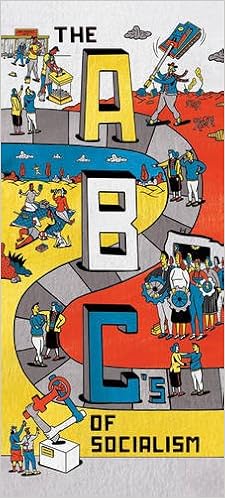
The ABC's of Socialism


The ABC’s of Socialism is a tight little book written by a collection of very intuitive intellectuals who lack the academic penchant for pretentiousness. If I had the means to buy one and place it in every hotel room across the country next to the holy bible, I would. But I don’t! So the best thing I can do is tell every person I know to read the ABC’s of Socialism.

Brevity can’t be undervalued here, you could read the ABC’s on one or two sittings on a toilet. Of course, it would be better to fully engage with the text as there are some real gems in each section. For example, here is a little excerpt from a section entitled “Don’t the rich deserve to keep their money?”;

The socialist view of redistribution within a capitalist society must reject an important premise at play in almost all tax policy debates: the pre-tax income is earned solely on individual effort and owned privately before the state intervenes...the first preconditions for firms to earn profit is state-enforced property rights

Each section is a concise answer sandwiched in-between a simple question we’ve all heard a million times (I.E. Socialism sounds good in theory, but doesn’t human nature make it impossible?) and a shorthand answer (like “our shared nature actually helps us build and define the values of a just society”). Complete with fun little drawings. The questions themselves range from simple and abstract (“doesn’t socialism always end up in a dictatorship?”) to a fairly complex analysis of society as it currently stands (see “isn’t America already kind of socialist” or “will socialists take my Kenny Loggins records?”).

I feel like a lot of really great people in my life are unwilling to give up on capitalism because of the supposed luxury and stability they perceive it has given them and their families. I can hardly blame them for feeling this way. ABC’s editor Bhaskar Sunkara doesn’t claim to present all the answers in this volume either. At the same time, I can think of no better place to start introducing your friends or family or even yourself to socialism. The opinions are well argued and philosophical enough to convince someone on the fence, but could also serve as an introductory rebuke to those who are almost violently against the idea.

Then, of course, there is the question of why you might read a book on socialism at all. It may seem like an extreme option in a country that already seems so opposed down party lines. Maybe you’re a diehard Democrat that believes in the power of capitalism for good (like Robert Reich! He’s a cool guy!). While I’d love to see this book and many other books convert you, I can assure you that the left has a lot to learn from Marxism as a critical theory. Donald Trump’s firebrand, “more jobs” nationalism (which seems interested in bringing the bottom, heavily exploited classes necessary for capitalism back to America for some inexplicable reason) could perhaps find a formidable opponent in the idea that workers deserve to take home a far greater piece of the pie, even long after they are done physically working (think construction worker, truck driver, coal miner) or in the idea that all people deserve to live a happy and equitable life simply because they are humans.

If you want to read this book, shoot me an email and I will personally buy it for you.


Tuesday, May 16, 2017

The Washington Connection by Noam Chomsky


Sometimes at work, I will listen to the Democracy Now! headlines. The show is about an hour long and the news is a straightforward, unabridged version of key events. If we compare them to the daily headlines I read in the NYT or NPR Morning Edition’s, there are some...er...differences. It isn’t that Democracy Now! is too partisan - NYT and NPR can hardly be denied a partisan standing - rather Democracy Now! is not gunning to entertain with the news. The charge that it is radical is as much from form as it is content. It is devoid of any band profiles or stories about cupcake stores and at the same time, it doesn’t spare any details when describing death and destruction taking place across the globe. It should surprise no one that Noam Chomsky gives regular interviews almost exclusively to Democracy Now.

Reading Part One of the Washington Connection it is easy to see that Noam Chomsky is not out to entertain. Like Democracy Now, he and his co-author are in the business of speaking truth to power, often contradicting the official government and mainstream media’s version of events with specialists and primary sources. This is truly important work and it comes with a great risk of being wrong (any right-winger worth their salt will remind you that Chomsky denied Cambodian genocide for fourteen years). It is also very difficult to read, and I’m not just talking about density. Chomsky takes on the mainstream media, the United States Military, and public officials of all kinds, breaking US involvement with 3rd world fascism down into benign and constructive terror. Since World War II, our foreign policy of intervention has either been benign, where we allow tyrannical regimes to carry out atrocity because we get 80% of our coffee supply from them (like in Burundi) or it is constructive, in which case we supply anything from weapons (like in Indonesia) to ground troops and bombing campaigns (like in Vietnam) to protect our business interests/investment opportunities and those of our allies.

I certainly don’t believe that history, politics, or current events have to be packaged in a fun and entertaining way, but the depth of cover up and propaganda that Chomsky claims is staggering. Many of the reports he refutes - outside of maybe Vietnam - are still officially on the record, it is way easier to believe these accounts than it is to acknowledge the conspiracy that Chomsky is trying to demonstrate. Many would love for Chomsky to be wrong both factually and morally, even those who would likely be sympathetic to his leftist message, simply because it would allow us to continue living in a world where our elected officials aren’t partnering with major corporations to perpetuate the conditions of a necessary (for capitalism) underclass around the word.These people especially should be reading the Washington Connection if only to ask the pivotal question: “what if he’s right?”


Tuesday, April 11, 2017

The Death of Adam by Marilynne Robinson

In the midst of reading 100% non-fiction in 2017, I decided to read Marilynne Robinson’s the Death of Adam after Sam Harris’s Letter to a Christian Nation. The idea was simple enough; read a book that supposes there is no place for religion in the modern world and then read a book that supposes there is! This is constantly a stance I wobble back and forth on and I was seeking opposing views. The Death of Adam was a foolish book choice for this purpose, but on the other hand, I don’t believe I’ve read anything that has inspired me quite like it has.

The temptation here is to treat “inspire” as a platitude, as though the Death of Adam made me feel good or reaffirmed beliefs I’d been mulling over. While it did those things, I’m more interested in taking action. As a set of essays self-proclaimed to take on all of modern thought, Robinson has taken to processing the topic as a way of challenging her readers to do the same. And her case for doing so is absolutely air tight.

We should be considering modern thought at all times. Any set of beliefs, progressive or orthodox, liberal or conservative, are rooted in history. Deriving the genealogy of these ideas is important. In Robinson’s first essay she discusses the influence that Darwinism has had on our economics, politics, and psychology. The effects have ranged from genocide to laissez-faire capitalism, all predicated on the immutability of evolution - the truth of which is very different than Darwinism. The essay is wildly educational, brilliantly written, and forces readers to think about the sorts of truths humanity has tried to pull moral codes from. Every essay takes on the subject of influence and history in ways that make one want to question the origin of everything.


I’m also very intrigued that Robinson refuses to take any opinion second hand. She goes right to the primary source to draw her own conclusions. There is no doubt that the immense amount of work this requires is masked by her effortless and gorgeous writing style. When discussing the merits of John Calvin, or Charles Darwin, or Marx, or Jefferson, or Freud, or anyone for that matter, Robinson does so with the authority of having read and studied their actual works. Her only citation of historians and academics comes as rebuke or demonstration of modern thinking gone astray. To the modern reader, no matter how well-read, one has to come to the realization that there are so many primary works, the worth of which we’ve only been assuming. I’ve never felt so pressed to read more.

The last bit of inspiration comes entirely from Robinson’s final essay titled the Tyranny of Petty Coercion (great title). Some of the most prolific and powerful writing I’ve ever encountered, Robinson dwells on the point that we’ve allowed our ideas to be censored because they are thought to have fallen out of fashion or to be uncool, dated, “delusional”, something it is cool to show irreverence toward. In it, she admits to being a liberal and a Christian, if I say she does so boldly do not take it to be melodramatic. You’re smart and passionate enough to believe the things you do, collective modern thought has nothing to lose and everything to gain from your categorical declaration of belief. Don’t be afraid to admit you’re a socialist because it will offend your girlfriend’s parents, or say you’re an atheist because it will break your mother's heart, or that you’re a liberal because your boss is a hot blooded conservative, or any of the opposite because the opposite is true! All we can do is go around inspiring each other. Robinson’s book is a necessary first step.

Saturday, March 25, 2017

Letter to a Christian Nation by Sam Harris


“That so much of this suffering can be directly attributed to religions - to religious hatred, religious wars, religious taboos, and religious diversions of scarce resources - is what makes the honest criticism of religious faith a moral and intellectual necessity. Unfortunately, expression such criticism places the nonbeliever at the margins of society. By merely being in touch with reality, he appears shamefully out of touch with the fantasy life of his neighbors” pg. 57

Let’s be real, Letter to a Christian Nation is not a letter truly addressed to Christians, but we shouldn’t be harboring any illusions that it is either. For one, author Sam Harris admits that he doesn’t expect any hardline Christians to read it. Two, the distinction is in the title itself. Harris is writing to the nation of these United States, a nation which allows a considerable amount of influence derived from religious texts/beliefs into public life, policy, and societal endeavors. So while Harris’ book may be written in a way that addresses fanatical Christians, his true appeal is to moderates and secularists.

Harris is imploring the people of the United States to discover the difference between how we treat people and how we treat their beliefs. Consider how we allow Christian parents to abstain from immunizing their children or how we allow Jehovah's Witnesses to abstain from life saving blood transfusions. Do we do this because our nation is allowing religious freedom or are we simply exercising religious tolerance? It seems religious freedom would be allowing these groups to practice their religion free of persecution from the law, but the burden of justifying harmful practices should fall squarely on the believer, not the nation as a whole. Harris outlines countless more examples in this concise argument and one has to believe there are countless more. This is not an offensive riff against religious people, it is a treatise for intellectually honest conversation.

And one does not have to accept Harris’ assertions that there is no God or that the world would be better if everyone stopped believing in one in order to participate in his general premise. Granted, they do need to read between quite a few condescending passages to fully engage, but what simmers underneath is a really important and substantial argument about the way we should structure society. We should want to see society structured in such a way that does not tolerate self-harm or the harming of others or perpetual opposition to legislation, scientific research, and humanitarian effort designed to reduce suffering all on the grounds that it is considered religious freedom and tolerance to so.

There is tremendous benefit to reading Harris’ arguments with this in mind. If you are avoiding his works because you feel he is too offensive or condescending or hot-button, then you are part of the problem Harris feels this nation has. The greatest human and societal achievements haven’t been attained without making swaths of everyday people very uncomfortable, in some cases even murderously angry. It is time we begin to discuss how to be intolerant without cruelty, start with this book.