Tuesday, April 4, 2023

Build a Castle from the Wreckage of my Loss


On Wednesday, March 15th, 2023 at about 8:00 am I found out that my father David passed away. It was a tragic and sudden shock. 

Dave lived in Washington state, he was an avid outdoorsman, mountain biker, kayaker, and a gifted carpenter. He competed in a number of bike races, loved to fish and pheasant hunt, and did woodworking so fine he was hired to work in the homes of billionaires. He was never so alive as he was on a river; surfing rapids on a stand-up paddle board or bombing white water in a kayak. He competed in slalom and even got so far as Olympic qualifying races. As a man, he was just impossibly cool. 

My dad and I had only a brief relationship as far as father/son relationships go. He entered back into my life when I was 13 years old. He lived in Northbend Washington, so visits here were few and far between. The first time I met him, I was enamored. He was funny and confident, things I was able to pick up on immediately, but I think I was also caught up in what I now understand to be his immense vulnerability and bravery. 

On that very first visit, prior to which I had only ever spoken to him a couple of times on the phone and written a few letters, he took me aside and apologized to me. In incredibly simple terms he apologized for not being there and told me that from here out he wanted to make sure he was "there" in some sense moving forward. I was 13, my conception of forgiveness was very limited, plus it isn't as though I suffered much in his absence. I had a good life and a fine and caring stepfather; I couldn't grasp exactly what if any pain he believed he caused. 

Looking back, I can only imagine how difficult it was to meet me, to say those things to me, and to make an effort to stay involved in my life in the way that he did. It would have been far easier to let me live my life, but that wasn't who he was. As I came to know my dad more, taking the easier road and thinking of himself first was - as far as I can tell - only something he did once, with me, and it haunted and pained him. It's clear this is why he worked stridently to make amends. 

Over the next several years we met a couple of times a year. We'd grab breakfast or lunch and we'd talk almost entirely about me. Our relationship grew even faster when he introduced me to his wife Kate. I'll never forget the breakfast she nudged my dad into taking me - that very morning - to meet my grandparents and his brother Doug who was in town as well. This was the first time I met any of them as a conscious person. This was probably also terrifying to my dad, but he did it and now I have a great relationship with an entire loving family who has embraced me and loved me since that day. 

Shortly after, I met all of his brothers and my immediate cousins, I vacationed to up north Michigan for years with the family and got to invite my grandparents to my wedding. I've written before about going out to visit my dad for the first time, how it inspired in me a love of the outdoors and gave me such a strong sense of purpose and self-identity. It was profoundly impactful on me. My dad transformed into someone I really admired and strove to be more like in all facets of my life. I've gotten to experience the outdoors more with him and joined in his traditions like the yearly Orcas Island mountain-biking trip he has been doing for more than 30 years. I brought my wife out to visit where we biked and backpacked to camp on the Washington Coast. After my daughter was born he visited more frequently and last summer she had so much fun with him as an 18 mo old that she still talks excitedly about the vacation over six mos later. 

This is all to say that we were just getting started when my uncle called me Wednesday morning to tell me he passed silently in the night. 

The very nature of tragedy is the acknowledgment of lost potential. I was so excited for my daughter to experience more of him, for me to experience more of him, and to continue to learn and connect to him in all the ways that had previously made my life feel whole. My heart aches as much for the people in his life like his brothers and his parents and especially his wife and stalwart partner Kate. The lost potential feels immeasurable, as does the tragedy.

On Saturday the 25th I traveled out to Washington where my dad's good friend was throwing a celebration of life event. The property where the event was held was the same place my dad stayed when he first went out to Washington, right on the river, it was also where I stayed. What immediately struck me was how large and immediate the embrace of my dad's community came together. His family and friends were all out in force; sharing stories and extolling the virtues of "Dave Z".

My dad had all four of his bosses he had ever worked for as a carpenter present, they each pulled me aside, tears in their eyes, to tell me what a great person my dad was. It made me immensely proud. He had kayaking friends who went on a memorial paddle just before the event and gave him a kayaker's send-off by running his empty kayak down the river, it was beautiful. His mountain bike friends came out and cooked up some incredible food for the event. My dad was obviously such a lynchpin in so many communities. 

During the ceremony there were a number of speeches, myself included, discussing how great of a person my dad was. Not just that he was cool or a hard worker, but that he was always centering others. His reliability and willingness to help anyone were brought up over and over again. He was always the first to jump in and help, the last person to eat, always volunteering, always stepping in or up even when things were difficult or he wasn't at his best. In my speech, I wanted to exemplify this and make sure in the wake of losing my dad I too do the difficult thing. Rather than focusing on all the loss, which would be the easier thing to do, I want to look to everything that I have gained from my relationship with my dad.

It seems today that our sense of community has become more threadbare. So much of our time is spent in digital spaces or at work engaged in wrought, tensional professional interactions. There have been lots of discussions regarding the impact of losing a sense of community on mental health, some people even tie our satisfaction with life directly to the quality of the relationships in it. One thing I have gained from my dad is not just an understanding of the virtue of community but his community itself. A voluminously deep, loving family, friends and traditions, and a connection to so many amazing places.

My dad did not exist in group chats or on social media. He rarely ever canceled on plans once they were made. He spent his free time engaged with others; from making cookies for his neighbors to helping someone with a home project. He did this regardless of the difficult day at work he had or what else he had going on, how he felt was not at the center of his decision-making. I can't think of any way to honor his memory more than to try and do the same whenever I can. 

While I wish my Dad and my children could have more time together, which is truly the most devastating aspect of all of this, I keep telling myself that everything that my dad is culminates in me. The last time I was out with him on the Orcas ride in Feb 2022, on our way back to the airport, he told me he was proud of the man I have become. I know that if I can continue to live in such a way that makes him proud and honors his memory my children will get to experience him even if it wasn't exactly the way I had hoped. 

I will strive to live up to that pride every day. Love you, Dad. You'll always be "there" for me..


Tuesday, March 14, 2023

Could We Actually "END" Gun Violence in Michigan?


I often wonder how far we would have to go to end mass shootings in this country. I've talked about this before, but in the wake of the deadly shooting on Michigan State University's campus - the second high-profile mass shooting in my state to happen in just over a year - I've been thinking about it again. 

Mass shootings are truly something to fear. While they're not necessarily common, they are sporadic, come when you least expect it, and are common enough to imagine your life being ruined or ended by one. The victims are always innocent, undeserving, and unexpectant. Any elected leader is right to try and address this problem. 

When it's your local politicians proposing the gun reform legislation, calling themselves brave, and attracting the ire of pro-gun lobbyists and activists it feels different, more real. With the extra dose of realness comes the stark feeling of helplessness. 

What is a state government, even one with singular party control of every branch, going to do to curb gun violence? It's a very different question from what a state government should do and what would actually work. 

The Michigan Democrats in power are attempting to fast-track* about a dozen gun reform laws to curb the problem. While I certainly wouldn't oppose any of the measures, I think they're woefully inadequate. The MEA has historically done a great job documenting gun control legislation in the state government, here they've outlined the senate package:

  • SB 76 Would require license or background check for purchase of firearms.
  • SB 77 Updates references to a pistol in the State’s penal code. TIE BAR WITH SB 76.
  • SB 78 Updates references in sentencing guidelines.
  • SB 79 Provides for penalties for storing or leaving a firearm where it may be accessed by a minor.
  • SB 80 Updates sentencing guidelines for weapons.
  • SB 81 Would exempt sales tax for firearm safety devices, safes, lockboxes, and trigger locks.
  • SB 82 Would exempt use tax for firearm safety devices, safes, lockboxes, and trigger locks.
  • SB 83 Would enact an extreme risk protection order, also known as a “red flag” law.
  • SB 84 Would prohibit purchase of firearms by an individual who has an extreme risk protection order. TIE BAR WITH SB 83.
  • SB 85 Enacts sentencing guidelines for making a false statements in relation to an extreme risk protection order.
  • SB 86 Would allow court fees for the service of processing extreme protection order actions.
The (literal) fatal flaw in all of these packages is that they are an attempt to curb gun violence rather than guns themselves. They each rely on incentivization and prevention logic that is fundamentally not how the law is capable of operating. 

SB 76 through SB 80 are an increase in penalties and criminal charges for illegally owning, storing, or selling various weapons. As is the case with making anything illegal, in order for the law to prevent things from happening it requires people to be caught. Further, someone who is going to use a gun to commit an act of mass murder is likely not going to be concerned that they're breaking some sub-category of the State's penal code by owning the firearm in the first place. 

SB 81 and SB 82 are an attempt to make firearm safety devices and storage boxes cheaper. The idea must be to incentivize people to better store their weapons by relying on the good old free market. This should hardly count as doing anything, maybe it's a bone thrown to the gun hounds. But it's striking to me that in what is considered a landmark gun reform package there is still this latent understanding that we are going to live in a country just teeming with guns and gun owners.

SB 83 and everything after implements and enhances what are referred to as "Red Flag" laws. These laws have shown some progress in preventing gun violence (although the jury is still out if we can even say they "work"). Essentially it allows a  state court to remove guns from the home of someone they deem a potential danger. It's easy to imagine this being used to prevent some mass shootings, even the two shootings in Michigan assuming the courts were tipped off correctly and took action. There are still many gun owners - both legal and not - who could commit terrible acts of violence without a single warning. Prevention hardly seems like the appropriate rhetoric to use here.  

None of this is to dunk on state Democrats. Michigan is a a state with a decently large number of gun owners and gun-owner sympathizers (like every Republican), so this could very well be the best a state government could do. 

But I have to wonder what my ideal package would look like. Particularly at the state level, if I was made God Emperor of the US I would nationalize and abolish gun and ammunition manufacturers on day one. If most gun advocates see the above package of bills as too aggressive, my proposals would look like an authoritarian nightmare. And maybe it would be authoritarian, but I happen to believe living under and raising a family under constant threat of murder is pretty oppressive. 

So here are 10 proposals I would implement to curb guns, and subsequently gun violence, in the state of Michigan:
  1. Immediately end the sale of all weapons and ammunition in retail stores across the state and provide a scheduled end and buyout of all small weapons and ammunition dealers in the state. Making it effectively illegal to sell guns and ammunition in a retail setting. 
  2. Ban all trade shows and events in which there is a sale of guns
  3. Ban carrying guns over the state border for commercial sale or trade.
  4. Do a scheduled and aggressive "no questions asked" gun buyback program offering well above market value 
  5. Do a scheduled and aggressive ammunition buyback program offering well above market value 
  6. Implement a more aggressive red flag law that permanently confiscates firearms after the court order is rendered 
  7. Sentencing for firearms to extend to permanent confiscation of all firearms for improper firearm use, registration, ownership, or storage 
  8. Expanded sentencing for individuals illegally selling firearms 
  9. Immediately end the manufacture of ammunition and firearms in the state of Michigan
  10. Ban open and concealed carry of a firearm by any civilian, resident, or visitor to the state of Michigan
As aggressive as these policies are, they still wouldn't "end" gun violence. It would take massive federal action to curb the gun ownership, production, and use this country sees on a daily basis. It's also important to note the ravaging level of opposition, possibly violent opposition, policies like this would see at an alarming scale. Yet it's still worth thinking about what it would take to effectively end gun violence rather than attempting to curb it. 

*As of this writing, the Michigan legislature has passed these bills. We can only hope the statistics fall in our favor. 

Friday, February 17, 2023

It's a Big Club

 I have a two-year-old so watching the 2023 SuperBowl wasn't necessarily in the cards for me. When I popped online the following day to see who won so I could make the obligatory small talk at work, I instead got caught up n the drama regarding Elon Musk sitting next to Rupert Murdoch to watch the game. 


Much has been made of the two men sitting in the stands. Musk the eccentric automobile entrepreneur who recently bought Twitter citing concerns over a biased media that runs rampant on the site and Rupurt Murdoch who has singlehandedly turned the brains of countless Americans to right-wing infused mush with his Fox News Network franchise. 

The image strikes at the heart of Musk's many contradictions; how can you feel concerned about media bias when you're enjoying the company of a guy who created the most profitable bias machine in the world? There is also something visually repellent about seeing two billionaire hucksters existing so casually together. These people, Murdoch especially, should be relegated to the shadows to do their dealings not brazenly at one of the nation's most viewed sporting events. 

The reactions probably seem too visceral, it reminds me of the reaction many had to seeing Michelle Obama warmly hugging George W Bush. I was always confused about what the expectation was exactly, is she supposed to stab him and stand atop his corpse shrieking "Death to American Empire"? Would snubbing him as a war criminal, however pleasing that would be to see, have made anyone feel any semblance of justice?


George Carlin once quipped "it's a big club and you ain't in it", referring to a section of society that exists on a sphere above us all. Like anyone whose interests and lives contain similarities, these people gravitate toward each other and form social cells. This hardly seems extraordinary. 

Yet Carlin is right that seeing these social cells in public is alienating and serves as a reminder that there is a group of people whose consumption and influence impact your life. A reminder that the conceptual democracy we live in seems a hollow promise when a seemingly literal cabal exists to pull the levers of American power. 

The anger is justifiable, if it seems misplaced at simply the notion of people with a lot in common just hanging out together it's important to consider what that "in common" entails. Billions of dollars, unbridled influence over the government, and a level of consumption that jeopardizes the planet to name a few things. 

It's bad enough we have to live under their thumb, let us look upon their club with anger.


Monday, January 30, 2023

US Healthcare Finance System Explainer


 It bears repeating; all healthcare should be free at the point of service. In many, many countries this is the case. It is unfortunately not the case here in the United States. The way we pay for health insurance here is through a user fee at the point of service, not unlike how you pay for other services like a haircut or a prepared meal at a restaurant. But healthcare is also very different than those things; it is expensive to administer for a variety of factors; like the technical expertise of those administering the care or the liabilities incurred from it. It is also more difficult to calculate the cost; things can come up mid-diagnosis that require special procedures or medications, providers don't have consistent rates for cost or quality, and often times doctors aren't sure of the costs of medications or technologies they use, and many times it wouldn't matter as there isn't much of a choice in whether or not to use them.

These are only a few of the reasons we have to have health insurance to pay for the healthcare user fees in this country, but rather than providing an efficient solution to these problems it ushers in all new complications. The insurance itself is often wildly expensive, we almost always need either our employers or the government to subsidize the majority of the costs. This creates problems such as gaps in coverage should you lose your job or eligibility, many people don't have insurance at all because they don't qualify for either employer-sponsored insurance or government programs. There is also the problem of underinsurance; the insurance that you have is inadequate in what it is able to subsidize as far as the care you receive which can cause exorbitant medical debt or denial of needed care. 

The result of these complications is a health financing system that oftentimes devastates people regardless of the quality of care they receive. The US is unique in that 40% of new cancer patients lose their entire life savings, over half the population reports difficulty affording care, a third are skipping out on care or rationing medicine citing cost as a primary concern, US Medical debt has topped $195 billion with a disproportionate amount being held by black americans, which alone costs financial stability, long-term health, and lives. But the lack of insurance also makes healthcare more expensive as people don't pay for the care they receive in, say, the emergency room, the providers then need to wrap that cost up in care for individuals with insurance. The whole problem compounds itself over and over again.

All of this is just a scratch at the surface of the problems with the US health financing system. The people most serious about fixing this problem understand that you have to remove the fee-for-service model that requires insurance altogether. Both Medicaid and Medicare accomplish this already in the US for people who are elderly or below a certain income threshold respectively. In these programs, the government fields the bill - or most of the bill  - for the care you receive so you either receive no fee or a very little fee. This is different than the fee-for-service model; imagine you could walk into a barber or a restaurant and receive whatever you needed and it was paid for by a tab that is wholly funded by the government. This is similar to how other countries set up their health finance system. Some, like Canada or Taiwan, finance care for their entire population this way. Others, like Germany or Sweden, have a combination of a government program and a heavily regulated employer program.

There is a lot of debate about which model would work best for the US. Medicare for All is a policy that would have a single-payer, the US Government funded by taxpayers, which essentially improves Medicare and extends it to every citizen regardless of age, income, etc. Medicare for America or the ACA 2.0 would be the combination model in which Medicare is shored up to prevent uninsurance and the rest of the US is covered by a more heavily regulated version of their employer-sponsored insurance which would prevent underinsurance. Both models would represent a dramatic improvement on the current healthcare financing model.

Those in favor of Medicare for All - the single-payer program - say it most efficiently removes the problems of our health financing system by decoupling health insurance from employment, ending the risk of insurance churn (where you lose your job and subsequently your coverage), allows the single-payer system to more powerfully negotiate care costs as a monopoly, and can deliver better cost efficiencies as everyone is in one risk pool. Those who favor Medicare for America (ACA 2.0) often cede these points, but their concern is that such a plan couldn't pass given heavy polling that suggests Americans covered by their employer-provided insurance prefer to keep that plan and would oppose anything that would eliminate it. Also that the insurance companies propped up by employer-provided insurance plans would more heavily oppose a single-payer plan that would unilaterally end their existence. Which says nothing of the workers who are employed at those companies.

Of course, the reason that we aren't even on the road to attaining either model in the US is that the private health insurance industry is very powerful. There is also a non-insignificant number of people who believe that the government should have no part in the administering of healthcare financing and, although they are very wrong, they represent a substantial enough voting block in this country. 

Thursday, January 19, 2023

The Taller They Are

 Review of The Overstory by Richard Powers

I mean holy shit.

In Richard Powers' twelfth novel The Overstory, one of the characters has just written a book around the concept that trees are actually social beings when her literary agent calls her to tell her "you wouldn't believe what you have me seeing on the way into the office". The Overstory itself has this power; after reading it I can't even look at my backyard the same way. 

Told through the perspective of 9 individuals whose lives constantly cross paths - less in cheesy one domino toppling the other way like the movie Crash or something, but more like an everyone and everything is interconnected type of way - The Overstory tells a story about trees. Powers' prose style, which before now I had been unfamiliar with, seems to be just laying out stunning sentence after stunning sentence. One can forgive the sort of rigidness of his familiarly archetypal characters if only because he can describe a tree with so much poetic, philosophical, and beautifully scientific language it becomes a genuinely emotional thing to behold.

I'm not exaggerating, I have yet to find a writer in my short life as an avid reader who has inspired in me such an appreciation for things I have lived in proximity with my entire life. Moby Dick has always been a favorite book of mine because Melville could take a mundane object like a cup of clam chowder and blow it up to a massive philosophical stand-in for concepts you would think would be far-fetched, and he does it with poetic prowess alone. The Overstory does the same, but more singularly; it's just trees baby. And maybe this is because I don't live in Herman Melville's world, but The Overstory is more intimate. Powers lives in our world too, when he prompts you to look around, it feels more real, less like just a fun literary exercise.

Which of course makes the actual story of The Overstory all the more crushing. If the novel is about anything other than trees it is about the complete and utter failure of society to protect and cherish them. Unlike other fictional books about climate change (cough cough Ministry for the Future), The Overstory has stories of mass movements. We watch fictionalized accounts of real efforts (like the Lumber Wars in the 90s) across many decades to protect forests and the environment at large. Massive peaceful demonstrations, civil disobedience, and violence toward property all fail. There are more cultural, "thinkfluencing" attempts like writing books, making video games, and scientists committing suicide in the name of awareness. There are even the small personal struggles of someone who simply does not want to mow their lawn in a suburb to give their plot of land back to the earth. They all fail.

And none of this is a spoiler. It can't be a spoiler because we know what happens already, we know what happens because we're living through this exact narrative right now. While the depiction of the Lumber Wars of the 90s was fictionalized, we saw its failures in real life. There are real people sitting in federal prison for property crimes in the defense of trees, charged as domestic terrorists. Climate scientists are literally committing suicide right now in brutal ways. Nothing has changed; the consumption is insatiable. 

So while Powers builds in you an intense appreciation for forests, endears you to what we can only now see as an essential partner for sustaining life on earth, and asks you to look around, you're also forced to see the fire. This could make The Overstory an incredibly important text, one that asks people to slow down and appreciate and take action to protect what is around them. But as we see in the novel itself, even when you're inspired to action the forces against you are awful and immovable. Maybe we are just looking at another literary exercise, except this one is not fun. 

It is, however, incredibly good.


Thursday, December 22, 2022

They Call Us Murderers: On Violence Pt III

 The United States government is shockingly tolerant of violence against the state. It has long encouraged violent insurrections against the government on just about every continent on earth. It has also condemned the violence and institutional political oppression deployed by world governments against their citizens, most recently in Iran for its recent crackdown on protestors and China’s dealing with citizens protesting Covid Zero policies.

As with anything regarding the United States, the contradictions are endless. In a statement by President Biden, the United States condemns Iran’s violence against peaceful protestors, but of course, the United States has both a long and recent history of doing just that. The US operates a political prisoner and torture facility in Guantanamo Bay yet they condemn Iran for imprisonment and torture, the United States has indicted citizens as terrorists for committing politically motivated property crimes, they decry China’s treatment of Uigyer Muslims yet they have the highest concentration of prisoners in the world despite having only a fraction of the world’s population - a disproportionate number of which are black and Hispanic.

The US is not wrong to condemn violence and oppression by the state, and of course, there is all sorts of justifiable violence against an oppressive government. It’s clear however that the US government is not centering violence in the context of ethics. What would logical consistency look like then? It would look a lot like amnesty for Assata Shakur.

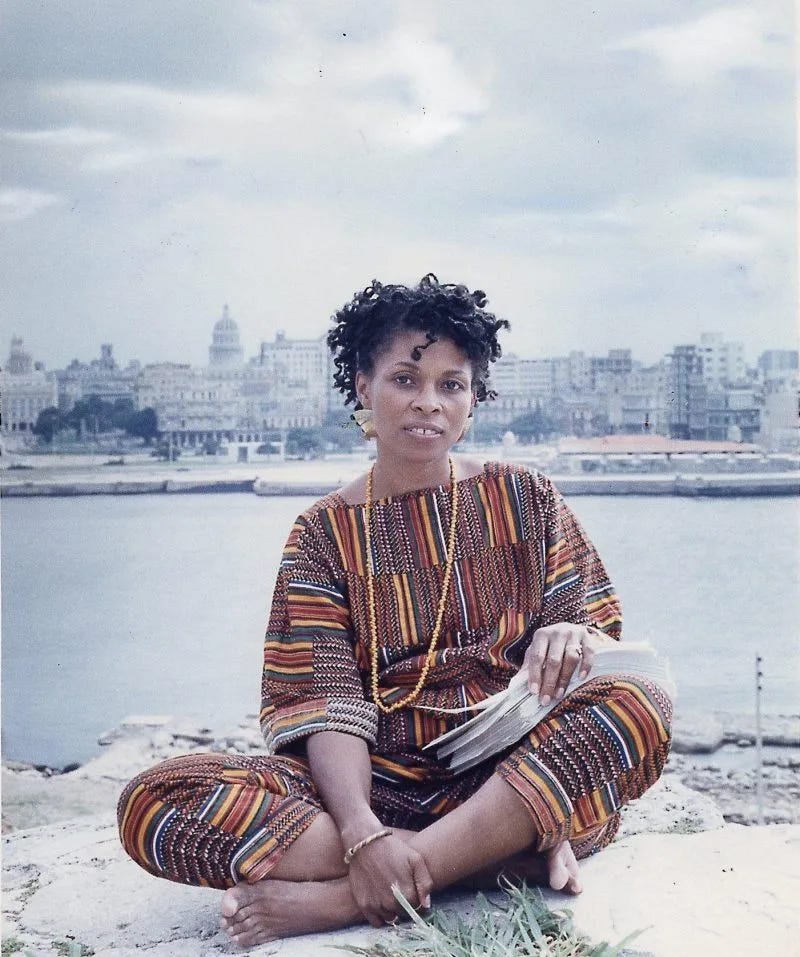
Assata Shakur is a black revolutionary currently living out her days in political asylum in Cuba after escaping a prison facility in the 1970s. The autobiography Assata documents much of her life as a young black woman in America, her revolutionary activities, and her life as what can only be described as a political prisoner.

The United States of Assata Shakur’s youth was as racist and violent a country as you’d see being accused of such today. Preserving segregation, Jim Crow, and white supremacy with blood. The stories of her youth are rife with white mobs terrorizing her grandparent’s business, being thrown out of amusement parks for white children only, and watching a never-ending deluge of television where “black people were harassed and attacked”. Detailing what she saw happen on the news; “Martin Luther King’s house was bombed. Then came Little Rock. I can still remember those ugly terrifying white mobs attacking those little children who were close to my own age…And each year I would sit in front of that box, watching my people being attacked by white mobs, being bitten by dogs, beaten and water-hosed by police, arrested and murdered.”

The death and destruction wrought on people simply for looking the way she did, something Shakur describes as “the most primitive, reactionary, ignorant violence that exists”, created an extremism and revolutionary resistance movement that opposed the government. In one of her many sham trials, Shakur gave a speech to the jury so they might better understand the Black Liberation Army to which she belonged;

The idea of a Black Liberation Army emerged from conditions in black communities: conditions of poverty, indecent housing, massive unemployment, poor medical care, and inferior education. The idea came about because black people are not free or equal in this country. Because ninety percent of the women in this country’s prisons are black and third world. Because ten-year-old children are shot down in our streets. Because dope has saturated our communities, preying on the disillusionment and frustration of our children. The concept of the BLA arose because of the political, social, and economic oppression of black people in this country. And where is oppression, there will be resistance. The BLA is part of that resistance movement.

While big corporations make huge, tax free profits, taxes for the everyday working person skyrocket. While politicians take free trips around the world, those same politicians cut back food stamps for the poor. While politicians increase their salaries, millions of people are being laid off. This city is on the brink of bankruptcy, and yet hundreds of thousands of dollars are being spent on this trial. I don not understand a government so willing to spend millions of dollars on arms, to explore outer space, even the planet Jupiter, and at the same time close down day care centers and fire stations.”

Throughout Assata, it’s clear that Shakur truly struggles with the more violent tendencies of this resistance movement. It took her a long time to join the Black Panther Party for this reason, but in the end, saw it was the only group adequately defending against the active brutality deployed by the United States government; “I was sick and tired of us being the only victims, and I didn’t care who knew it. As far as I was concerned, the police in the Black communities were nothing but a foreign, occupying army, beating, torturing, and murdering people at whim and without restraint. I despise violence, but I despise it even more when it’s one-sided and used to oppress and repress poor people.”

It’s clear that whatever violence she condones is of a defensive nature, not as an agent for the change she hopes to see. She’s clear that a revolutionary strategy must focus on mass movements, not military ones; “armed struggle, by itself, can never bring about a revolution…it must be part of an overall strategy for winning, and the strategy must be political as well as military.” Self-defense is the most justifiable of the whole spectrum of violence, yet simply embracing these tactics and beliefs made the entire organization a massive threat.

This is what ultimately made her and many other black revolutionaries a target of the United States government; Shakur did believe violence against a repressive state to be an inevitability. The sentiment that “nobody in the world, nobody in history, has ever gotten their freedom by appealing to the moral sense of the people who were oppressing them” was often shared in her circle. And while she felt that “a war between the races would help nobody and free nobody and should be avoided at all costs”, she also knew “ a one-sided race war with Black people as the targets and white people shooting the guns is worse. We will be criminally negligent if we do not deal with racism and racist violence, and if we do not prepare to defend ourselves against it.”

Sentiments like these made Shakur the target of the United States COINTELRPO program. She began to be viciously harassed and surveilled by the FBI and law enforcement. A common practice was to surveil a revolutionary, gather enough faulty “intel” to accuse them of a number of crimes, recklessly pursue and arrest them (ideally killing them in the process as they did to Fred Hampton), and then bank on racist courts and juries to pin them to a crime and get them locked in high-security prisons.

One might be inclined to think it stops there, however as Shakur notes; “in prisons, it is not at all uncommon to find a prisoner hanged or burned to death in his cell. No matter how suspicious the circumstances, these deaths are always ruled suicides. They are usually black inmates…among the most politically aware and socially conscious inmates in the prison”. If the arrest didn’t kill you, there was a good chance you could be taken out once in prison. A number of prisoners both notable and not have been killed this way. It’s a way to deploy the justice system as a more discrete instrument of murder since if the public sees someone in the process of the courts they’re less concerned than seeing them gunned down in the streets in cold blood.

Shakur herself was almost the victim of such a garish plot. She recounts that she would stack cups in front of the door of any prison cell she was stationed in when; “one night, in the middle of the night, the cups came crashing down. I immediately awoke to find four or five male guards standing in the doorway of my cell”. She was able to scream loud enough to dissuade the guards from doing anything. This was not the only time that police and guards tried to kill her. It’s worth noting here Shakur was never even convicted of a crime, she was simply being processed.

If it wasn’t an outright murder attempt, the prison conditions themselves were horrific. Solitary confinement was leveraged against Shakur without reason. International jurists from the United Nations Commission on Human Rights who were investigating prison conditions in the United States said “one of the worst cases is that of Assata Shakur, who spent over twenty months in solitary confinement in two separate men’s prisons subject to conditions totally unbefitting any prisoner.” From Shakur’s own words:

“If I wrote a hundred pages describing the basement of the Middlesex county jail, it would be impossible for you to visualize it. It was a big, grayish, pukey greenish cell. The ceiling was covered with all kinds of pipes, some small, some huge, some dry, some leaky. There was no natural light, and the jailers refused to open the small windows located near the ceiling. The average temperature was 95 degrees. It was infested with ants and centipedes.”

Assata Shakur was arrested on charges she was never guilty of, an arrest that almost killed her. She was then brutalized and stuck in solitary confinement for over a year of her life. She was deprived of her child and her loved ones were constantly being harassed. She is just one radical, there are countless others that suffered the same fate and whose stories may never be told. Hers is a crucial story told from beneath the hooves of the high horse upon which the United States rides around the world stage.

Remember the treatment of Assata Shakur and thousands of innocent black inmates at the hands of the US government, remember recent torture victims never accused of a crime, remember the sponsored bombing campaigns being undertaken against civilian populations the next time The United States Government seeks to condemn other nations for the same. The Declaration of Independence declares that “whenever any form of government becomes destructive…it is the right of the people to alter or abolish it, and to institute a new government”. The United States has justified many violent uprisings under this exact premise.

So considering this, if Assata Shakur’s only crime was opposing a government engaged in destructive behavior and escaping what was surely political imprisonment and torture, the United States can forgive these transgressions and issue a pardon to Shakur. Violence against the state is after all a hardened American value.

“I am about life…I’m gonna live as hard as I can and as full as I can until I die. And I’m not letting these parasites, these oppressors, these greedy racist swine make me kill my children in my mind before they are even born. I’m going to live and I’m going to love, and if a child comes from that union I’m going to rejoice. Because our children are our futures and I believe in the future and in the strength and rightness of our struggle.” - Assata Shakur

Thursday, November 10, 2022

COVID is Simultaneously Terrifying and No Big Deal


It's been two years since COVID-19 struck the United States and it has since killed over a million people in that time. Before reaction to the disease was politically polarized, back when we were uselessly wiping our groceries down before we brought them into the house, we made a series of decisions that have become a focal point in the midterm elections. Schools were closed down, offices were closed down, companies were given payroll relief, and things like unemployment benefits were expanded. 

Fast forward a year and one COVID vaccine later and schools have resumed but, along with airlines, have mask mandates in place, unemployment benefits are coming to an end, workplaces are hybrid to the extent they can be, and our supply chains are in shambles. Controversial vaccine requirements crop up to do anything from attending a concert to working at your job. COVID continues to kill thousands of people a day.

Today, schools are in full swing, mask mandates and masks themselves are almost wholly gone, vaccine mandates are minimal if existing at all, and expanded benefits programs are practically forgotten (mostly because no one wants to admit they were wrong when they pinned the blame for the workforce shortages on them). Now that our societal COVID defense measures have largely come to an end and we're trying to politically litigate what was necessary and what was damaging to the economy and society as a whole, I can honestly say I feel just as in the dark as I ever was. 

While I'm more certain of the effectiveness of some actions I can take - like wiping down my groceries is useless, getting boosted is not useless, wearing a mask on an airplane might be useless but I'm going to do it anyway - I'm not entirely sure how terrified or angry I need to be. The effectiveness of cloth masks has been challenged, some believe masks do nothing, although it seems the data leans into other types of masks being very effective, yet when there are mask mandates cloth masks are accepted. However, this doesn't seem to matter as there are effectively no mask mandates and almost no one wears them anymore. Is wearing a mask useful if I'm the only one doing it? Should we demand a return of the mandate or a more extreme one that requires KN95/N95 masks? Should we be fighting this battle?

Even the vaccine and the boosters are a cluster of conflicting information. First, the vaccine was supposed to be the end of Covid, which turned out to be false as you could still be infected and transmit the disease while vaccinated. The narrative shifted to say it lessens the likelihood of infection, this too seems to be wrong. Now the narrative is cornered into the likelihood of severe illness and death, which seems to be technically true but not valuably true. It is unsurprising then that so many Americans have opted not to get the final round of boosters.

The questions are endless. Did remote learning cause the severe suffering of public education or did the death and destruction wrought by the pandemic cause this? Are public schools even suffering as a whole or is it mostly just vulnerable populations suffering more? Did shutdowns cause our current inflation and supply chain issues or was it something else? Was expanded unemployment responsible for restaurant closures or was it workforce exploitation? 

It's even impossible to assess the risk to yourself or your loved ones as you try to weigh these various decisions. The rate of death is lower than it was, but the disease is still killing hundreds, sometimes thousands a day, and many say it could spike again. The probability of Covid killing you if you're young is low, even lower if you're a child. However, deaths of young people have trended up and down. Deaths of vaccinated people have also jumped lately, although vaccination remains the best variable against death or severe illness. Long covid is apparently a thing even if you don't get severely ill. Or maybe it isn't...a thing...at all. 

The point is the internet is so flush with quick and accessible information that essentially any sentiment, thought, or fear can be justified with data or expert opinions. I don't want to die or get very sick, I don't want my loved ones to die or become disabled from illness, especially if it was preventable. I am terrified that this could happen at any moment, worst case scenario is it happens because of something I did or didn't do. And yet it's not even clear I can do anything at all. Everything to lose with inaction, yet all action is useless. Total paralysis.