Tuesday, May 16, 2017

The Washington Connection by Noam Chomsky


Sometimes at work, I will listen to the Democracy Now! headlines. The show is about an hour long and the news is a straightforward, unabridged version of key events. If we compare them to the daily headlines I read in the NYT or NPR Morning Edition’s, there are some...er...differences. It isn’t that Democracy Now! is too partisan - NYT and NPR can hardly be denied a partisan standing - rather Democracy Now! is not gunning to entertain with the news. The charge that it is radical is as much from form as it is content. It is devoid of any band profiles or stories about cupcake stores and at the same time, it doesn’t spare any details when describing death and destruction taking place across the globe. It should surprise no one that Noam Chomsky gives regular interviews almost exclusively to Democracy Now.

Reading Part One of the Washington Connection it is easy to see that Noam Chomsky is not out to entertain. Like Democracy Now, he and his co-author are in the business of speaking truth to power, often contradicting the official government and mainstream media’s version of events with specialists and primary sources. This is truly important work and it comes with a great risk of being wrong (any right-winger worth their salt will remind you that Chomsky denied Cambodian genocide for fourteen years). It is also very difficult to read, and I’m not just talking about density. Chomsky takes on the mainstream media, the United States Military, and public officials of all kinds, breaking US involvement with 3rd world fascism down into benign and constructive terror. Since World War II, our foreign policy of intervention has either been benign, where we allow tyrannical regimes to carry out atrocity because we get 80% of our coffee supply from them (like in Burundi) or it is constructive, in which case we supply anything from weapons (like in Indonesia) to ground troops and bombing campaigns (like in Vietnam) to protect our business interests/investment opportunities and those of our allies.

I certainly don’t believe that history, politics, or current events have to be packaged in a fun and entertaining way, but the depth of cover up and propaganda that Chomsky claims is staggering. Many of the reports he refutes - outside of maybe Vietnam - are still officially on the record, it is way easier to believe these accounts than it is to acknowledge the conspiracy that Chomsky is trying to demonstrate. Many would love for Chomsky to be wrong both factually and morally, even those who would likely be sympathetic to his leftist message, simply because it would allow us to continue living in a world where our elected officials aren’t partnering with major corporations to perpetuate the conditions of a necessary (for capitalism) underclass around the word.These people especially should be reading the Washington Connection if only to ask the pivotal question: “what if he’s right?”


Tuesday, April 11, 2017

The Death of Adam by Marilynne Robinson

In the midst of reading 100% non-fiction in 2017, I decided to read Marilynne Robinson’s the Death of Adam after Sam Harris’s Letter to a Christian Nation. The idea was simple enough; read a book that supposes there is no place for religion in the modern world and then read a book that supposes there is! This is constantly a stance I wobble back and forth on and I was seeking opposing views. The Death of Adam was a foolish book choice for this purpose, but on the other hand, I don’t believe I’ve read anything that has inspired me quite like it has.

The temptation here is to treat “inspire” as a platitude, as though the Death of Adam made me feel good or reaffirmed beliefs I’d been mulling over. While it did those things, I’m more interested in taking action. As a set of essays self-proclaimed to take on all of modern thought, Robinson has taken to processing the topic as a way of challenging her readers to do the same. And her case for doing so is absolutely air tight.

We should be considering modern thought at all times. Any set of beliefs, progressive or orthodox, liberal or conservative, are rooted in history. Deriving the genealogy of these ideas is important. In Robinson’s first essay she discusses the influence that Darwinism has had on our economics, politics, and psychology. The effects have ranged from genocide to laissez-faire capitalism, all predicated on the immutability of evolution - the truth of which is very different than Darwinism. The essay is wildly educational, brilliantly written, and forces readers to think about the sorts of truths humanity has tried to pull moral codes from. Every essay takes on the subject of influence and history in ways that make one want to question the origin of everything.


I’m also very intrigued that Robinson refuses to take any opinion second hand. She goes right to the primary source to draw her own conclusions. There is no doubt that the immense amount of work this requires is masked by her effortless and gorgeous writing style. When discussing the merits of John Calvin, or Charles Darwin, or Marx, or Jefferson, or Freud, or anyone for that matter, Robinson does so with the authority of having read and studied their actual works. Her only citation of historians and academics comes as rebuke or demonstration of modern thinking gone astray. To the modern reader, no matter how well-read, one has to come to the realization that there are so many primary works, the worth of which we’ve only been assuming. I’ve never felt so pressed to read more.

The last bit of inspiration comes entirely from Robinson’s final essay titled the Tyranny of Petty Coercion (great title). Some of the most prolific and powerful writing I’ve ever encountered, Robinson dwells on the point that we’ve allowed our ideas to be censored because they are thought to have fallen out of fashion or to be uncool, dated, “delusional”, something it is cool to show irreverence toward. In it, she admits to being a liberal and a Christian, if I say she does so boldly do not take it to be melodramatic. You’re smart and passionate enough to believe the things you do, collective modern thought has nothing to lose and everything to gain from your categorical declaration of belief. Don’t be afraid to admit you’re a socialist because it will offend your girlfriend’s parents, or say you’re an atheist because it will break your mother's heart, or that you’re a liberal because your boss is a hot blooded conservative, or any of the opposite because the opposite is true! All we can do is go around inspiring each other. Robinson’s book is a necessary first step.

Saturday, March 25, 2017

Letter to a Christian Nation by Sam Harris


“That so much of this suffering can be directly attributed to religions - to religious hatred, religious wars, religious taboos, and religious diversions of scarce resources - is what makes the honest criticism of religious faith a moral and intellectual necessity. Unfortunately, expression such criticism places the nonbeliever at the margins of society. By merely being in touch with reality, he appears shamefully out of touch with the fantasy life of his neighbors” pg. 57

Let’s be real, Letter to a Christian Nation is not a letter truly addressed to Christians, but we shouldn’t be harboring any illusions that it is either. For one, author Sam Harris admits that he doesn’t expect any hardline Christians to read it. Two, the distinction is in the title itself. Harris is writing to the nation of these United States, a nation which allows a considerable amount of influence derived from religious texts/beliefs into public life, policy, and societal endeavors. So while Harris’ book may be written in a way that addresses fanatical Christians, his true appeal is to moderates and secularists.

Harris is imploring the people of the United States to discover the difference between how we treat people and how we treat their beliefs. Consider how we allow Christian parents to abstain from immunizing their children or how we allow Jehovah's Witnesses to abstain from life saving blood transfusions. Do we do this because our nation is allowing religious freedom or are we simply exercising religious tolerance? It seems religious freedom would be allowing these groups to practice their religion free of persecution from the law, but the burden of justifying harmful practices should fall squarely on the believer, not the nation as a whole. Harris outlines countless more examples in this concise argument and one has to believe there are countless more. This is not an offensive riff against religious people, it is a treatise for intellectually honest conversation.

And one does not have to accept Harris’ assertions that there is no God or that the world would be better if everyone stopped believing in one in order to participate in his general premise. Granted, they do need to read between quite a few condescending passages to fully engage, but what simmers underneath is a really important and substantial argument about the way we should structure society. We should want to see society structured in such a way that does not tolerate self-harm or the harming of others or perpetual opposition to legislation, scientific research, and humanitarian effort designed to reduce suffering all on the grounds that it is considered religious freedom and tolerance to so.

There is tremendous benefit to reading Harris’ arguments with this in mind. If you are avoiding his works because you feel he is too offensive or condescending or hot-button, then you are part of the problem Harris feels this nation has. The greatest human and societal achievements haven’t been attained without making swaths of everyday people very uncomfortable, in some cases even murderously angry. It is time we begin to discuss how to be intolerant without cruelty, start with this book.


Monday, March 20, 2017

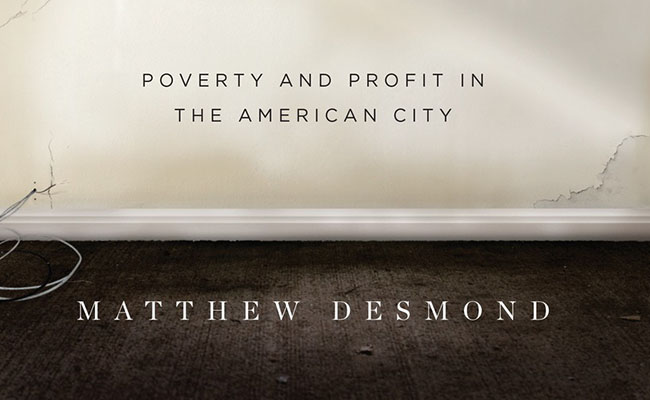
Evicted by Mattew Desmond


When talking about the housing crises and subsequent recession of ‘08, I used to blame it almost entirely for my parent’s divorce. I’d usually posit that had the market not crashed, employment not taken a nosedive, then my mom and stepdad could have made things work. This was largely an effort to couple a personal affront with a larger criticism of the system. The problem with what I was doing was not relative to the truth of the matter, but more of a problem with using the power of narrative to contextualize flaws in the system. After all, my parent’s divorce was not proof of predatory lending or high stakes debt investments, the only credibility it lent my argument (assuming it is true) was that my life was adversely affected by the housing market crash. This is an example of a strong rhetorical tool overtaking the argument it was meant only to bolster.

I’ll be clear, this is far from what Matthew Desmond does in his book Evicted. Desmond meticulously documents poverty in Milwaukee inner cities and rural trailer parks as only a professional journalist could. While first focusing on two landlords and some tenants, he then magnifies these stories, tracking them into some increasingly dark places. Evicted is an exceptionally important book because of the way in which it documents our country’s failure in dealing with our most vulnerable citizens. These are not sob stories, they are gritty realities meant to frustrate the reader.

Each tenant, or character as you might mistakenly be apt to call them, is extorted by their landlord in the most sickening ways. They are thrown increasingly into drug addiction and poverty as eviction after eviction piles up. The stories are heartbreaking, unfair, and gut wrenching. Every American should read them so they can get a glimpse of the way this country is designed to profit off suffering. The idea is that, unlike regular, middle-class tenants, in order to make a profit off our poorest citizens, the landlord must milk a high number of them for everything they are worth. This makes the eviction a pivotal tool. It allows landlords to remove a tenant at the moment they become unprofitable. The result is a terrifyingly fast carousel of poverty and profit.
Despite the fact that Desmond litters Eviction with hard numbers and detailed passages on flawed housing policy, it could still be entirely possible for readers to walk away from it thinking greedy landlords are the problem, or the government, or ineffectual social programs. This is because the main focus is on the way the narrative of downtrodden people like Arleen makes us feel, not what systemic policy most likely put her there. While the descriptions of poverty and the cyclical brutality of the inner-city may make us physically wince, they detract and overshadow the brief passages on causation. At the same time, the descriptions are necessary for any reader concerned with living in and creating a just society.

For this reason, Desmond's book is worth reading, but cautiously. It is an excellent ancillary text that lends itself to a worldview already privy to the flaws of capitalism and America's perpetual reliance on poverty for profit. As a conversation starter it runs the risks inherent in narrative style non-fiction, so resist the urge to recommend it to your mother-in-law's book club.


Thursday, March 2, 2017

The New Prophets of Capital by Nicole Aschoff


When Whole Foods came to Detroit I remember Kai Ryssdal of NPR’s Marketplace doing an interview with Walter Robb, the CEO of the company at the time. Admittedly, I was on the bandwagon; I thought a Whole Foods in Detroit was a good thing, was part of the revitalization effort happening across the city. Ryssdal, though, posed some difficult questions to a clearly annoyed Robb (who at one point says something along the lines of “that’s why I’m an entrepreneur and you’re just a journalist”). The skepticism Ryssdal expressed was rooted in gentrification and because of Robb’s continued counter to the concerns over high prices always boiling down to “just doing it right” Ryssdal ended up asking him what his plans were to teach the residents of Detroit how to shop at the store.  


This interview profoundly affected me. I began to see the urban revitalization led by Dan Gilbert and his ilk (whom I worked for at the time) as flawed, despite their intentions. At the same time, I had difficulties expressing this skepticism, I wasn’t sure why dumping private capital into economically disadvantaged areas seemed to result in more inequality when the intention and efficiency were in the right places. It was also difficult to explain to fellow suburbanites why I had my doubts about Detroit being labeled as a “comeback city” when they saw the city generating profit in ways it hadn’t for some time.


This was until, very recently, I read The New Profits of Capital by Nicole Aschoff. The New Profits basically breaks down the stories of successful, well-intentioned, entrepreneurs that seek to make the world a better place through capitalist markets. Aschoff focuses on four big players: Sheryl Sandburg of Facebook, John Mackey of Whole Foods, Oprah, and Bill/Melinda Gates.


Each section follows a pattern. The first part generally discusses the subject in a positive light; Sheryl Sandberg breaking barriers as a woman CEO, John Mackey hasn’t taken a paycheck in years and pays his employees profit share, Oprah’s unfettered benevolence, the Gateses wild success in reducing disease worldwide. This is important, Aschoff isn’t a snooty leftist whose aim is to defecate all over the capitalist class for being evil or greedy. She recognizes the importance of understanding each of these individuals as essentially good. For Aschoff, the flaw is in the philosophy.


The next part of each section usually delves into the limitations of capitalist markets to accomplish the endgame of each subject. The ideas here are enlightening and, in many ways, a total game changer. Some key points used against the subjects are that capital - unlike human needs - can’t be satiated, that markets require inequality, and that private capital is undemocratic. There are more about the limits of the individual vs the system (you can’t bootstrap your way out of poverty)  and conscious consumerism as well. Each was backed up by an abundance of sources demonstrating that capitalism necessitates inequality and a certain amount of people left behind.


The final part of each section talks about ways in which society could be constructed, democratically and socialistically, that would serve the needs of people over the needs of capital. Whether or not you believe this is the answer, The New Profits of Capital is certainly worth reading. If only to poke holes in the success stories capitalists are telling in the wake of immense suffering and poverty. I can’t recommend this book enough, I almost wish it were a documentary for fear that too few people will read it.

And just FYI, I emailed Aschoff at editor@jacobinmag.org to request a Part II featuring Elon Musk, Mark Cuban, Dan Gilbert, and Sarah Koenig from the podcast Serial. So...fingers crossed.


Friday, February 24, 2017

Disobedience and Democracy by Howard Zinn


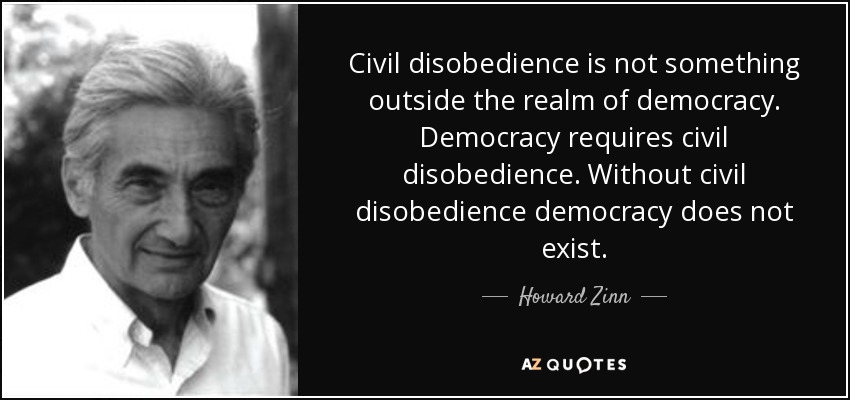
Disobedience and Democracy is a short essay Howard Zinn wrote in response to a short essay about Law and Order written by a Supreme Court Justice. Zinn outlines nine fallacies in the original essay, quoting extensively enough so that reading it is unnecessary. Each fallacy deals with a more fundamental question on law and order; when, if ever, it is morally permissible to break the law through protest? According to Judge Fortas, the justice who wrote the piece Zinn is eviscerating, the answer is never. Zinn disagrees.

It’s hard not to look at Zinn’s argument as a relic. The moral peril the nation was in at the time of his essay seemed greater than that of today. We’re talking about the Vietnam War, McCarthyism, redlining, and remnants of Jim Crow. So when Zinn states the scope of the civil disobedience in question did not outweigh the immorality of the things they protested, this seems, somehow, truer than today. When Zinn argues that burning your draft card or blocking the road to a chemical weapons manufacturer doesn’t compare to the atrocities of an illegal war, the benefit of hindsight means there are few of us who would disagree as modern readers.

That said, it is important for the modern reader to understand that Zinn’s arguments, at the time, were not widely accepted. That which he advocated the protest of is more comparable to what is happening today than we may be willing to admit while reading argumentative essays of the past. The Vietnam war and the conquests of Indo-Asia/Latin America can strike parallels to the relentless wars in the Middle East today. Surely we can use the same fallacies of law and order when assessing the moral decision demanded of the nation in the case of Edward Snowden, or Standing Rock, or Flint Michigan.

In this regard, Zinn’s words are more relevant than ever. Providing a moral justification and guidebook for disobedience against the state, Disobedience, and Democracy becomes essential reading at a time when democracy is most threatened. While we like to believe we exercise control over our lives by merely participating in democracy, the reality is that we don’t have a say in far too many ways. Americans don’t vote on foreign policy or wars, they don’t decide how much of their taxes go to schools vs corporate subsidies, and with so much corporate spending in elections, they don’t really even elect the leaders that make these decisions. Zinn makes the compelling argument that when democracy becomes an obsolete tool of change, disobedience becomes increasingly necessary.

Whether you’re protesting the state at Standing Rock or the Bundy Ranch, Zinn’s line of questioning will prove invaluable. What do we owe the sanctity of law and what does it owe us? Why must civil disobedience necessarily be non-violent? What are the limits of our government and how do we keep it in check?

If you’re planning to get organized, don’t leave home without your copy.


Monday, February 13, 2017

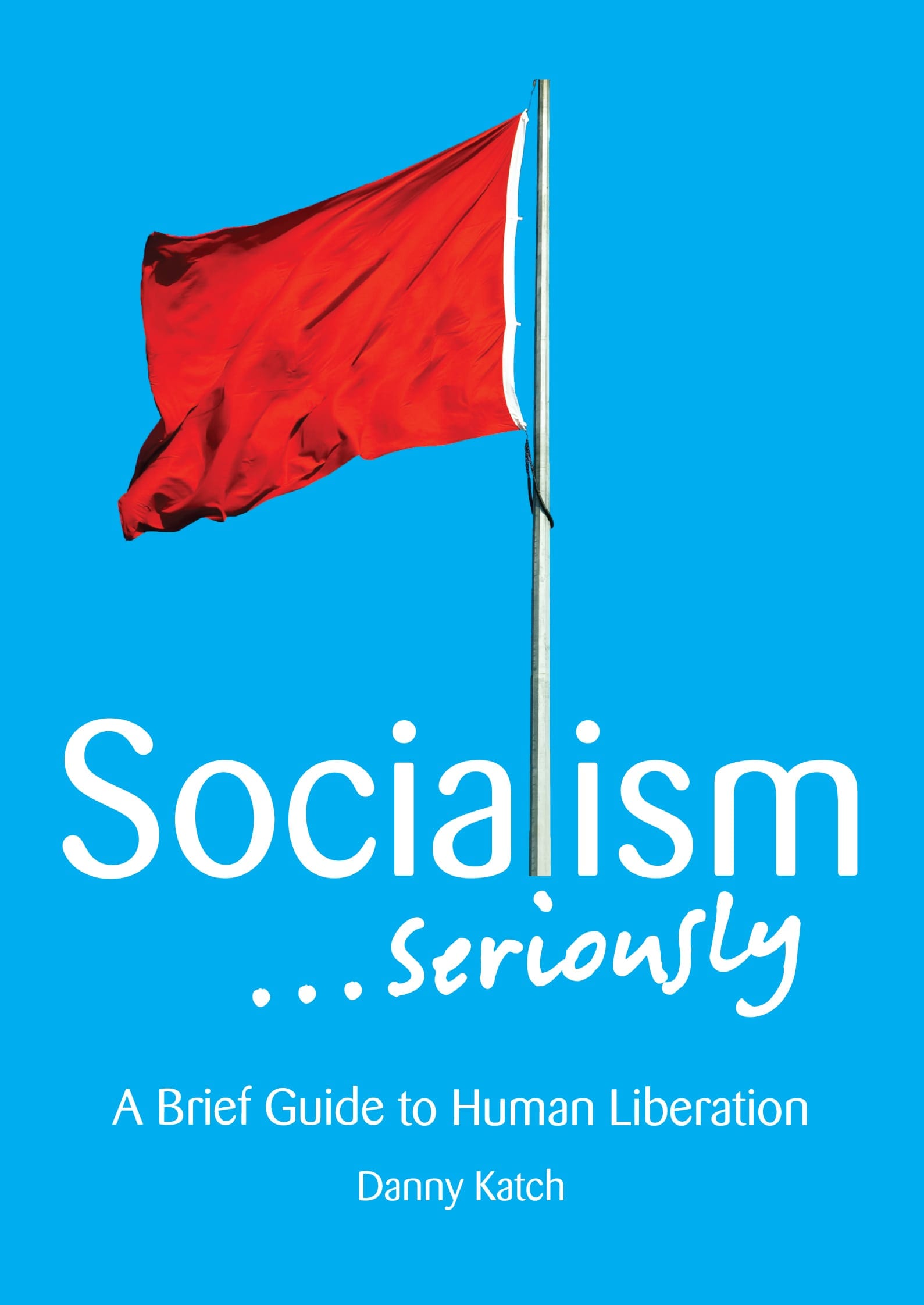
Socialism...Seriously by Danny Katch


Being from the Midwest, I think the ascendancy and eventual victory of Donald Trump came as less of a surprise to me than many people on the coasts. Michigan was an absolutely essential victory for the Donald and he carried it exactly the way I predicted he would; losing the wealthiest/most diverse counties and sweeping everything else.

I called this victory in Michigan, not from luck, but because this is exactly how Sanders took the win from Clinton in the primaries. Almost county by county. Clinton’s loss in the Mitten speaks volumes about the limitations of Democrats, but this is a book review on a short book, so I’ll keep it short.

So many who consider themselves left leaning value the world the Democratic Party claims it fights for. We care about the environment, economic empowerment, minimum wage increases, ending poverty and war. There is a lot of speculation why the rest of the nation isn’t on board with the Democrats despite their supposed dedication to the causes listed above. These explanations range from racism to stupidity, to brainwashing and corruption. While these could all be a little right, they don’t explain the limitations of the Democratic Party.

Think about the inadequate responses environmentalists have when talking about the jobs that are lost when coal plants are shut down, or of labor activists when advocating the minimum wage, or of democrats advancing agendas of Global Trade when auto jobs are shipped to Mexico.

Even Bernie Sanders, considered the furthest left of the party, gives some wildly inadequate answers to perfectly understandable questions. Just the other day when he was debating Ted Cruz (of all people) about health care on CNN; he was posed with questions from a business owner about their inability to afford the ACA provisions enforced on their business. Sanders’ answer pretty much amounted to “sorry, but you have to offer insurance, if you can’t, go out of business”. That is a nightmare answer for small business owners and probably the reason why so many of them hate the government.

So, why can’t the Democrats answer these questions? Because they are all operating under the assumption that their ideal world - the one devoid of war and poverty and injustice - can be achieved under capitalism. But capitalism doesn’t account for the jobs of coal miners when plants are shut down, or of minimum wage employees, or the sustainability of a salon in Texas that offers health care.

Enter Socialism...Seriously by Danny Katch. A short introduction to Trotsky inspired Socialism via humor and laymen terms. There are a lot of working parts in the book, Katch is asking his readers to imagine a world that isn’t structured by capital or profit, driven by a purer democracy than we have today, and all while debunking some of the major criticisms hurled at the ideology.

At times it seems like Katch has the answers Democrats lack. For example, in a world that doesn’t conform to the rules of “profit first”, full employment and environmentalism seem more compatible. When you really consider that we have to sell our labor to survive (something Katch goes into in perhaps his strongest section of the book; Freedom isn’t Free) suddenly it makes sense that coal miners and auto-workers and displaced lumber workers banded together in Michigan to elect Donald Trump. They see Clinton and the left as job cutters, destroyers of livelihood. There isn’t much indication that they are wrong either, Obama himself admitted that coal refinery workers might hate him for legitimate reasons. When Donald Trump enters that scene promising to bring back lost jobs and protect future ones he makes sense to people who have no choice but to work for a living. Katch is offering a vision of a world in which you don’t lack basic needs or a job just because society decided to automate truck driving.

This short, airtight book is a great one to share. Even if those you give it to aren’t going to run out and buy a copy of the Communist Manifesto, it still offers succinct and radical criticisms of capitalism and government, essential for anyone who is interested in answers beyond the standard liberal talking points.

Where Socialism...Seriously deludes itself is not in the ideology or implementation, but rather its perceived accessibility. I don’t find Katch very funny, his humor parades as edgy but is actual banal and overly safe. One wonders if he favored a poppy, referential humor over a more biting one for fear of isolating readers or if that is just his sense of humor. Either way, it is easy to imagine this sense of humor pissing off actual laborers. Then there are some passages about religion toward the end that seem rushed and incoherent, after a few sections of savage capitalism take-downs the section titled “Is Socialism a Religion?” seems like it’s attempting to win over an abundance of people who associate Socialism with Atheism, which isn’t to say those people exist, but rather that they would never read this book.

Which really speaks to another limitation on the left. This book is great to share with liberal friends and family, or maybe people who don’t consider themselves very political but voice concerns about social justice and human decency. Yet even after all the imagining of a socialist America, this book got me to do, it still couldn’t get me to imagine a Trump voting machinist in Up-North Michigan reading it, let alone being convinced of anything it has to offer.