Wednesday, December 10, 2014

Essay: Peter Pan 1, Washington Redskins 0

I have seen a live production of Peter Pan the Musical on 3 separate occasions, I have seen the animated movie hundreds of times, I've read the book, I've even been on the themed ride in Disney World. This may lead you to believe that I am in some way a fan of Peter Pan. I'm not. I think the musicals are terrible (which is not to bash the brilliant young actors who star in them), the animated movie is probably the worst Disney film, the book is incredibly creepy, and the theme park ride is no Wicked Twister. Of course my feelings for Peter Pan are irrelevant, the Pan legacy is for children to enjoy and from what I understand they do. Here are where my feelings become less irrelevant: I'm concerned that kids are watching Peter Pan and enjoying it...because Peter Pan is really racist. This isn't a secret either, there is a strong history of racism towards Native Americans in Peter Pan stories. In fact the only reason I wanted to watch NBC's live production of Peter Pan the Musical was because I wanted to see how NBC would handle the racist depictions of Native Americans.


But let me back up. I think it is important to note that there are still plenty of racist depictions of Native Americans in 2014 America. I would say the worst perpetrator of this cultural appropriation is Sports. You have the Cleveland Indians, the Washington Redskins, the Atlanta Braves, the Chicago Blackhawks, the Kansas City Chiefs, and probably any number of smaller teams with similar names. The reason I believe sports are the most guilty is because it seems the most institutionalized. I'm unaware of any restaurant chains, or company names, or chocolate bars, or major brands that borrow (read: steal) from Native American culture. Which isn't to say those things don't exist, I'm sure you can find them, but none are more well known and vigorously defended as American sports teams. Which got me thinking about why Peter Pan hasn't changed over the years. Our sports teams cite reasons like tradition, and branding, and endearment toward a culture (all of which are terrible arguments, I'll get to that later), but what reason does Peter Pan have for not editing its racist content, especially since it is specifically designed for children. Put simply; why do we think it is O.K. to keep depicting these stereotypes when it is clear we have the capacity to change them?


But let me back up even further. I need to reiterate that this is not O.K.Cultural appropriation is hurtful. I think this is a hard thing for people to grasp because their culture is not as painfully distributed as that of the Native Americans. Redskin, for example. After the trauma (read: genocide) the Native American people have suffered throughout history, for white people to tell them that they have changed the meaning of the word redskin to simply a benign nickname is outrageous. We should not get to decide how a certain word, a word with historically painful connotations to a group of people, should come across to those people. But isn't it enough that Native Americans are saying they don't want to be depicted like this any more? This should be enough to make you stop dressing like them for Halloween, it should make you not want to get Native American Tattoos, or Native American themed clothing, and it should certainly make mainstream brands change their image. Why not? I've never understood why we should just go on offending people, especially people who have endured unfathomable offenses for many, many years. I'm not asking for laws that force the name change or organizational oversight, though that would be nice, I'm asking why the team doesn't change it when it is clearly hurtful to a group of people. I'm asking why fans don't feel the need to pressure their team to change the brand. I'm genuinely curious if it is because the pride and money and brand behind the word Redskin is, and Americans will admit this, more important than the pride and feelings and brand behind actual people. We are telling Native Americans that our symbol for them is more important to us than they are.

Back to Peter Pan. If you know the movie you know the brilliantly racist song "Why is the Red Man Red". The Musical has a song called "Ugg - A - Wugg", which has Native Americans singing utter gibberish in what can only be described as a parody of their language. Not to mention the Native Americans are prancing around in red face, doing stereotypical and, in all probability inaccurate, Native American things. However you can't just take them out altogether, they provide key plot points! I wanted to see how the NBC production would handle this dilemma and I truly believe they did not receive enough credit for what they did; they went over the top in an effort to make this less offensive. For one, they cast the actress who plays Tiger Lilly (the fictional tribes matriarch, which is actually pretty cool) with a girl who has distant ties to the Cherokee nation. This to me always seems like a cop out, like the "I'm not racist I have a black friend" argument. Yet it wasn't the only thing; they changed the lyrics in "Ugg - A - Wugg" to include actual Native American phrases, so it is less of an outright joke. The characters are not dressed like stereotypical Native Americans, they are referred to as islanders or simply Natives, and they aren't caricatured (saying things like, "me like Peter"). They seem to belong to no specific culture, if anything they might even be considered pacific islander. Which, don't get me wrong, is still far from perfect. The point I'm trying to make is every one was so busy bashing Christopher Walken's acting and talking about how boring it was, that they didn't give credit to the production for really trying.

Notice the sea shells? Eh?

That isn't entirely true. The New York Times had made mention of it, so did some other major arts and entertainment commentators. They pointed out that NBC tried to make Peter Pan less racist, but kind of as an after thought. No one though, at least in my opinion, has given them enough credit. The production team at NBC responsible for putting this together acknowledged that the cultural appropriation was offensive and they made a concerted effort to change it. They changed the establishment of Peter Pan. They changed Peter Pan because it was the right thing to do. Not because hundreds of Native Americans would be tuning in, not because they would make money on the deal, but because they found a reason to change it. There is no way to know why for sure, it could have been disingenuous, they may have just feared the backlash from the PC crowd. Even then, that means this major network felt accountable. I believe that is more than you can say for sports teams. They may never change their branding. While I agree that a team brand is different than a depiction of real people in fiction, it stands that both these depictions have real world pain associated with them. As passive fans and consumers, we have not created the backlash that NBC would have gotten for running a racist production. We are too afraid that allowing the Politically Correct movement to make significant changes in sports branding we are allowing our masculinity to be be challenged. Well I'm here to assure you that there is nothing weak about asking a brand to reconsider its approach, there is value in standing up for those being made fun of. Native Americans have truly endured, they are still here, we shouldn't be treating them like they aren't. It's time to grow up...

Wednesday, December 3, 2014

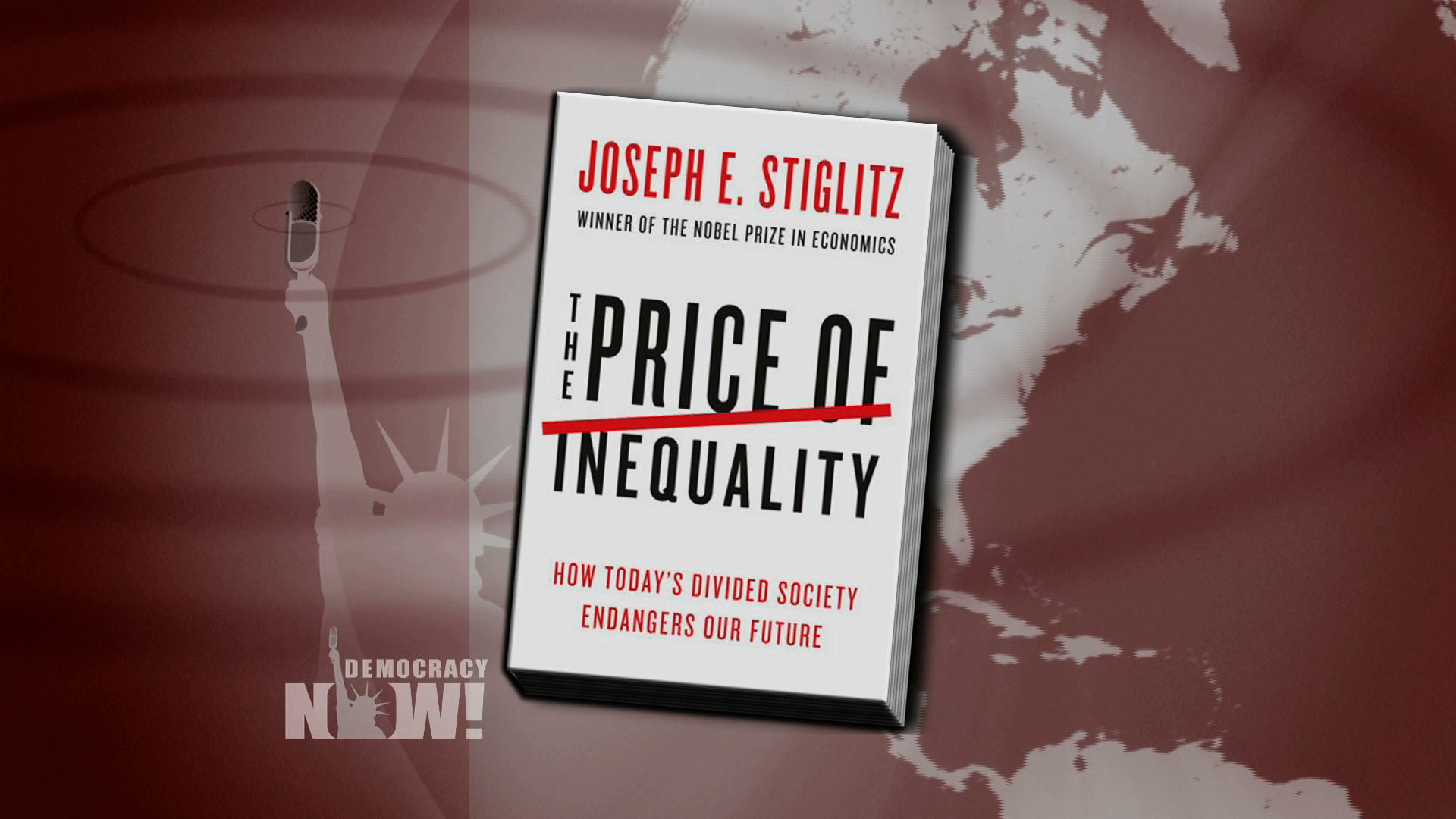
Book Review: The Price of Inequality by Joseph Stiglitz

Joseph Stiglitz is the proud owner of a Nobel Peace Prize in Economics, which is great, but his work in The Price of Inequality is far from peaceful. The book is a non-stop assault on austerity and the politics of the 1%. Stiglitz uses vast amounts of data, ranging from social experiments to primary economic studies, to explain exactly what is wrong with our economy, the politics surrounding it, and how to fix it. The amount I learned from this book will have me running back to it again and again. Why? Why read this book more than once or reference it on a weekly basis? Because it will help you understand who is to blame for the mess we find ourselves in, and no one is safe.

Stiglitz rips up NeoLiberals like Clinton, Libertarians, Democrats, Republicans, Progressives. This is because Stiglitz has no time for partisan name calling, he has an economy to save. His agenda is simple: point out that wealth inequality and poverty are gaining momentum and harming a vast majority of the American People. Check. Point out that this massive amount of inequality and poverty is deliberately caused by the wealthy, as it is in their best interest. Check. Demonstrate that both government action and inaction are just as much to blame for this inequality and poverty as the wealthy are. Check. Dispel any myth that the impoverished and less fortunate are a necessity in America. Check. Outline a series of comprehensive political moves that would balance the budget, lessen the amount of poverty and inequality, and protect the US consumer/economy. Check. If these issues interest you, regardless of political affiliation, you should read this book. Even if these issues don't interest you, you should own this book. That way, when you're sitting around and wondering why your four year degree was so expensive, you can look up that education funding was cut - raising the cost of tuition - and then that same money was given to students in the form of loans so that the schools could still get paid, but banks can make money off people going to college! Boom! Now you know.

Not impressed yet? In the age of the internet where people explore and express their feelings about economic policy via memes it is frustrating that there isn't a lot of substance behind them. This is what I love about Stiglitz. He has a level of ferocity that makes his work exciting and dynamic, his lack of political affiliation helps him stick to principles, and he explains the motivations behind major political policy that things like a meme or a fancy youtube video cannot. So if you're left leaning, you're not just making the empty claim that the minimum wage should be raised, but instead you're explaining to a crowd of adoring fans that the reason it hasn't been raised is because it cuts into profits in a way that can't be avoided...unlike taxes. Or maybe you're right leaning, but instead of complaining that our jobs went over seas or into Mexico, you're tucking your kids in at night with a bedtime story all about how free trade agreements allow doing business in deregulated markets incredibly cheap and now kids just like them are being worked literally to death because we don't have protective tariffs that deter businesses from going elsewhere for cheap labor.

Stiglitz turns policies of any party inside out so you can see the lobby at work, what government action or inaction lined whose pockets. He analyzes how our billionaires and millionaires are plaguing the entire planet, with a process called rent seeking. It is where a few vastly rich people own everything, every single thing, and allow you to use it for a price. Monopolistic cable and utility companies, dominating telecommunication companies, bullying corporate farms, tech giants, Too Big to Fail banks that owns everything you think you own, etc etc...I can almost guarantee you are frustrated by rent seeking in some capacity and if you want to know why, I cannot recommend this book enough.


Thursday, October 30, 2014

Book Review: The Stars of the Sky by Jim Arapostathis

The Stars of the Sky is a science fiction young adult novel by Michigan native author Jim Arapostathis. Although the book is clearly geared toward a younger crowd of readers, the young adult side of science fiction often uses the fantastic to provide simple and open understanding of the real world we live in. This makes Stars of the Sky an excellent read for any age group, it constantly reminds us to stay curious, adventurous, and honorable.

The story follows Krown, a young cave man coming of age. He wants to partake in his tribe's mammoth hunt, a ritual reserved for the brave men of the tribe. Essentially Krown gets separated and decides to help a crash landed alien named Gothis get the necessary supplies for his ship. Thus, Krown, Gothis, and Star (a young girl from Krown's tribe) set off on a journey where they meet impossible odds. Literally, there is absolutely no end to the danger and it seems to get worse and worse with each page. Extreme cold, giant animals, space alien pirates, etc etc... And the moral of all this danger isn't something as banally thrown around as "be brave" or "never give up" - though those are there too - I like it because it teaches you to think critically about your doubt. Krown is constantly doubting his own ability, his relationship with start, his own reality. And Arapostathis doesn't just invite his readers to reject it, but rather treats it as it is; reality. We all doubt, Harry Potter doubted, but the way Krown doubts is so refreshingly realistic and anyone who has been through 9th grade can relate. Krown reconciles with his doubt the only way we ever can; by pushing on and doing the right thing. Helping Gothis is impossibly dangerous and risky, there is no reason to trust him, but Krown does because it is the right thing to do. He doesn't just think of himself, he doesn't just think of Star, he thinks of and takes action on behalf of the least well off in any situation.

This is why it is important for any young adult to read The Stars of the Sky. When one is 14, they are literally coming of age. They began to think critically of themselves, they become self conscious and aware, they began to doubt their own abilities. To Arapostathis, this is a critical time to think, not of oneself, but of what we can do for others. We know our own limitations; Krown is smaller than the creatures he faces, he isn't as technologically advanced as space pirates, he isn't smooth talking, and he isn't especially wise. Yet despite all this, by doing the right thing, by helping others, Krown proves his ability to himself. Stars of the Sky invites us all to be curious, to be doubtful, to be brave, to do the right thing, and above all; to take action. Any person, of any age, can be inspired by such an invitation.


Tuesday, October 14, 2014

Capital in the Twenty First Century by Thomas Piketty

"Yet it seems to me that all social scientists, all journalists and commentators, all activists, and especially all citizens should take a serious interest in money, its measurement, the facts surrounding it, and its history. Those who have a lot of it never fail to defend their interests. Refusing to deal with numbers rarely serves the interests of the least well-off"

This is the last statement of Thomas Piketty's Capital in the TwentyFirst Century. It is a comprehensive look at the history of wealth and income inequality through the past two and a half centuries. The amount of research and accuracy is staggering, they are largely irrefutable, and they are almost all primary (this book exists as documentation of his study, not a fragmented compilation of other studies followed by a political conclusion). Piketty's piece proves that America, and the whole rest of the world, is at the same level of wealth/income inequality that it was at before WWII and posits that this is a problem.

I led with the last quote of the book for two reasons. The first is that it is totally true. Piketty's book may not be the most riveting read; there are no sparkling vampires, there is no humor, it isn't laden with references to hip things that will make the younger readers say "I know that one!". We, my generation in particular, are not interested in numbers as a political phenomenon and maybe we should be. Many young voters are quoted saying things like "I don't know much about fiscal policies, but I really care about social issues". I find this unacceptable. I care about social issues too, but social and fiscal issues are not separate spheres. The problems of today have a lot to do with economy, many people protecting their money appear to be protecting their morals or their rights for example. Citizens and journalists and activists need to watch were the money is going, where it has been, and why. Only then can any political opinion, even one of pure ideological social justice, be fully formed.

Off my high horse; the second reason I led with this quote is because it is one of the only demands the author makes of his reader. Basically I thought that as someone who advocates responsible government intervention in capitalism, this book would be a silver bullet against opinions differing than mine. This is incredibly egotistical of me and if I had held this expectation for long I would have been disappointed in the book. This is because Piketty does not write rhetorically, he is not flashy, he doesn't need to call for reader action. Although he points out that no research can be perfect, his book stands as the closest thing we have. And despite little gems like, showing that levels of inequality have been at their starkest before 1930 and 2008 in the past two centuries, does not really argue much. This is because he doesn't have to. If his statistics are largely irrefutable, so too, is his conclusion; it should be taken not as a demand, but a fact as plain as the sky is blue.

Oh right. His conclusion. Here you go; "The overall conclusion of this study is that a market economy based on private property, if left to itself, contains powerful forces of convergence, associated n particular with the diffusion of knowledge and skills; but it also contains powerful forces of divergence, which are potentially threatening to democratic societies and to the values of social justice on which they are based". He essentially proves that though the market economy based on private property creates great equalizers, its inevitable outcome will be that the return on capital will outpace the rate of growth (represented by the equation r > g). This creates a society of rentiers (or people who own everything and simply rent it out) who become more and more dominant over those who own nothing but their labor. And his numbers back it up: the global inequality of wealth is currently increasing at a rate that cannot be sustained.

Piketty has many suggestions; a global progressive annual tax on capital being the best, followed by a heavy handed use of inflation, and even some simple taxes like the estate tax and a wealth tax. However after each suggestion follows; "but this should be left up to democratic debate". This means that Piketty is simply calling for us to do...something...even if it is give tax breaks to the largest corporations because you think that is what is going to improve the quality of life and justice. This brings me back to the beginning. The men and women voting, or revolting, or even just complaining need to take a vested interest in numbers and money. Piketty's book is a great start, but you have to be willing to suffer through the immeasurable historic context to find what you ultimately believe is the right solution to our century's greatest problem.


Monday, September 29, 2014

Book Review: Karen Joy Fowler's We Are All Completely Beside Ourselves

We are All Completely Beside Ourselves is a novel about the Cooke Family. A father, a Mother, a Brother (Lowell), a Sister (Fern) and our protagonist Rosemary. Spoiler alert: Fern is a chimpanzee. I thought at great lengths whether or not to say this fact seeing as the first few chapters hide it from you. However I think you're supposed to know that Fern is a Chimp, I think Fowler anticipates you knowing because you read the back of the book, or you read about the book in the NY Times, or your friend told you. Anyway I think it is part of Fowler's craft, keeping the reader in the dark even though they already know what is coming. That seems to be the structure of the entire narrative. The protagonist Rosemary tells us straight up that she's starting in the middle of the story. From there she takes us on a wild ride; jumping from memory to memory, decoding them, adding details, taking parts out that were made up, pulling some details (even some memories) out of her deep subconscious, all while dealing with the harsh realities these memories have caused for her. I have never been on such a realistic and deeply personal journey with a fictional character before.

And Rosemary's journey is a pretty fantastic one. Fern was a chimpanzee that her father, a prominent psychology professor and scientist, was studying in conjunction to Rosemary herself. That means these two children were both experiments on language, understanding, and psychology. They grew up in a house full of grad students and observations on their games, conversations, and interactions. Obviously man has a lot to learn from chimps, Because they are so closely related to humans a study performed on chimps is a study performed on The Self. Much like Fowler's novel is a study of the self. Each memory that Rosemary recalls is initially foggy, she has repressed a lot. Having a chimp for a sister and the trauma that follows has clearly left her with guilt, emotional damage, self loathing, etc... But mostly it has left her with a lot of questions. We meet Rosemary right at the moment in her life when she wishes to finally face these questions, naturally when she is in college. Her parents are too Midwestern and guilt laden to provide her with the answers and she won't get anything from her missing fanatic brother; so she looks into her self. Fowler's protagonist is so genuine and so real in her guilt that you can't help but become infatuated with her inner journey.

This is because we are so used to totally omniscient narrators and suspense coming from plot points. But Rosemary's journey through her memory is different. For one it is incredibly difficult because she was so young. Each memory has to be carefully reconstructed physically to make sure it is real. For example she has a memory that pops into her head from time to time, of her father purposefully running over a cat, but she knows this cannot be a real memory as she would not be able to see over the dash in her car seat. It was a memory that she fabricated as a young child. And this has obviously been done before, in college we all learned about narrators that couldn't be trusted  and our professors used to think it blew our minds. However Rosemary's "unreliability" isn't tricky, she's trying to bring the audience with her to the truth, not hide the truth. In this way we are watching a character face facts and be honest with themselves, our narrator has to be willing to say "I've repressed that memory because...", which makes you absolutely love her. Because we have these sorts of moments where we are fighting to be honest with ourselves, especially in the context of where and who we are now, being a result of where we came from. The feelings evoked in this journey are so potent, if only because they are invariably true of all people.

And speaking of truth, it seems like Fowler had to have actually had this happen to her (obviously it did't). She writes so vividly, not because every action performed by her character is a deliberate one, wrought with detail, but rather because every single one of her characters messes up, or says something stupid, or that they regret, or they do something stupid or incomplete, arbitrary. As I said before, Fowler's novel is a study of the self and we won't necessary like what we see. It makes us ask if everything we hate about ourselves, if every mistake we ever made, was totally preventable. This is the type of question that makes us hate novelists like Fowler, we want to believe that our past did not create us, but the only way to be free of the mistakes we made in the past is to face them in the present. Fowler's study is to show us a mirror, via a chimp, where we see the very worst of ourselves. The results of the study? When the subject looks in the mirror and sees their self, they are proven to be a more intelligent, rational, and free human being. They lead a much more honest life, if not a happier one.

"The world runs on the fuel of this endless, fathomless misery. People know it, but they don't mind what they don't see. Make them look and they mind, but you're the one they hate, because you're the one that made them look" - Lowell on the seemingly impossible task of stopping animal cruelty. A point that rings so painfully true in my life and the lives of anyone who wishes the best for all creatures.


Wednesday, September 10, 2014

Americanah by Chimamanda Ngozi Adichie

We've all heard that our identity is not a matter of choice. We don't choose our race, we don't choose our gender, we don't choose our sexual orientation. But in Americanah by Nigerian author Chimamanda Adichie, this claim is wrapped in the poetry of a love story. Which sounds really cheesy; we don't choose our identity like we don't choose our soul mate...sounds stupid. However when Adichie does this, in the way she writes her novel, it is far from stupid, it is just the truth.

The novel's protagonist Ifemelu, is a Nigerian immigrant to America. Though, she is also so much more than that. Ifemelu, is beautiful, she's smart, she's hard working, she has values. Which are things you expect out of every literary character, but in Americanah, attributes like these play a tremendous role in the lives of the characters, more so than other novels. For example Ifemelu, due to her attractiveness, finds a rich white boyfriend in the states who uses his money/power to get her a green card and an eventual path to citizenship. Something she may not have gotten had she not been very pretty, smart, or an immigrant (the white fellow would not have dated an American Black). Privilege in this book comes across as more idiosyncratic, every little aspect of our identity can manifest into privilege (or the opposite), and to Ifemelu, it is impossible to fight, the only way to combat it is to merely notice it.

And reading Americanah it hits you how true that is. How the aspects of our identity, including our privilege, carry us through life. We are simply along for the ride. So what is Ifemelu's response? To write a blog. Ifemelu is a young blogger who starts the prolific race blog; Various Observations About American Blacks by a Non American Black. The novel is peppered with posts from this blog; posts about Barack Obama, about questions one will get as a black woman, a very kick ass post on hair. But they are never argumentative, only observations. Ifemelu is acutely aware that being pragmatic will not change your identity, but demonstrating how ones identity might effect their living conditions, leaves the reader with the irrefutable message of love and understanding. This way no one feels the need to escape their identity, or try to become something else.

Which is all anyone is ever trying to do in this novel. In Nigeria, all of the character's were trying to become European; putting their kid's in European schools, structuring their families the way Europeans do, going to Europe on vacation, moving to Europe.  In America everyone is trying to become rich, many who are black are trying to become white (or less black). Some American's are trying to become non-American (while laughably trying to hold on to the privileges that being American comes with). Everyone is living this single track story of someone other than who they really are. There is a painful lack of honesty. Which is why Ifemelu's blogs (she starts one in both America and Nigeria) are so important. More importantly though, is Obinze.

As I said, the novel is, at its heart, a love story. Obinze is Ifemelu's love in Nigeria, she moves, loses touch, he moves on, she comes back etc...(no spoilers). Though they both have other partners, they both have other lives, we as the reader get the feeling they are not fulfilled with anyone but each other. One is constantly present in the other's life, no matter how hard they try, they cannot choose to stop loving one another. In this way, one is part of the other's identity. The love they share is not something that even the most traumatic of drama can shake. Loving who we are truly meant to love is the most beautifully metaphoric way to tell those struggling with their identity to be who they were meant to be. The language of Aichie's love is so somatic that it cannot be interpreted as love that one decides to walk towards or away from, but the love that one falls into, the way one falls into their body, or their situation, or their sexual preferences.  And if we can love someone else with no choice in the matter, then there is no reason we can't love ourselves and who we are.


Tuesday, July 29, 2014

Book Review: As I Lay Dying by William Faulkner

Whenever summer hits I always reach for a Faulkner book. Reading about the American South in the sweltering heat of the summer always spurs a deeper sense of empathy for what is going on in the novel. This summer I decided to reread As I Lay Dying. 

The novel chronicles the Bundren family on their journey to bury their newly passed mother in town. Anse, the husband, has promised to bury Addie in the town she was born in and will stop at nothing to do it. He and his family pass trial after trial in Anse’s effort to bury his wife where she promises. This seems very noble, endearing, and could maybe make for a really great read in a summer book club for moms. But the Bundren family is far from perfect; in fact every trial they face, putting themselves and others in danger, is almost directly a result of their stubbornness. Every member of the family “refuses to be beholden to any man”, meaning they will not accept any favors, they will not be in the pocket of anyone. And it is frustratingly selfish considering they have children, they have injured, and it seems they have little to no respect for the dead. The Bundren family is a profoundly selfish family, but their task seems uncharacteristically selfless at the same time. I won’t spoil any endings, but the duality makes for a tantalizing read. 

On top of this, it is incredibly fun. The style is written from the perspective of every member of the family and a few outsiders. Each “chapter” is a different family member’s name and their account of how they experience every scene in the book. This is strikingly biblical, multiple perspectives on the same series of events, each one unique, but each one offering the same narrative. There actually aren't a lot of events at all, but the length of the book is due to multiple perspectives on what is happening. Some of the more interesting perspectives include a 7 year old child, a father in denial of his own seemingly righteous motives, and the deceased herself: Addie Bundren. Because Faulkner can seamlessly transition into a completely unique and new perspective in each character’s voice, this book is great for anyone who loves to read into the psychology of characters. It requires motives to be questioned, sense imagery to be interpreted (is that a cow mooing or someone having sex?), and almost a complete distrust of what anyone is telling themselves. 

The most amazing part to me is how Faulkner, through the use of the aforementioned style, is able to change the perspective of the reader. We begin to question the merits of the Bundren family; whether it’s the whole family or any single member. A completely non spoiler example would be whenever we are inside the head of a Bundren, it seems they are speaking Standard English, but if we are seeing them from an outsider’s perspective; they are speaking with a rural vernacular that connotes a less educated individual. Now we are questioning what the Bundren’s must think of themselves; do they have overblown expectations of how they must sound? Or do they do this unwittingly? Faulkner allows his readers to look disapproving at this protagonist family without being overly didactic or writing in a way that makes people use the word pathos too many times. If you like to analyze the psychology of characters by seeing the world as they see it, you will not find a more fun way to do this than As I Lay Dying and many other Faulkner novels. Prepare for headaches.