Friday, June 1, 2018

Class Action by Jacobin and the CTU


Today, wildcat teacher strikes are popping up across the nation; particularly in states with the most consistently underfunded schools. These schools have lost even the most basic and essential tools for learning and the legislature is still cutting teacher pay, benefits, and budgets. Austerity in public education seems to be the new rule, particularly in the most vulnerable, low-income counties, but not exclusively. Teacher pay has stagnated nationwide and now there is a growing teacher shortage crisis as class sizes grow and bureaucratic testing standards strip any joy out of curriculum writing.

Most Americans understand this is happening. Most Americans, regardless of their politics, love their public school or they at least love the public school model. It is a model we know works when it’s given the proper tools to succeed. Which prompts most Americans to wonder why they aren’t given those tools. The answer is simple.

Capitalism hates your public school.

The public school model as we know works (just look at how our adequately funded and supported school districts compare globally) is one completely devoid of a profit motive. To a political economy that requires constant, unsustainable growth, models with no profit motive are seen as investment opportunities. This is why our nation’s politicians and powerful business leaders have waged a secret war against public education since the early 1990’s.

Anyone can go read about the expansion of for-profit charter schools, the application of corporate methodology to the classroom, slimy educational technology deals, the trojan horse Teach for America, and the proliferation of standardized test supply companies. But nothing comes close to the importance of Class Action, a tight, little booklet published as a joint venture between Jacobin Magazine and the Chicago Teachers Union.

What makes Class Action so important is its willingness to lay the blame entirely on capitalist forces. Doing so is necessary because, as Class Action also demonstrates, the only strategy that can effectively save our schools is one that resists efforts to inject a profit motive into the model. Although it’s short, it’s packed with the context and history of school corporatization as well as winning strategies for resistance as exercised by the CTU in their 2012 strikes.

Americans need to know that the seemingly benign “solutions” pushed by business opportunists are part of the overarching strategy of breaking the public school model. Class Action is a good read for fostering this awareness, but it also offers strategic insights on building coalitions of parents, teachers, and community leaders.

The best news is that you don’t have to be a card-carrying socialist to read this book, it won’t burn your hands.


Thursday, May 17, 2018

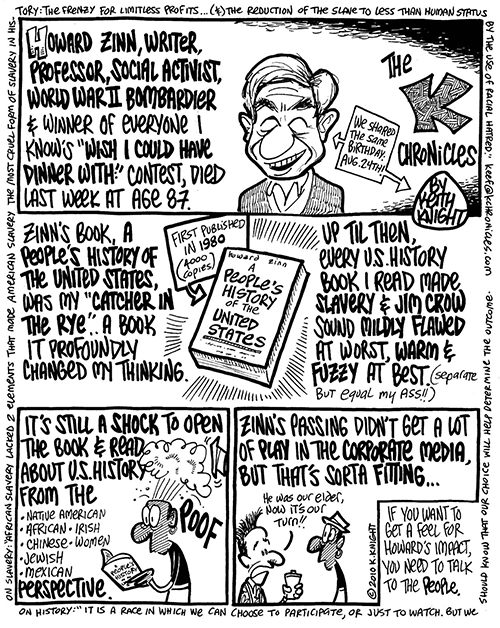
A People's History of the United States


When you play “arguing with anti-leftist”* Bingo, you should always have a square that anticipates their view that, because you were educated in public schools, you are brainwashed by the liberal/Cultural Marxist agenda.

It’s hard not to kind of see their point. Teachers are generally left-leaning (although I’m fairly certain my 8th grade history teacher was alt-right after I recall entire lesson plans where he justified the treatment of Native Americans because they were so “savage” to settlers), academia is generally left-leaning and they write the textbooks, and tolerance - something they try to teach you  in school - is almost a left-leaning concept by default (another square in the bingo game could be the phrase “and I thought liberals were the tolerant ones”).

At any rate, you always tend to think you’re not brainwashed. You were taught a pretty accurate history in high school and college. I’ll admit that I thought this. Then I read Howard Zinn’s A People’s History of the United States.

It almost seems incredibly cliche’ to say that a book has transformed your worldview as an adult, especially an adult that believes himself in the welterweight category of heavy readers, but there is no other way to describe reading A People’s History.

Zinn takes his reader from the beginning of this nation to 2001, just after 9/11. What makes the historical perspective he documents interesting can be summed up well in this quote from the book:

“All those histories of this country centered on the Founding Fathers and the Presidents weigh oppressively on the capacity of the ordinary citizens to act. They suggest that in times of crisis we must look to someone to save us: in the Revolutionary crisis, the Founding Fathers; in the slavery crisis, Lincoln; in the Depression, Roosevelt; in Vietnam, Carter. And that between occasional crises everything is alright, and it is sufficient for us to be restored to that normal state. They teach us that the supreme act of citizenship is to choose moong saviors, by going into a voting booth every four years to choose between two white and well-off Anglo-Saxon males of inoffensive personality and orthodox opinions”

Zinn introduces you to a whole range of historical figures who were ordinary American citizens that organized movements. Zinn zeros in on the aspects of history left out of public school lesson plans, namely that every ounce of progress America made towards a thriving democracy was driven by people whose only power was a collective one.

It seems repetitive and boring and obvious to talk about the ramifications of this book today. And it would be if all you talked about was how America used to be really oppressive and we seem dangerously close to getting back to some of those points. But if you take the key lesson of this book it is possibly one of the more important things you could possibly read in Trump’s America.

Why? Because this history squares everyday citizens as the chief catalysts for change. It does not demonstrate a resistance parade of late night TV shows and personalities, the liberal celebrity brigade, or a diverse corporate boardroom. Your favorite people in power are not giving any more of it to you no matter how much they hate the other people in power. This includes politicians, even good ones, so stop fetishizing your vote and get involved in a campaign to end gerrymandering or something!

If you’re feeling helpless and burned out in the face of Trump and corporate Democrats and the limits of electoral politics I couldn’t recommend a more empowering book.

__________________

*An anti-leftist is a term I am trying to popularize. It’s basically someone who holds almost incoherent and highly contradictory conservative views simply to ‘trigger the libs’. Things like hating big government but loving Trump and the wall, hating crony capitalism but advocating charter schools, supporting the troops but being prepared to shoot them should they come for our guns, distrusting Muslims but valuing Trump’s deals with Saudi Arabia, loving what Trump or Reagan or Bush did/does but hating those exact same things when Clinton, Carter, or Obama did them.


Friday, March 16, 2018

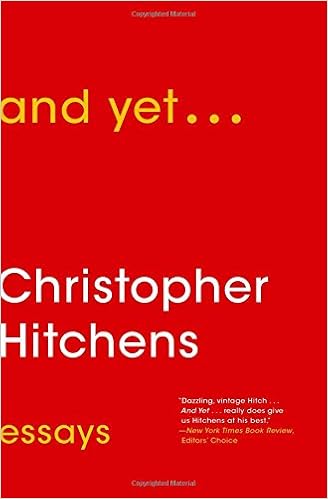
And Yet.... by Christopher Hitchens


I picked up a collection of essays titled “and yet” to see if the compiled writings of Christopher Hitchens went deeper than my previous experiences with his work.

As of this moment, 4:45 pm on Saturday, March 11th, I am completely comfortable with coming to the following conclusion: I don’t care for Christopher Hitchens, may he Rest In Peace.

“And Yet…”

Having no experience with Hitchens outside of his essay eviscerating Mother Teresa and near ubiquitous YouTube presence, I felt it was time to actually sit down and read a body of his work. My experience with Hitchens seemed to be more in an attempt to like him when the truth was I felt his world renown, biting wit was lacking.

Hitchens always had a good grasp of his debate opponent’s argument, he could quote hypocritical verses from various religious texts from memory and could cite all of the major events and characters in historic/current events. All of which is remarkably impressive but not necessarily grounds for fandom. After all, a full grasp and understanding of a subject will certainly help you make a well-rounded argument, but should not be taken for one.

I’ve always felt the Hitchens' snark and depth of knowledge was aimed more at domination than a fostering of understanding. It was almost Socratic. Crushing his opponents in debates or making a fool of network news hosts, Hitchens often won an audience to his side by proving the fallibility of the person opposite him.

Even in the few pieces, I’ve read, the topic he chooses is given a thorough lashing but by the end of it, I don’t feel like I’ve been brought anywhere. It isn’t that Mother Teresa is somehow undeserving of getting the Hitch treatment (no one calls it that FYI) and it is an important alternative analysis of popular history, but from my understanding that isn’t really why people read it. At the end of the day, Hitchens assumes the reader will concede to his muddied point on the grounds that he’s made someone look thoroughly stupid.

So I picked up a book of his at Barnes&Noble. Just grabbed it off the shelf and bought it. This was a mistake. “And Yet…” is a series of essays published posthumously and chosen by virtue of not being selected for Hitchens' first (massive) compilation of Essays titled “Arguably”. This makes them second-rate essays by default.

It’s obvious why. A good selection of these essays is book reviews. A.N. Wilson, Salman Rushdie, Mikhail Lermontov, Ian Fleming to name a few of the authors visited. Maybe Hitchens writes in-depth deep dives into books, but it seems that these are plot summaries followed by a hasty endorsement (and yes, I realize I’m no expert, but I always don’t have fans...or readers).

The rest of the essays in “And Yet..” can be safely categorized as frivolous musings. Some of these observations are interesting, Ohio’s election numbers looking spotty in “Ohio’s Odd Numbers” or Hillary Clinton’s long history of PR follies in “The Case Against Hillary Clinton”. Others seem downright useless, like Obama’s likeness to a feline in (ready for it?) “Barack Obama, One Cool Cat” or how middle America has a diverse level of difficult to understand idiosyncrasies in “My Red-State Odyssey”.

Ultimately though, most of the pieces in “And Yet…” are well-written thoughts that the reader is expected to enjoy because Christopher Hitchens wrote them in his Christopher Hitchens voice.

It’s important to remember that Hitchens made his living as a writer, by definition there have to be pieces he wrote because he needed to collect a paycheck. It seems, with a few notable exceptions, that “And Yet…” is entirely composed of these types of tidbit essays.

So it seems I need to give Hitchens another chance, but having only experienced his body of work in what is essentially a last ditch effort to profit off his peripheral thoughts, I can say I’m not yet sold on the “greatest polemic of our time”


Wednesday, November 22, 2017

The Case for Socialism by Alan Maass


Local elections on Nov 8th, 2017 yielded 15 candidates endorsed by or direct members of the Democratic Socialists of America (DSA). Many of these candidates unseated Republicans in territory rarely ceded to Democrats. Organizations like the DSA and PSL have seen a staggering rise in involvement. If you find yourself increasingly curious about socialism, Marxism, Communism, etc you are evidently not alone. That makes it a good time to read up on the subject. I’ve been reading a number of soft introductions to Democratic Socialism since Bernie Sanders’ primary campaign really put it on my radar. The Case for Socialism by Alan Maass is probably the least of which I would recommend.


Bernie Sanders may have endeared me - as well as a large swath of young people - to Democratic Socialism and he might identify as a Democratic Socialist (along with people like Howard Zinn, Hellen Keller, and Martin Luther King Jr.), but he isn’t necessarily so. As Noam Chomsky said, “Bernie Sanders is a good man, and I supported him, but his views were closer to a new deal democrat; they would be very familiar to someone like, say, Eisenhower”. This is exactly why colloquial, accessible, and introductory texts are needed. Otherwise, we have a bunch of millennials out there thinking FDR was a Marxist.


This isn’t to say Alan Maass doesn’t address misconceptions about Socialism (the idea that Denmark or Finland or China represent shining examples when none of these states are run by the people/laborers was a particularly well-written section). It’s just that a lot has been written on this subject and if you want to bring people into the fold of your ideology there are a number of things you need to do that Maass doesn’t.


The most important thing is coherence. When someone comes looking for a text to introduce them to a subject they want to be immediately enthralled by a compelling and straightforward argument. I should know, as someone who has gone to a number of texts portending to introduce socialism to the masses I am often astounded by the lack of organization in some of these pieces. Maass suffers from overtly passionate and tangential political writing; the rate at which he switches topics from the Russian Revolution, to Obama, to the nature of war, to the ‘08 recession can be measured in sentences. He ends up talking a little bit about a lot of things while lacking in substantial discussion of any one subject.


The Case for Socialism bills itself as, well, as a “case”. For doing so, it doesn’t imagine a world in which socialism has fully replaced capitalism. I don’t understand this. Anyone is capable of criticizing the state of the world while drawing express connections to capitalism as the primary reason. Liberals and Social Democrats do this extensively, it is, in fact, part of the very fabric of their political philosophy. Socialists are not seeking to mitigate the effects of capitalism, they are trying to replace it. For newcomers, it is difficult to imagine what socialism would look like (Scandinavia? Cuba?). Maass is particularly remiss in his scant covering of the role democracy will play in socialism. While his critiques of capitalism and its effects are biting they largely overshadow his solutions. His explanations on labor’s ability to get us to a socialist utopia are sporadic and focus on how terrible our current system is. The question of practicality plaguing socialism as it does, it is a shame Maass doesn’t take more time to address it.


Finally, an introductory text should not try to stand on its own, it should...well...introduce you to other works! The Haymarket Books edition puts an addendum to the book titled “What Else to Read” (which is a testament to Haymarket Books, not Maass). In it, Maass freely admits that the book is devoid of sources and that he isn’t remotely interested in citing them. While this end section has some more to read on certain subjects, in-text citations help the reader build a crucial relationship with other texts in the context of your arguments. Not only that, but if your reader doubts your numbers, statistics, or historical accounts for a second you could potentially drive them to sources explicitly seeking to discredit your ideas!

Ultimately, Maass does craft some good arguments. He has very convincing sections on what Socialism is or isn’t and some fairly imaginative sections on what Socialism could look like. I wouldn’t recommend this book to someone curious about Socialism, but who hasn’t quite bought into the idea. I’d rather push the ABC’s of Socialism put out by Jacobin Magazine or Danny Katch’s Socialism Seriously. If you’re sold on Socialism and you're already trying to satiate your endless hunger for better arguments, you should consume the whole of The Case for Socialism if only for the few morsels to be found there.


Sunday, October 15, 2017

The Fire Next Time by James Baldwin


On the hundredth anniversary of the Emancipation Proclamation James Baldwin sits down to write two letters; one is to his nephew and the other to no one in particular. These two searing essays are combined into one brief collection titled the Fire Next Time. In it, Baldwin ruminates on the nature of freedom and the imperative task of confronting white supremacy, suggesting there can be no true former without the latter.

“My Dungeon Shook”, Baldwin’s letter to his nephew, could read as a shorthand form of Ta-Nehisi Coates’ Between the World and Me. Aside from the brevity, the major difference is Baldwin sees white supremacy something to combat with constant struggle, Coates sees it as immutable. While there is certainly plenty of foreboding language, Baldwin ultimately entreats his nephew to “make America what America must become” (which is a great counter phrase to MAGA). And what America must become is free; no longer dependent on oppression. His tone is hopeful and his candid yet elegant conversation with his nephew is nothing short of heartwarming.

“Down at the Cross” reads like Marx’s brief critiques of religion, except where Marx sees religion and nationalism as a way to cope with the atrocities of capitalism, Baldwin sees them as a way of coping with white supremacy. The piece has two focal points; Baldwin’s own religious upbringing and his brief run-in with the Nation of Islam. Early in his life, Baldwin would come to choose between falling in with the church or with the streets, since these were the only choices America gave him. Baldwin loved the church, but ultimately its insistence on living for the afterlife and perseverance was too passive an approach and did not deal with reality. Baldwin was also unable to rationalize the existence of a higher being in the face of such stark inequality. The Nation of Islam seemingly juxtaposes the church with its fiery rhetoric and call to action (the segregation of an all-black society), but Baldwin effortlessly argues that civilization itself cannot accommodate even the most utopian of segregated societies because the toxicity of white supremacy demands the destruction or subjugation of the inferior. As the title implies, America cannot continue to survive while white supremacy still courses through its most sacred institutions and there is no true freedom until the decadence of America is no longer built on the backs of others. If we (Baldwin demands action from both whites and blacks, men and women) continue to fall into organizations that do nothing but distract from the painful realities of white supremacy or if we continue to do nothing but live our daily lives, then America will forever be a place that depends on suffering.

I recently read a Facebook exchange between two high school classmates. Evidently, someone they went to school with is currently an active member in an unabashed white supremacist group. This individual is a fourth-grade teacher. One classmate was of the opinion that this person needed to be outed, preferably fired, but certainly exposed for their beliefs. The other classmate felt this was bullying, that it would only drive the individual further into their hateful views and that we shouldn’t take action until we know their views are causing real harm. It is important to note that many Americans likely agree with what they imagine is the level-headed response of the classmate advocating the cautious approach to the white supremacist teacher. It is also important to note that these Americans are trying, perhaps (and even most likely) unknowingly, to preserve a country built on racism. To them, a rational society must tolerate viewpoints, even intolerance itself. The Fire Next Time serves as a warning should we decide not to confront this very thinking. If we ever want the abolition of racism, we can never allow it a moment's comfort.


Tuesday, August 29, 2017

Killers of the Flower Moon by David Grann


“We have a few old mouth-to-mouth tales, we exhume from old trunks and boxes and drawers letters without salutation or signature, in which men and women who once lived and breathed are now merely initials or nicknames out of some now incomprehensible affection which sound to us like Sanskrit or Chocktaw; we see dimly people, the people in whose living blood and seed we ourselves lay dormant and waiting, in this shadowy attenuation of time possessing now heroic proportions, performing their acts of simple passion and simple violence, impervious to time and inexplicable” – William Faulkner

The atrocities committed by the United States against its indigenous people is not an unfamiliar story. Only the scariest of blind patriots would deny that this nation has done wrong by the native populations and are likely denying something in themselves by doing so. Given the depravity of the systematic removal, war, and genocide carried out, reading about the Reign of Terror – committed against the Osage tribe in the early nineteen hundreds – shouldn’t be more affecting than any other historical account. From this context leaps Killers of the Flower Moon by David Grann.
In his meticulous and riveting retelling of the Osage County Murders, Grann is both poetic and informative. His descriptions of the Osage County countryside show a true knack for writing that can be sorely missed in historical recounts and his carefully crafted research manifests itself in into a landscape of storytelling, each piece is woven into the larger picture, as opposed to a bullet for bullet recitation of sources. Grann is cautious in telling the Osage story to avoid portrayal of a mere documentation of butchery, what sets this story apart is that it is deeply personal. This makes Killers of the Flower Moon a uniquely unsettling book.  

The Osage tribe was essentially forced from their land by western expansion, moving to a virtual wasteland. When oil is discovered on the infertile lands, the approaching industrial revolution turns the reservation into a boomtown. The Osage Indian Tribe becomes impeccably wealthy with every oil operation having to pay handsome dividends to members of the tribe. Had this land been owned by white people, we’d know their family name today like we know the Bush family name or other old money oil families. In the case of the Osage, they were met with a murderous plot, the size and scope of which is truly astounding. Stretching across every branch of government, industry fat cats, law enforcement, medical professionals, pastors, and renown criminals it seems every sect of America could be indicted as a key player in the plot to terrorize, murder, and rob the Osage Tribe out of its headright.


Eventually, the FBI is born and takes the Osage as its first case. These sections show Grann at his worst. The Bureau seems too lionized (Hoover’s own human rights violations are relegated to a single sentence, referring to them as “scandals”) and the agents on the case archetypically cartoonish. When you learn the murders themselves were carried out by people who spent nearly their entire lives getting close to the Osage, treating them like humans in a nation that thought them uncivilized dogs, your stomach will literally turn. Which is far from a spoiler, the real suspense doesn’t come from the mystery of who might be killing the Osage tribe, but how a human being can be capable of doing so. Grann documents, even further than the newborn FBI did at the time of the case, the vast conspiracy to systematically destroy a group of people for simply living on land they were forced to own through oppressive western expansion. It should be taught in every school.


Wednesday, July 19, 2017

The Political Economy of Racism by Melvin Leiman

“The scholar who accepts no harsh judgment because it does not do justice to the entire complex truth can really accept no judgments about society because all are simplifications of the complex. The result is scholarly detachment from the profound ethical conflicts of society and from that human concern without which scholarship becomes a pretentious game” - Howard Zinn


Having taken me a thoroughly long time to read, I finished The Political Economy of Racism the same day I went to the Macomb Juvenile Justice Detention Center to workshop some poetry with the students attending the facility’s subcontracted school. These were young men whom the system had failed at every level of their lives, regardless of the scope of their “crimes”. Some of these students were going to go straight to prison to serve 20 years, 30 years, or life and they were 14 -16 years old. There is not a society on earth that can deem itself a success while condemning children to lifetimes in prison. What can a book as dense and academic (not to mention a terrible “summer read”) as Melvin Leiman’s offer in the face of utter societal failure?

A lot.

Leiman’s is a challenging read, making this a hard book to recommend, but what he has to offer is critical. He works out two distinct lines of discourse; 1) a hard look at the economy of discrimination ranging from slavery to redlining (the book was written in the 70s so mass incarceration was really only starting to ramp up) and 2) an absolutely savage Marxist takedown of any school of thought that avoids branding capitalism as public enemy number one.

In his first line, Leiman makes it very clear his interest does not lie with the petty racism of individuals. While he feels any degree of racism is grotesque, it is obvious he places the emphasis on systems designed to hold African Americans down for any number of reasons. Slavery was, after all, an institution of value that was justified by evoking the perceived inferiority of black people. The argument is that racism maintains the underclass necessary for capitalism. It is a smart line to take, some Marxists receive criticism because they feel that racism would disappear if capitalism was toppled. Leiman makes no such guarantee, but he is very adamant that racism can never be abolished under capitalism as it is far too necessary; we need to justify exploitation by labeling those at the bottom as deserving of their place in society, the best way to do this is fostering the idea of race based inferiority. While this underlying premise seems obvious, Leiman’s scope is complicated (and arduous). He covers monopolistic economies where companies rely on disadvantaged communities - ones that may be ravaged by over policing and redlining - for cheap labor (think of Wal-Mart or McDonald's) and competitive economies where discrimination and racism help keep wages low across the labor market. And that’s just the tip of the iceberg. Every dissection is thorough and complete with hard numbers and analysis. Have I mentioned this book was dense?

The second half of the book examines radical critiques of racism, Orthodox critiques of racism, and hybrid positions such as Black Nationalism or Black Capitalism. To many, taking on the conservative school of thought is the easiest to swallow. Libertarian and conservative ideologies often pay lip service to a certainly palatable repulsion to discrimination and racism, but will not endorse government intervention to prevent it. The idea is that discrimination does not benefit the participants of a market system in the form of profits, stock prices, and/or publicity, in fact, it may harm them. Even where that is true, libertarians and conservatives fail to address the larger political economy that benefits more generally from the existence of an underclass perpetuated by systemic discrimination and racism. These were among some of the most buoyant and fun sections to read, Leiman’s take on liberalism and class-centric leftism are more complicated but no less crucial. The orthodox liberal ideology - say, of your Clinton variety - warrants criticism because it is a full endorsement of a class based system with a welfare state to mitigate the condition of the lowest classes. It attracts well-meaning people who don’t believe suffering should be so prolific but doesn’t truly offer them an answer for eliminating its necessity for America to maintain its decadence. Every examination of critical theory on racism that Leiman explores is vital for understanding the limitations of our system as a whole.

It is important to understand the persistence of racism in America, why the students I taught poetry in Juvenile Detention live in an entirely different world than the students I teach in the suburbs. This divide is entirely manufactured. Leiman’s solution to toppling capitalism is black and white labor unity, something he feels racism is also employed to stop. There isn’t a single element of racism that Leiman cannot prove the absolute utility of in his book. It’s worth stating again; the decline or abolition of capitalism will not guarantee the the decline or abolition of racism, but there will be no such thing under capitalism. Reading The Political Economy of Racism can help elevate the conversation against racism to much needed heights.