Tuesday, October 4, 2016

ReWriting the Rules of the American Economy by Joseph Stiglitz


When the 2008 financial crisis struck, Noam Chomsky, influential leftist intellectual extraordinaire (and arguably a dying breed), recommend the United States government enlist Joseph Stiglitz to help drive the recovery as, at the very least, an ideological consultant. Even though the government uncharacteristically ignored the recommendation, the American public should most certainly not. Especially the American left. We should be paying very close attention to what Stiglitz is saying, what he’s doing, and probably what he’ll eventually be screaming.

ReWriting the Rules of the American Economy is by no means the best thing I’ve read by Stiglitz. It lacks the depth found in The Price of Inequality and doesn’t have the bite of any of his Great Divide essays, but it does something far more important than deep exploration or evisceration, something crucial; it better frames the debate.

Essentially, ReWriting the Rules could be seen as a smarter, more concise, but less accessible version of Robert Reich’s Saving Capitalism. Like Reich, it is easy to picture Stiglitz getting exhausted in the endless debate over the free market vs the size of government and, also like Reich, thinking it doesn’t matter. The idea is we need to rewrite the rules so the government works for all Americans, not just some. Once you see the debate this way it is difficult to see it any other way.

Which is good! Stiglitz offers up some great ideas here and it is particularly important for the left now because he’s puts to rest some debates you can currently see raging between the left and the far left, mostly in the wake of Sanders V Clinton. Trade deals for instance; Stiglitz doesn’t like the TPP because it undercuts labor and the idea of transparency in trade. At the same time, he wants America to engage in trade because you can’t have the sort of wealth distribution policies he wants if America’s wealth accumulation is stymied by aggressive protectionism. His compromise? Get a regulatory body (the FTC?), or make one, to regulate business participation in trade deals; making sure they are following a series of rules on the environment, human rights, and labor rights - both at home and abroad - in order to take advantage of free and protected capital flow between nations. Who on the left would not agree with this? Exactly.

The only very real and very frustrating part of this book is the layout. Broken into two parts (three if you count the introduction) titled “The Current Rules” and “ReWriting the Rules”, Stiglitz fractures his problems and proposed solutions in a such a way that makes ReWriting the Rules a less coherent and engaging read.

Nevertheless, there is a lot of potential in ReWriting the Rules of the American Economy to be an ideological unifier of the left, as though Stiglitz is offering his consultancy and all we need to do is pick up his book and start taking his advice.


Monday, September 19, 2016

Free Will by Sam Harris


The Oxford English Dictionary of Philosophy seems to allude to the fact that the world of philosophy, for the most part, doesn’t really believe in free will. The school of thought that chocks free will up to an illusion is Determinism and apparently it is seen as a given. The only two schools that are  allegedly held to challenge determinism are compatibilism and libertarianism (not to be confused with the political party, thinking, etc). Not only are these two schools relatively unpopular, they don’t even appear to believe in free will; they seem more concerned with the implications of responsibility. This, at best, maintains that free will is a useful illusion, but an illusion all the same.

It is the general, I-don’t-give-a-rip-about-academic-philosophy-public that perpetuates the specious illusion of free will. It is Sam Harris’ job in his essay, aptly titled Free Will, to dispel the beloved illusion. By my incredibly ammature standard he can only do this by making an argument people can follow, allaying any fears about the implications of dropping the illusion, and by writing a book people will generally want to read.

Harris’ compelling argument consists of applying a very simple question to all things we perceive as free will; “where is the freedom in that?”. Basically if we can’t account for our desires, urges, fears, and reactions, we cannot attribute what follows from them as free will. It can be a hard leap to make; I want to believe that I chose to read this book, but I can’t differentiate between what prompted me to and what would have prompted me not to. So where was I free to make a choice? Breaking it down to the simple application of a question makes the argument relevant and useful when considering what you’re subjected to in day to day life. This allows you to maintain control despite not really being ‘in control’. As Harris puts it; “you do not control the storm, you are not lost in the storm, you are the storm”.

Many people might posit that without, at the very least, the illusion of free will we might become listless or immoral. Here Harris’ job gets easier. Free will is an illusion without which we can become more aware of what we are, products of the physical world - our surroundings, our physiology, our biology, our instincts etc etc (there are infinite possibilities which I don’t doubt is why the illusion of choice laid out before us persists). By manipulating the physical world or having it manipulated for us we can still lead fulfilling lives full of awareness, understanding, and action*.

For example, let’s say you have a problem with eating too many Zebra Cakes at one time. If you imagine this is your choice and simply a matter of resisting the wrong choice (eating Zebra Cakes) and making the right choice (not) then there is no doubt you will still have a problem with Zebra Cakes. This is because you cannot control your desire for Zebra Cakes, you cannot control the chemical effect they have on you, and you cannot control your desire to want one after the other (among, again, an infinite number of possibilities beyond your control that determine your actions). There are some days that you don’t eat too many Zebra Cakes and seemingly resist the need to eat many at one time. It is here the illusion gets dangerous; you are falsely attributing any number of things beyond your control to will power. It isn’t as though you made your urge go away, it just didn’t trump, say, your fear that your wife would leave you if you didn’t kick this Zebra Cake habit, or the way your lunch digested, or an infinite of number of possibilities that simply reduced your desire or trumped it.

Ultimately it doesn’t matter, if you keep subjecting yourself to that what you desire, you’re going to give in. Every. Time.

Let’s strip the illusion away. You know beyond a doubt, despite an unexplainable good day every so often, that you are going to gorge the shit out of Zebra Cakes if they are at home whether or not you like it. You cannot make your desire for Zebra Cakes simply go away, so after reading Sam Harris’ book Free Will you realize you have to make the Zebra Cakes go away. This requires both awareness - where is your urge for the ZCs the strongest? When does it seem to diminish? What are you doing when hunger strikes? -  and action; you realize you have no craving for Zebra Cakes at the store so you don’t buy them OR you do have a craving for Zebra Cakes at the store so you go to a store that doesn’t have them or you go to the store with someone who can stop you from buying them. This level of awareness and action, likely not present when you believe you can willfully make the right choice, seems to be exactly what people are afraid will disappear should the illusion of free will shatter.

(*Two side notes here: None of that was Harris’ example, he does a far better and more concise job of declawing the implications of abolishing the illusion of free will. By action I don’t mean you have free will, you’re spurred to action by your lack of belief in free will - or at least your capacity to stop eating Zebra Cakes - and/or fear and/or frustration and/or dumb luck. If you follow your action to where it came from there is no way it was free will, but hey, it’s better than just laboring under the idea things beyond your control are just going to magically disappear one day!)

Honestly the hardest thing Harris will have to contend with in his argument is writing a book people will want to read and be receptive to. Scratch that, there is really nothing he can do to make people respective to this idea, people love free will. What he can do is what he did;  Harris kept the book simple, kept it very short, and he left out (apart from an absolutely chilling intro to the essay) any controversial examples. The only problem is that Harris is a controversial figure. Conservatives tend to hate him because he is an atheist or because he doesn’t believe all people on food stamps are snakes, but liberals tend to hate him because he isn’t a cultural relativist and probably comes off as islamophobic when he uses data to point out that a lot of modern Muslims think it’s still OK to throw gay people off of roofs.

Well...he tried anyway. If nothing else, and there is a lot else, Free Will is a fun read and gets you thinking. Even if you can’t follow Harris’ logic or think he sounds like a douche at times, it is still immensely important to think about free will and what we subject our subconscious to, being that it often affects our conscious actions. It is impossible to read this and think it is devoid of any truth, plus it --

You know what? Forget it. You’ll either have the urge to read Free Will or you won’t, but it isn't like you really have choice in the matter...


Wednesday, September 14, 2016

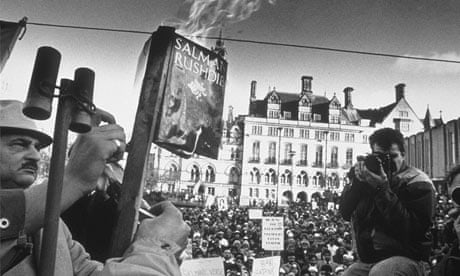
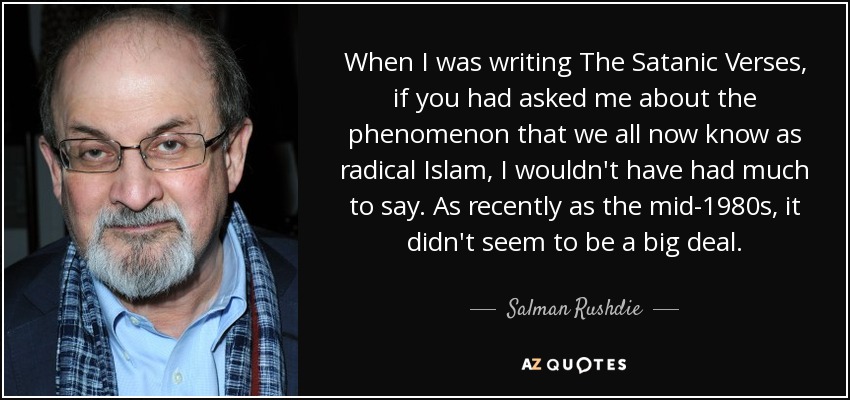
The Satanic Verses by Salman Rushdie


In college I wrote my capstone course’s final paper on Angela Carter’s Night at the Circus because I was enthralled by the idea of Magical Realism. The class was a Contemporary British Lit course and my professor, a true diamond in the small Midwestern college rough, assigned a lot of contemporary magical realism. As good as the class was I noticed that Rushdie was nowhere in sight. When I finally did pick up Rushdie’s the Satanic Verses it was for two distinct reasons and I was disappointed on both fronts. The first was because I hadn’t read much (if any) magical realism since taking said college course four years ago and the second was because the book’s reputation for controversy makes it seem like a relevant read in light of current events.

The Satanic Verses seems to be a series of dreams, or reincarnations, mythic retelling psych, or visions, or any/all of the above. I am not informed enough a reader to catch what is allusion, what is allegory, what is satire, and what are just purely imaginative riffs on reality. I know enough to discern that all of this is present, entertaining, and thought provoking but I also know that I’m missing something crucial. The allure of magical realism is that it pulls the energy and vibrant connotations behind mythology or theology and amalgamates them with modern themes grounded in realism, things like race or socioeconomics. The problem is I know next to nothing about Islam and did not read actively enough - which is to say I wasn’t googling for relevance every time I had an inclining to - in order to catch the connotations or implications that come from evoking its culture and traditions. This both is and is not Rushdie’s fault. Obviously I could have learned more about the topic at hand, the issue is that I was not inspired to. I think this is partly because Rushdie also belongs in the Hysterical Realism category. Those in this category - coined by James Woods who included DF Wallace, Zadie Smith, Rudie, and a few of their contemporaries - I’ve found are guilty of, at times, introducing armies of characters that stand to serve on the author’s whim. Maybe there is a particular societal indictment they wish to make on, say, police brutality. In the case of Rushdie, he created a character, complete with a cartoonish backstory, that perfectly illustrated talking points on the subject. The resulting character was too ridiculous to be real and too convenient to really be all that magical. The end result was that I was bored of these characters and didn’t care enough about them to inspire a more active read.

 This translates directly into the second reason for my disappointment. It’s no secret that Rushdie received death threats emanating from the Ayatollah in Iran for this particular novel. In my experience it seems that some critical readers in the western world approach this book looking for an obvious and scathing criticism of Islam, or at least the beginnings of an argument. I, for one, am guilty of this. But Rushdie is a talented fiction writer, he exists in the world of representation and language as a craft, not telling one what to think. If it seems like a specious reason to be disappointed in a work of fiction that’s because it is. At the same time, Rushdie did receive death threats and had to go into hiding. While the Satanic Verses is irreverent, often lampooning the religion and the very idea that we can so conveniently make ancient ideas compatible with modern society, it is hardly groundbreaking as far as ideology is concerned. So what Rushdie was really threatened over was ability to write fiction, an ability you’d have to appreciate in order to find merit in the reputation preceding the death threat. This would have been the case had Rushdie’s merging of form and content really resonated with me, which it regrettably didn’t.

Of course, all of this is a huge injustice to Salman Rushdie and the Satanic Verses. Rushdie is a tremendously gifted fiction writer; his lyrical style can dance effortlessly from humor to tragedy and craft some of the most beautiful and fantastical passages I’ve ever read. All of which says nothing of his and his book’s obvious influence in some of my favorite authors, from Zadie Smith to Junot Diaz. The problem was the Satanic Verses did not scratch a particular itch. I think that if I had read Rushdie in the classroom with any number of resources at my disposal I would have written my college capstone course’s final paper on it instead of…well...this.

Tuesday, August 9, 2016

Notes of a Native Son by James Baldwin


“People are trapped in History and History is trapped in them”

Baldwin’s series of essays in Notes of a Native Son are both bold and beautiful. Beautiful, obviously, because they are written beautifully, but true impression comes from being bold. Baldwin writes these essays in 1955, a time not so different than now in that it assumes a certain amount of progress has been made, that the horrors of history have been erased by American ideals and heroism. In Notes of a Native Son Baldwin explores the limitation of progress and its harbingers, taking on whatever one assumes as progress and, without wholly defacing it, demonstrates its uselessness in the face of white supremacy as a system. This book is brilliantly split into three different themed sections.

Part One of Notes features Baldwin as a fierce critic of the new, seemingly progressive ways in which the African-American story is told. He contends that “it is only in his music that the negro in America has been able to tell his story” and from there he proceeds to tear apart 3 works of art: Uncle Tom’s Cabin, Native Son, and Carmen Jones - the film reimagining of the opera Carmen but with a predominantly black cast. One gets the sense that Baldwin’s criticism of these 3 works spans further than the face; like he is criticizing the mode of telling and the larger trend in literature or film that the work represents. He makes the point on Uncle Tom’s Cabin I’ve been dying to hear; the sentimentality of the protest novel gives it an inability to fully grasp the horror of what it is protesting and therefore falls short of making a meaningful change in anything but people’s emotions. His love/hate relationship with Native Son takes on landmark portrayals of the kinds of conditions intense and manufactured poverty can cause by attacking their attempt at saving the main character with a transcendence of race (something Baldwin vehemently believes is not possible). In Carmen Jones, Baldwin breaks down how useless and doomed for failure the reimagining of old stories with Black Casts can be; African American Stories are unique and can’t be grafted onto old European operas. Each piece serves as a reminder to the world of art, representation, and storytelling that within a world designed by white supremacy a more radical form of expression is needed to break the mold and affect real change.

In part two, Baldwin focuses more on institutions of supposed progress through a more personal lens, something he does more as the essays progress. The Harlem Ghetto discusses how civil rights leaders, well meaning politicians, black owned press/media, and solidarity with Harlem Jews have all proved inadequate in raising the condition of those who live in the city. There is a deeper and historic oppression that runs deep in the Harlem Ghetto. Here, Baldwin seems uncharacteristically vague, but he seems to suggest that the people of Harlem need power over their own lives, which requires people who have it (white people) to cede it and, until they do, progressive institutions will never be able to accomplish discovering a true way forward. In Journey to Atlanta Baldwin illustrates the conditional progressivity of the progressive party with a story about his brother who was invited to sing for them at a campaign rally down south. The way in which brother and colleagues were treated shows the clear unwillingness or inability of the most progressive whites to really put their luxuries and privileges aside  in such a way that will truly help African Americans exercise power in their lives. Baldwin’s title essay, Notes of a Native Son, is a revelatory piece about his relation to his father and is about how white supremacy compounds generationally, all set to a Harlem riot the day of his father’s funeral. In a vulnerable moment this essay expresses the feeling of helplessness in the face of a society built on the idea that an entire people must always remain inferior to deliver its comforts. While this isn’t an institution per se,  it is evidence of what happens when progress is pretended but not made.

With the exception of his final essay, A Stranger in the Village, the third and final section blurs together. The first 3 pieces are all about Paris, the perception of it as a shining beacon of progress and the reality that it is just different than American in ways that are remarkably and almost imperceptibly worse. Both Encounter on the Seine and a Question of Identity share the idea that thinking Paris is progressive, America is regressive, or even vice versa, is operating under the same false pretense that either place was not built on white supremacy. Baldwin acknowledges that Paris may seem to take a different approach than America, but insists that it is just a difference in language. To really sell this slightly stretched point we’re given his 3rd essay Equal in Paris. In it, Baldiwn recounts his arrest by French authorities for being the recipient of a stolen bed sheet (Bed. Sheet.). While the situation did not come with the language of racism that it might in the states, it certainly came with the bureaucracy of racism that is prevalent in the Western World. He carries this theme into his final essay, in my opinion the most powerful, A Stranger in the Village. Baldwin provides his reader with assured proof of the ubiquity of white supremacy by providing a fairly extensive account of his time in a Swiss village that has never seen a black person before. He emphasises the difference in bewilderment at seeing a different race for the first time; that when black people saw white people for the first time it was as a subject sees a conqueror and when white people saw black people for the first time it was as a conqueror surveying subjects, now it is a the conqueror is seeing the conquered for the first time. Pointing out that white people are related to those that built society as we know it in at least one major way that he is not, that this is ingrained in any human in society, and that race cannot be truly transcended. So in the end, even the progress one would expect from a blank slate is a farce.
 
Reading Baldwin’s portrayals of the Harlem riots and thinking of modern Ferguson or Baltimore, reading Baldwin’s insistence that the black narrative must be radically unique and thinking of the modern almost all white Oscars, reading about Baldwin in Europe and thinking about the Brexit and the growing LePenn-esq movement I have to wonder; was Baldwin right? Surely all of these things are just affirmation of the themes he presents here, that we haven’t come much further is just proof of the limitations he so eloquently explores. Or it is as Baldwin suggests; “Even when the worst has been said, it must also be added that the perpetual challenge posed by this problem was always, somehow, perpetually met. It is precisely this black white experience which may prove of indispensable value to us in the world we face today. This world world is white no longer, and it will never be white again”.

Monday, August 1, 2016

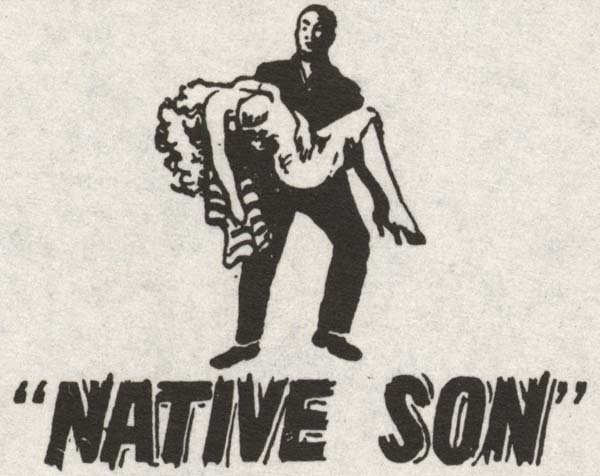
Native Son - Richard Wright


Perhaps the essence of white guilt can be summed up by one’s reaction to this novel or one's inability to fully grasp what it means. Published in 1940 (!), Native Son is practically a catalogue of the many forms racism can take; outright bigotry, systematic discrimination, redlining, racist representation in the media, even left wing paternalism and patronizing sentimentality. Compound this list onto a race of people for long enough and you, apparently invariably, get Bigger Thomas, the novel’s...uh….protagonist? See, it’s hard because Bigger is violent, unpredictable, bitter, and angry at the conditions he is forced to live under. Of course living under such conditions grants him no opportunity to articulate these feelings so instead he expresses himself in some, quite frankly, egregious acts. He kills, he rapes, he shoots at police, he defaces property a la masturbation (don’t worry this spoils nothing; the power is in the telling not the plot points) all to rage against the very oppressive, white manufactured world he has been confined to.
   
All of this makes me - modern white dude reader - wholly uncomfortable. Bigger is a hard character to grasp because I’m not sure of the implications inherent in giving him the benefit of the doubt. I have no doubt, say, that concentrated poverty formed on racial lines to specifically exclude blacks from our nation’s prosperity, and to profit from it as a nation, could (emphasis on could, denoting the mere possibility) cause those same people to resort to crime in order to survive. But breaking the law and succumbing to evil are very different. Do I really believe that compounded racism can create monsters like Bigger? If I feel his poor conditions are, while not a justification, an explanation of his actions...am I just as patronizing as the almost comically patronizing and assumptive leftist characters? Am I to blame whether I like it or not? Those seem like two different lines of questioning because they are. I’m not sure I’m willing to allow gruesome, uncalled for murder, molestation, rape, and sadistic uncaring corpse disposal be grounded in sympathy for the perpetrator’s circumstances - no matter how perpetuated by racism they were. But on the other hand,is this lack of sympathy also to blame?

Taking a page out of Dostoyevsky’s the Brothers Karamosov (or I guess any Dostoyevsky novel but less obviously) Wright fleshes this argument out in Bigger’s trial. Taking place in the last section aptly named ‘Fate’; the focus is on Bigger’s lawyer Max, who gives an essay length plea to the court making the case that we - white people living comfortably off a system that perpetually denies the pursuit of happiness to people of color, who maintain the system or at least refuse to acknowledge it to sustain that comfort - are entirely responsible for the creation of Bigger and the inevitable future Biggers to follow. If nothing else, and there is a lot else, every American should read Native Son for this speech. It really is an exceptionally well written argument. But any counter must come from within the reader since the prosecutor (the opposing argument) is a weirdly religious bigot whose counter speech is about enforcing a letter of the law that enforces racism as policy. One gets the sense he’s just there to make Max look more right.

 Even if the cental theme is stretched to uncomfortable lengths, perhaps because it is, Native Son is still essential reading. Its grasp on the forms of racism that grow beyond slavery and outward bigotry has rarely (if ever) been replicated in fiction (and this was published in the 40s!!). Reading this book at a time when desperate and angry black men are shooting innocent police officers in retaliation for not so innocent police officers enforcing troubling policy tells me the argument being presented by Wright hasn’t had the book closed on it yet. So do yourself a favor and open this one.


Tuesday, July 5, 2016

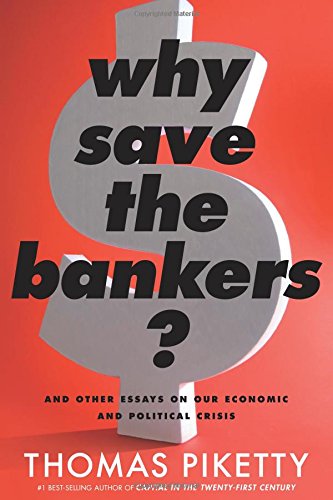
Why Save the Bankers by Thomas Piketty


What a stupid name for this collection of essays by economist Thomas Piketty. One would think it is an entire book of intensely ideological essays dedicated to rumination of whether we should have bailed out a corrupt financial industry. Instead, the reader is greeted with a series of opinion pieces written for a leftist French Magazine from 2008 - 2015. Written with both brevity and the authority given to a man whose career revolves around the study of capital as it pertains to major world powers, each piece offers insight on questions of inequality, globalism, taxation, trade, and even topics like terrorism or reparations for slavery.

The best part about reading WSTB was the timing I had in picking it up. Reading Piketty make plea after plea for a government that steps in to bail out citizens who are inevitably left behind by global capitalism (that global capitalism leaves many people in the lower and middle classes behind is an indisputable fact at this point, thanks largely in part to Piketty's work in Capital in the Twenty First Century) AND watching those citizens rebel against global capitalism with phenomenons such as Trump or the Brexit, offers unique validation to everything he was saying in real time. It's almost like reading a countdown to dangerous nationalist protectionism. What's more interesting is that Piketty's tome Capital in the Twenty First Century was long thought to be an arm of the far left, but it seems that Piketty believes in bailing out the banks, free trade agreements, and rapid technological advancement with the caveat that there must be strong social governments that work to redistribute the subsequent gains from global economic growth. After realizing that our world governments, for the most part, have been doing the opposite of what Piketty suggests doing at the time, it is amazing to look around and see everything he warned would happen if they don't; booming economic inequality, nationalist protectionism, distrust of governments, xenophobia, anti-globalism, and terrorism (which is actually the weakest piece, but the point is compelling and worth looking into at length).


The worst part about this books is mostly likely the decisions made by the publisher. The title and the exception of depth. If you're looking to read snippets as to why we might be where we are as an international community while maybe restoring your faith in a capitalism that could work for everyone, then this is a great and gratifying read. But if you're looking for depth, data, and a longer, more detailed timeline you should do yourself a favor and actually read Capital in the Twenty First Century all the way through. Then, ideally, publishers won't feel the need to push a sparknotes version like Why Save the Bankers.

Sunday, June 19, 2016

Purity by Jonathan Franzen

"He settled down to write the big book, the novel that would secure him his place in the modern American canon. Once upon a time, it had sufficed to write the Sound and the Fury or The Sun Also Rises. But now bigness was essential. Thickness, length." (186)

"So many Jonathan's. A plague of literary Jonathan's. If you read the New York Times Book Review you'd think it was the most common male name in America." (207)


Purity is the latest novel by Jonathan Franzen and the third book I've read of his. Like Freedom and The Corrections, Purity features a cast of characters set against a familiar cultural backdrop all striving to become the virtue the title of the novel extols; free, correct, pure. Naturally human nature gets in the way of this, but the resulting read is always fascinating. Frankly, I didn't think Purity was as good as the Corrections and certainly not better than Freedom. The volume of characters and the amount of bloat that Franzen dedicates to filler characters makes it harder to feel anything for the really important and interesting ones. Subsequently it took longer to really reel me into the larger story. Nevertheless, Purity is essentially Franzen and essentially good.

While there is never exactly a main character in Franzen's novel there is usually one that the theme and plot circle around. Pip, whose real name is Purity, is a young millennial riddled with millennial problems; saddled with 100k + in student debt, socially conscious working for corporate America, higher education promising high and a real world delivering low, the product of a single parent. We meet Pip as she is talking to her megalomanic mother about her need for money and imploring her to disclose who her real father is. The adventure that follows this opening scene sees Pip getting involved in a Wikileaks like organization called the Sunlight Project and an investigative journalist organization called DI, but not always through the perspective of Pip. We get backstory and context that ranges from life in East Berlin in the 1980s to New York to Bolivia. This is all coupled with Franzen's characteristic inclusion of current events; Julian Assange is there, the NSA, Google, Obama, feminism, the Californian drought, Snowden, Facebook, they are all there along side their predecessors in the 1980's. Whether Franzen, making a larger point about the world around us by putting a microscope on his characters, is looking to explain the modern political climate or document its effect is difficult to determine, but it's fun to think about and read into.

At the same time, this is where Franzen has always been the most tedious. I would never criticize a book for being long unless it is so unnecessarily. Franzen's Purity can be excessively self-referential; anything from his career as a writer (see the above quotes) to his political views is found far too often and far too obviously. A work of fiction that paints characters into a larger political tapestry has to avoid the pitfall of becoming a dumping ground of opinion. Franzen fails to resist this urge too many times. The clarity and moral turpitude with which Franzen's characters perfectly summarize any ideology such as feminism or socialism, capitalism or journalistic integrity, punctuates the narrative with protruding, unrealistic sound bites. He might stop short of turning his character's into Ayn Rand like mouth pieces for a deeper philosophy, but the inconsistency distracts from an otherwise great story. Watch as what was good dialogue devolves into Franzen opinion;
"I could tell your mother a thing or two about corporations" Anabel said darkly
"But the alternative doesn't work, either. You get the Soviet Union, you get the housing project, you get the teamsters union. The truth is somewhere in the tension between the two sides, and that's the sphere the journalist is supposed to live". (365)
This, and many other sections like it, are not complicated enough, too one sided. Not even 10 pages after this exchange we see the same characters battling it out over whether or not a man should have to sit down when going to the bathroom. The exchange is messy, but real. Manufactured messiness is a gift that Franzen uses well, we get flawed logic ("but I have to sit down") and manipulation; "she proceeded to cry torrentially. The only way I could get her to stop was to become, right then and there, a person who experienced as keenly as she did the unfairness of my being able to pee standing up". It seems that Franzen himself works best in the tension between two sides, it's when he explicitly takes one when you wonder what the hell he is doing.

I've always thought that Franzen should worry less about expressing himself and spend more time existing in the complicated. Part of the fun is extrapolating the themes from his novels and the flawed characters, fun that is spoiled when we're given the right answer. At its heart, Purity is about secrets, how the existence of secrets make up our identities and yet we have an obsession with appearing pure, of looking like we have none. It's a difficult subject to explore through fiction. When Franzen is on, and he is on through most of this novel, his exploration is fun, emotional, and thought provoking. He should be given more credit as a world builder, even though he works within the world we already know, few living fictional authors better capture what it means to live in it (assuming, of course, you're white...). It's no secret this book is a modern take on Great Expectations (Pip?), but whether this is Dickensian or not, there is no living author quite like Franzen. We should all look forward to his next attempt at the great American novel.