Sunday, January 31, 2016
Book Review: Moby Dick and Why You're Wrong
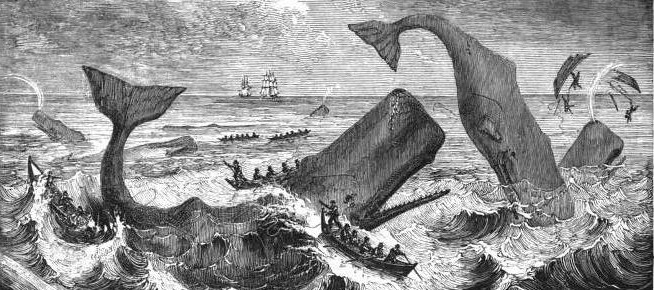
Moby Dick, regarded as the great American Novel, is itself a metaphor today. The narrative we all know: crazy sea captain goes after a white whale. We all know "call me Ishamael". It's like we can't help but think about this American tale whenever we're face to face with narrowly focused ambition or obsession. Moby Dick is the objectified stand in for American values in times of intense, single minded focus. We might invoke the title when talking about athletes, or any competition for that matter. As we chase this giant thing, this life accomplishment, we do so intensely and, though we fail as Ahab does (you can't tell me you didn't know that), all glory is in the chase. It is truly American to try your whole life to accomplish one thing with fierce dedication. But for the most part, I find this "reading" of the book a damn shame.
That is to say, this is more of a cultural feeling towards the book than an actual contextual argument of what happens. The sentiment is annoying too; we can say all these great things about Moby Dick but at the end of the day not nearly enough people are going to read it. It's silly to think we're going to apply all these feeling of ambition we have no problem referencing in our own work and lives to actually pick up the book and literally suffer through it. Because that's what you would do; suffer. If you love language and poetry, dense philosophical reveries that go nowhere, then you might be able to get through the heartier sections, but it isn't as though you can blow through Moby Dick in a day, your mind can only actively read for so long. And you absolutely have to be active, you'll fizzle out in the middle of a chapter about paintings of whales if you aren't. I'm not trying to make anyone feel bad or look down from a high horse either, I'd be lying if I said I never got distracted or that I was 100% present in every chapter. There are entire sections of chapters I know I missed and could potentially be forever lost on me. My point is this is hard, it is a hard book to read. But it is also worth it, which makes its reputation as a difficult but important book immensely frustrating. Why? Because Moby Dick is essentially all about getting out in the world and discovering the truth for yourself. Allowing this book's reputation as difficult and your preconceived notions about its themes stop you from reading it, is a crime against literature.
Here is something you might not know about Moby Dick; it is not about the Whale. There is a reason only small portions of this book are related to plot and why the massive chunks in-between seem to be about inconsequential things. That's because Ahab's hunt for the whale and Ishmael's hunt for the truth are practically one in the same; they are both "striking through the mask" as Ahab would say. The whale is not some allegory for God or a penis or something, Ahab is hunting him to escape his own Allegory of the Cave (Plato is the most present, but you'll find Locke, Hume, Kant, Epicurus, Aristotle, fucking everyone). When the white whale took Ahab's leg he "identified in him not only all of his bodily woes, but his intellectual and spiritual exasperation". To Ahab, Moby Dick is not just a shadow on the wall, but the wall itself. Ahab seeks to destroy the wall and find the truth behind the object at hand, perhaps even proving that it was indeed just a big whale and nothing more. Ishmael is less concerned with one single thing as he is with things like the whaling industry, the anatomy of a whale, bowls of soup, pieces of wood...etc etc. While Ahab's is a "monomaniac" quest in that he heaps all possible truth behind one single object, Ishmael seeks to find all possible truth behind every object. He is always butting heads with naturalists, academics, and those dedicated to the study of the physical world. Which means he is often wrong scientifically or factually (he calls a whale a fish for example). This is because Ishmael is not concerned with the accuracy of physical truth, but of the truth way down behind everything. Ahab is not concerned with the physical whale but the truth heaped on his hump (Ahab's words, not mine).
In short, the book is about ambition, but it is more an invitation to look beyond the physical world. Melville's ability to take the seemingly mundane object - a bowl of chowder, a rope, whale guts - and blow them up to philosophical proportions is the most inspiring thing about Moby Dick. The reason you should force yourself to read this violent, drawn out, and dense book is exactly because that is what the book teaches you to do. If you're not actively forcing yourself in pursuit of truth despite the difficulties and perils that come with such a journey, then you aren't truly living in reality. Who knows, forcing yourself to read Moby Dick could be the start of a more fulfilling life, but you won't know until you try.
**Quick aside: The final fight scene between Moby Dick and the Pequod's crew is like the most fun I've ever had reading. A three chapter long battle in which MD kicks some serious ass....
Monday, November 16, 2015
A ReRead of The Stranger by Albert Camus
Rereading the Stranger by Camus, it is obvious that America has hijacked Existentialism and any subsequent narratives. I see the philosophy and the narrative of the Stranger everywhere now. I watched Clerks the other day and saw countless parallels between Mersault and Dante; when describing the book to a friend who has never read it I gave into the temptation of comparing pre-existential crisis Mersault to pre-Brad Pitt Edward Norten in Fight Club; the internet is full of listicles prompting readers to live life to the fullest and not to let traditional, societal expectations prevent us from doing what we want. This all seems really existential, but I think there is something fundamentally wrong, though it is hard to put my finger on exactly what.
It seems that Hollywood and the internet respectively enjoy stoking the idea that we can't live passive lives. But their portrayal of it is missing something fundamental, something the stranger demonstrates in abundance. To Hollywood and career internet motivators, pre-existential crisis characters are boring and monotonous (think Norton's condo in Fight Club), that they are letting some triviality get in their way. They live totally unappealing lives and are usually foiled by existentially and unrealistically laid back, cooler people (Pitt from Fight Club or Randall from Clerks). On the surface, what makes this life so desirable is that it is liberating; you're free of the fetters of societal expectations. As though by removing crushing expectations we are somehow going to live happier. This all jives pretty well with existentialism, but the portrayal of what it means to live a wholesome life is still far too selfish. This idea that American mediums are spouting is still operating under the assumption that all of this is for the individual, a very American concept. Every insistence that you follow your dreams or forget what others are saying are all perpetuating, not the idea that you have to be an active participant in life, but that life is somehow meant for you.
Think about pre-existential crisis Mersualt, what makes his life so undesirable to me is his selfishness. Whether he's at his mother's funeral, hanging out with friends or loved ones, or just existing in the public, he is constantly bitching about people in his way. Not in his way like they're preventing him from following his dreams and ambitions, but in his way like their existence is preventing his existence from dragging him to his inevitable end. Or just preventing him from taking a nap and having a cigarette. In every moment Mersault is aggravatingly thinking only of his needs, of his fatigue, how uncomfortable he is, how disgusting other people are and how they are making him feel unpleasant. He lays out in great detail how pathetic is mother's old (new?) fiance looks trying to keep up with her funeral procession and how much it bothered him. The unnamed Arab man he kills (that the man is unnamed is case in point really) is preventing him from going to a shady place while he is caught in the sun. Mersault's passive life is passive because he is unthinking, because he is operating in a default setting that assumes his life is the most important one. After his existential crisis, he thinks only of others and hopes they come out to cheer his death in ecstasy. It's not like he lives a really sexy and desirable life after his revelation, he doesn't get to relive his life the way he sees fit and follows his dreams, he dies. What makes Mersault existential is not his new life in contrast to his old one, but rather his new thinking.
That's the tragedy to me; I know people who live incredibly vibrant and exciting lives that still fall in the same pitfalls Mersault falls into. That there is a sort of anti-selfishness in Existentialism that maybe entrepreneurial/capitalist America doesn't want to acknowledge. That living life as an active participant, not passive, means actively considering your life is no more important than the lives around you. Living actively, existentially, has nothing to do with people getting in your way and everything to do with your acceptance that they are there and so are you and no one is any more important than anyone. The second you attribute meaning and purpose to your life, the way American pop culture is always portraying as the only way to a fulfilling life, is the exact moment that you are living passively, taking the easy way out. It could be that Existentialism has nothing to do with living and everything to do with how you think, it is after all a philosophy.
**Read the Stranger, if you've already read it, reread it. I picked it up and a week later France gets attacked by terrorists and over a hundred of their citizens are tragically killed. They are attacked by a group of people who believe their life's purpose trumps another's. I picked it up right when protesters in Missouri with legitimate complaints of racism are considered detrimental to an individual's freedom of speech. I read this at a time where it is considered critical and intelligent thinking to assume the worst of people, to accuse those in poverty of gaming the system because of your taxes, when it is in fact the easiest possible way of thinking. Today we are plagued by those who consider their life the most important and meaningful, our country's values and pop culture are encouraging us to believe this. The Stranger is a reminder that this is man's default way of thinking and only by actively rebelling against this notion can we truly transcend.**
Wednesday, September 23, 2015
Drown by Junot Diaz
Daniel Beaty is a performance poet and artist that talks
passionately and personally about issues of race. One of his more well known
pieces is titled Duality Duel. In it, Beaty goes back and forth in two
different personas; his ivy league educated self and his street self. The two
personas are aptly named Nerd and Nigga. The Nerd flourishes stories of success
in an attempt to tell the Nigga there is no need for him any longer, but the
Nigga fires back that the Nerd is no longer relatable to his people, that he
can't fulfill his obligations to lift them up without his Nigga side. The piece
is powerful, Beaty has a goosebump evoking delivery from his projection down to
his body language. Besides that though, the piece is also smart and accessible
all at once. Beaty, using a performance poem that anyone can listen to and
engage with, isn't overly poetic on the surface at all, but on further inspection you
start to notice rhyme schemes and meter. It's also heavy in content, duality
being an altogether difficult subject to reconcile. Artists like Beaty though, are important because, just as his poem states, they make art and complex
dialogues more accessible.
This is why Junot Diaz is an important presence in
contemporary literature. The experience he comes from is both that of a black
minority and an immigrant and he is highly critical of the kind of baggage that
comes with both. His novel; the Brief and Wondrous Life of Oscar Wao, which
might as well be Duality Duel the book, won the Pulitzer prize for literature.
Before that, he published a book of short stories titled Drown. Each story,
most of which could very well be about Diaz himself, feature Yunior, Dominican
immigrant to New Jersey (see) and seem to dip into different moments of his
young and adult life. We get snapshots of him as a child in the DR waiting for
his father to send for him; to stories of him as a young man trying to date
young women; to stories of him dealing drugs on the corners in America. Aside
from two stories, one about Yunior's dad in America and the other about a
reoccurring allegorical character named Ysrael, all of these stories take place
in "the streets", both literal and metaphoric. This means they come
packed with violence, misogyny, bruiting masculinity, race and racism, drugs,
gangs, etc etc. This makes it an ideal read for most men who might not often
feel a connection with literature set in lofty White America. In fact, it
almost seems Drown is exclusively for men, Yunior is always gratingly fronting
his manhood (even as a child) and women are unabashedly objectified. That isn't
to say that women can't read the work in Drown and derive any sort of meaning,
but the book empathizes almost entirely with men.
This could strike a lot of readers as annoying. Fans of
Diaz's Oscar Wao who value its balance between "the street" and
literary endeavors might not appreciate the more subtle literary presence in
Drown, which is more frankly about manhood. This is valid criticism, Drown's
male characters are despicable to women, they're overly violent, their thought
processes are simplistically male (sex, food, more sex). Other readers though,
readers these characters are supposed to empathize with, might find them
relevant. Once those readers are hooked, that's when Diaz works in the more
complex and subtle elements. Every female character, though treated poorly, is
complex, generally strong (often physically), and have an in-depth,
multidimensional kindness. Yunior is often afraid to speak out about his run
ins with sexual abuse because he thinks he'd be perceived as weak, while he tries
to brush it off it is still evident these instances of molestation haunt him
(read: drown him). Yunior also seems to be constantly reconciling with the
cruelty of masculinity, implying that it is almost inherent in his brand. His
father and his brother seem cruel, irresponsible, inconsiderate, and sometimes
downright insidious. Yunior, often mirroring their behavior, feels what he is
doing is wrong, but also conforms to the pressure of his family and friends.
While the stories of Drown may be masked in manliness, beyond the surface there
is a delicate and emotional sub-narrative worked subtlety into each piece.
Of course one could argue subtlety working in complex themes
could mean they're willfully ignored or unintentionally unnoticed, thus
dampening the conversation they're supposed to provoke in readers who are
already hostile to these literary methods. But in Drown, the deep conversation
triggers are so haunting - fast escalating moments of intense violence, or
sexual molestation that happens excruciatingly slow - that they're impossible
to ignore. Diaz stays relevant to say, inner-city youth, but could potentially
have them questioning the intricacies of their masculine identities. Even
if he doesn't, his attempt at reaching a readership that doesn't usually feel
powerful prose is for them is a commendable effort. If nothing else, he is a
different voice in a sea of homogeneous voices speaking about tortured white
geniuses.
Monday, August 10, 2015
Book Review: Austerity by Mark Blyth
In Austerity Mark Blyth dives into what is now a very entrenched belief in American politics. Explained simply, austerity is just scaling back government spending in the form of budget cuts, privatization, and making way for private sector investments. If this sounds familiar it's because this has been the American Republican economic policy for some time now. In his book, Mark Blyth explores both the ideological history and practical applications of Austerity, as well as some brief notes about how it relates to our current crisis. The books is apparently meant to be modular too, so if any of those topics interest you, you'd be able to read one section without having read any of the others. Or so Blyth says. After reading the whole book cover to cover it is pretty obvious that not having read some sections will leave other sections less powerful since Blyth's thesis draws strength in its scope of study on the subject. For example the history of austerity as an idea and the history of its applications combine to make austerity as a concept truly inadequate in any capacity.
And this is essentially what Blyth's book says over and over; no, austerity never 'works'. By works, he means that it fails to pull a state out of economic depression over and over. Some countries like Germany can practice austerity and run a surplus, but Blyth points out that if every country did that it would be short-lived as there would be no one actually spending money. This is precisely why austerity is so dangerous; it seems to make common sense. Left, Right, Center, a lot of people regardless of political affiliation might agree that during a recession the government should spend less, should strive for surplus and growth in an attempt to pull itself out of perpetual unemployment and economic travesty. Yet, historically speaking, Blyth shows us it is impossible to cut one's way to growth. Every country that has tried to do so has either failed or forced its citizens through grotesquely long bouts of unemployment and poverty before the economy righted itself after some sort of bailout. Currently, austerity is halving practicing country's demand and subsequently growth. The more countries that practice it the worse off export and import markets become too. Wages take a hit, social programs become broken or profit driven, productivity becomes stagnant, and despite all of this the debt rarely corrects itself. Blyth explains that the ideological stance for austerity began with libertarian/anti government thinkers who, lamenting that the government was necessary if only to protect property rights, didn't want to pay for an expanding state, believing that it interferes with markets. The problem with this is that if you don't properly fund the state it won't do what it necessarily needs to do properly. It seems the reason for austerity now is that politicians are convinced that the market alone, with limited if any help from the government, will take care of itself. The problem that this book highlights is that it won't and it never has.
Blyth is fun to read in some part because he isn't a partisan extremist. He doesn't use words like "austerity jihadists" as Krugman might and he doesn't believe in some corrupt republican party agenda like mass privatization in return for kickbacks. He rather casually posits that the ideology, uses, and justification of austerity are flawed, but given its intention it remains used despite a distinct lack of results. On that same note, Blyth can get intensely over dense when talking about economic theory or history and the book has one of the biggest shit show post-scripts I've ever read. It's definitely worth picking up if you're interested, for example, in why schools historically keep getting their budgets gutted, but it might not be the most riveting thing you'll read all summer.
Tuesday, July 28, 2015
Book Review: Freedom by Jonathan Franzan
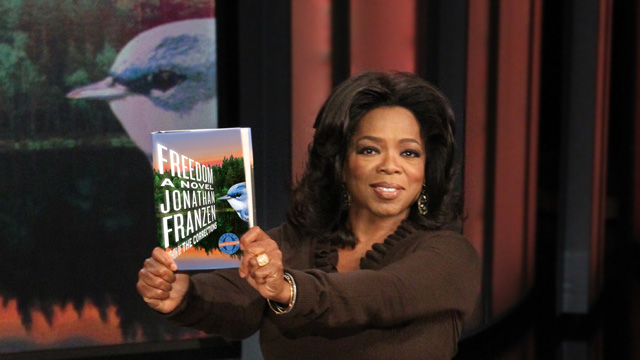
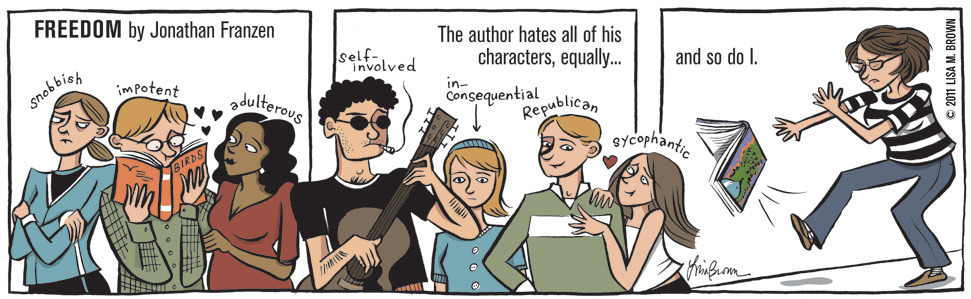
'Freedom', a Novel by Jonathan Franzen, is an incredibly fun reminder that nothing in life is ever really free. Franzen, who planned on writing a political novel about washington, turns instead to writing about families, a subject he mastered in the Corrections. He often inhabits each of his characters and gives you juicy tastes of his own eccentric political views or his take on bands like Bright Eyes. Franzen's presence here - obvious at times while not at others depending on how well you know the author - can be marginally distracting. Often times you're too consumed in the drama of whatever is inducing it to even notice. Still, Franzen evidently lives in every single character. The political opinions, often bordering that of Paul Ehrlich, can get tiresome and its eccentricity loses luster at several points. It is when Franzen is writing about the politics of family and community that he is at his best.
Here, Franzen navigates things like rape or adultery, depression or parenting, as though each event is a series of political moves. There are major pillars of political drama like crushed idealism, deceit, and the inherent injustices of democracy played out as the main female character (patty) tries not to sleep with her husband's rockstar best friend or the main male character's (walter) valiant attempts at not sleeping with his assistant. These scenes are often the most fantastic and easily consumed. They're especially fun when paired with the more experimental narrative styles Franzen uses in Freedom; the first section of the book is written from a collective POV of neighborhood gossip, the second is a memoir written by Patty herself. This way Franzen is able to layer what would otherwise be mechanical story telling into deeply personal triads into his character's psyche. In other words, he does a good job masking what he's doing. You think you're reading about family, parentings, growing up, and finding your way when you're actually reading what it means to be a cog in the human race machine.
As a result, modern politics is almost works better as a setting than a thematic endeavor. 9/11 is definitely present, but so is overpopulation, military contractors, environmentalism, neoliberalism, each political movement of the early to mid 2000's informs the narrative in new ways. Joey, Walter and Patty's son, gets caught up in a military contracting scandal, Walter tries to use environmental policy as a front for anti-growth movements. This is where the book might get tedious. There are times when Walter or Richard (his best friend) or even Franzen as narrator might start riffing on a subject for seemingly no reason; a particular unconvincing conversation between Joey and his college roommate about the Israel/Palestine conflict comes to mind. While barely thematically relevant it is even harder to draw parallels between the plot and the debate. It's easy to roll your eyes at moments like this and think "yes, we get it, too much freedom is a bad thing" or "when your freedom infringes on mine it ceases to be freedom at all". While modern politics are skillfully used, when they're bluntly applied to situations it gets flimsy in the realm of believability. Politics work better as a backdrop here, because we've already seen so much of them thematically. One could argue this is probably why Franzen went with the family as his primary thematic vehicle over Washington, he should have more consistently stuck to it.
Freedom though, is a brilliant piece of work. One of the more fun conflicts it offers is whether there is a certain level of duality in the title. While there are many artfully crafted instances of one character's freedom inhibiting another's, there is also precious little willpower. As stated earlier, crushed idealism is a staple of any political drama; think Mr. Smith Goes to Washington. It's almost laughable that these characters feel they have a choice in what they are doing. Whether they're disconnecting and cheating on their spouse or perusing something truly and utterly selfish, the reader is doubtlessly let down as that character almost unwittingly winds up doing what they were vehemently against mere seconds ago. This can be heartbreaking or hysterically funny at the drop of a dime. Franzen has you riding up and down with every character in their respective sections, feeling confident when they are and equally as devastated at their seemingly inevitable failures. Perhaps the reader too comes to inhabit Franzen's characters.
Thursday, July 23, 2015
Letter to Representative Trott Concerning Minimum Wage
Please feel free to copy, edit, paste, and send to your representative.
Representative Trott,
A major concern I have as a member of your constituency is the minimum wage. Given that you are a Republican, support the TPP, and are by no means a fan of Keynesian economic policy, I don't believe you will take any action on Senator Bernie Sanders recently introduced bill to raise the minimum wage to $15 an hour. And that is fine. But I do wish you would consider supporting legislation that raises the wage to a number you and your party deem fair.
Consider that the average number of hours worked a year is 2080 (assuming a 40 hour a week schedule). At 7.50 an hour we are looking at individuals living off $15,600 annually. After taxes - which would be the full 35% average Americans pay because the great state of Michigan has rid itself of an earned income tax credit (thanks again to your party) - you're looking at individuals earning only $10,140 a year.
Consider these aren't just teens working summer jobs. I've linked below to a study published in the New York Times that shows many individuals working on minimum wage are over the age of 25, are parents, and are most likely the head earner for their household. No family could live off 10K a year, no matter how austere. This leads to food stamps, welfare, and receiving subsidized insurance from the ACA.
Consider that your party (wrongly) blames welfare, food stamps, and the ACA for massive deficits, debt, inefficient expenditures, and everything short of ISIS I would think you would consider all avenues to limit these programs. Since you've gotten nothing but pure resistance from democrats in making massive cuts to these programs, perhaps a better - more efficient if you will - way to lessen the effects you feel (wrongly) they have on the economy would be to raise the wage, subsequently eliminating the need for such programs. You would certainly get democratic party support and, as demonstrated through history, wouldn't have to raise the wage again in the next 5 to ten years. I fail to see why you shouldn't at least give it some thought.
Raise the wage, even a little bit, it just makes sense.
As promised, my source;
http://www.nytimes.com/2014/06/10/upshot/minimum-wage.html?_r=0&abt=0002&abg=0
Representative Trott,
A major concern I have as a member of your constituency is the minimum wage. Given that you are a Republican, support the TPP, and are by no means a fan of Keynesian economic policy, I don't believe you will take any action on Senator Bernie Sanders recently introduced bill to raise the minimum wage to $15 an hour. And that is fine. But I do wish you would consider supporting legislation that raises the wage to a number you and your party deem fair.
Consider that the average number of hours worked a year is 2080 (assuming a 40 hour a week schedule). At 7.50 an hour we are looking at individuals living off $15,600 annually. After taxes - which would be the full 35% average Americans pay because the great state of Michigan has rid itself of an earned income tax credit (thanks again to your party) - you're looking at individuals earning only $10,140 a year.
Consider these aren't just teens working summer jobs. I've linked below to a study published in the New York Times that shows many individuals working on minimum wage are over the age of 25, are parents, and are most likely the head earner for their household. No family could live off 10K a year, no matter how austere. This leads to food stamps, welfare, and receiving subsidized insurance from the ACA.
Consider that your party (wrongly) blames welfare, food stamps, and the ACA for massive deficits, debt, inefficient expenditures, and everything short of ISIS I would think you would consider all avenues to limit these programs. Since you've gotten nothing but pure resistance from democrats in making massive cuts to these programs, perhaps a better - more efficient if you will - way to lessen the effects you feel (wrongly) they have on the economy would be to raise the wage, subsequently eliminating the need for such programs. You would certainly get democratic party support and, as demonstrated through history, wouldn't have to raise the wage again in the next 5 to ten years. I fail to see why you shouldn't at least give it some thought.
Raise the wage, even a little bit, it just makes sense.
As promised, my source;
http://www.nytimes.com/2014/06/10/upshot/minimum-wage.html?_r=0&abt=0002&abg=0
Friday, June 5, 2015
Book Review: Dissident Gardens by Jonathan Lethem ☭
Dissident Gardens is the tragedy of Eden played out in Sunnyside New York. "The Gardens" refers to the neighborhood in which Rose - no doubt aptly named according to her role in the garden and narrative - the central character in Lethem's novel, resides. Rose is an elderly jewish woman (though her relationship to her faith is complicated) who, in her prime, was a deeply connected member of the American communist party. She tempts all manner of characters with her radicalism, the Apple of Knowledge if an apple could have crippling expectations. We watch her daughter, her husband, her daughter's husband, her nephew, the son of her black cop lover, and her grandson, having fallen from the garden, navigate their doomed existence; doomed to dedicate their lives to bringing communism to the world of mere mortals. Dissident Gardens explores the heart of American identity one failed radical ideal at a time.
And it is a refreshing exploration. Lethem possesses a seemingly endless depth of critical knowledge about the age in which he writes. Each sentence explodes with allusions to pop culture, politics of the time, and historic events. As he hops around from generation to generation almost arbitrarily, this is even more impressive. It allows him to be witty and fun, but also poetic or genuinely engaging in dialogue at the drop of a dime. The result is an incredibly fun read; engaging, funny, and critical. The only issue I take with this is that Lethem seems to strike only one tone and some of the musings from characters he writes about at a younger age are downright implausible. Which is easily forgivable seeing as nothing Lethem has to say in this novel is anything short of stunning. Each characters tragic life is being driven forward from fear of Rose's ferocity, though the plot isn't linear, time is the only thing more ravaging than Rose. That Lethem can navigate each time period his characters are present in is an essential skill. The history of major league baseball, popular television shows, folk musicians known and unknown, all delivered with an expertise that provides a backdrop of historical realism. Each character makes a pathetic attempt at some actual event in time, whether the modern occupy movement or an episode of the Who, What, Where television game show, to springboard their communist ideology. One character releases a working man's folk record that is dwarfed by Dylan's of a similar style, another tries to start a minor baseball league called the proletariats who are dwarfed with baseball's revival on the east coast. Each artfully crafted event adds scope and context to each character, the idea being it is impossible to forge a unique identity in the midst of an American identity that is inescapable and immutable.
Historic realism in the 60's, 70's and beyond, complete with real major events, might have some people thinking Forrest Gump. Which is a good start, but instead of a bumbling single guy getting up to pee in the middle of the night and changing the course of history by accidentally discovering Watergate, you have a whole ensemble of characters dedicating their lives to what seem like painful exercises in futility, history moves without them. That's the other thing, Dissident Gardens can be incredibly sad, but not without a certain amount of didacticism. While each character tries to burst onto the American frontier waving a hammer and sicle banner big enough to make Rose proud, they ultimately fail. With the exception of Rose herself, who, though kicked out of the party officially, seems to instill this radicalism everyone is striving for into her own personal Garden of Eden; Sunnyside. It is almost as if Lethem wants his reader to walk away believing that one's politics are best lived out in their communities than debated as a lofty pillar of idealism for the nation to raise. In fact the characters who embody communism as a discourse only, are the ones who fail the hardest, it could be argued they don't even get off the ground. The others, who try to live out communism but in a rapidly anti-communist world - say Meriam (Roses daughter) and her Husband Tommy - are only marginally successful in the moment and are soon washed away by time, not even a blip on the historic radar. But this failure shouldn't sound flippant or humorous, it is truly heartbreaking. You feel excited for Tommy Gogan's record release as he and Meriam rush around making the necessary sacrifices for getting the poor man's ballads onto the music scene and you're right there with him feeling the enormous defeat in the form of Bob Dylan's raging success in doing exactly what Tommy's is doing but first....and better. Each character has this moment where, the reader with them, they are on the brink of something great and instead fall very hard and very short.
It is also important to point out that Dissident Gardens is in no way an endorsement of communism. Though that is an ideal the characters strive for, it is no reason to avoid this book. Lethem is far from pushing even the most benign liberal agenda. He likely chose communism because it really was the doomed American identity, but it is also considered adversarial to God and indeed seems to take God's place with regards to worship for many of the characters. Dissident Gardens is a very cunning novel that ties together themes like 'community over identity' with heartfelt tragic characters. Communism will be the least of your worries as you navigate the complex range of emotions Lethem will evoke. It can be as painful as watching the doomed inhabitants of the Garden of Eden try to clamber back in after their fall from grace, not realizing the garden has moved far along without them.
Subscribe to:
Posts (Atom)