Friday, July 5, 2019
Girl with Curious Hair by David Foster Wallace
I recently read the short story collection Girl with Curious Hair by David Foster Wallace. The unique aspect of this collection stems from setting almost every story in real moments that occurred in history. The collection reminds you why DFW is a true fiction craftsman but also gave way to some unsettling realizations I have about the author.
The first story - the best IMO - "Little Expressionless Animals" shows DFW at his best. Dancing between reality and fiction, the story outlines the journey of an exceptional Jeopardy contestant and her love affair with the producer's daughter. The constant blurring of that line of what is real and what is not highlights how ridiculous reality can be how. It's fun, thoughtful, and brilliantly composed.
From there the reader is greeted with the collection's title story "Girl with Curious Hair". The piece features realistic settings and concepts but seriously fucks with characterization. It follows a gang of absolute monsters in their exploits in arson, drug exploration, assault, and more. Very reminiscent of a Clock Work Orange.
It's here the collection starts to lose me a bit. I'm not so sure in our time of intolerable cruelty I need to be reading DFW's reality-bending fiction. I'm not saying I want to be comforted by my fiction, but the cruelty displayed in this story tied with the mess of misogyny, racism, and overall power struggles in the stories to come don't need to make you second guess whether men and women are capable of such things.
In the final and longest story, "Westward the Course of Empire Takes Its Way", we're treated to exploratory dialogue on the nature of fiction itself. I get the sense that without a certain amount of off-putting edge DFW feels fiction is little more than a glorified advertisement, meant to make readers feel good. So he strives to make his readers uneasy; characterizing women as impossibly particular, making his characters disfigured in some way, gratuitous violence.
The thing is we never explore why making a character transgender or disabled makes readers uneasy, why playing to these stereotypes and biases for the purpose creeping your readers out is actually harmful in the greater scheme (ironically DFW complained about David Lynch doing this exact thing with Richard Pryor in his review of Lost Highway). One could argue this isn't the point of the fiction, but then what is the point?
Interventions by Noam Chomsky
Noam Chomsky remains cogent as ever in his old age. He's still giving interviews, appearing on Democracy Now, writing, etc. Still, because there are so few voices countering hegemonic US foreign policy the prospect of losing Chomsky is truly depressing. Or it was before reading his book of op-eds Interventions and realizing that time is indeed a flat circle and anything Chomsky has said will apply to all of the exact same things for the rest of time.
For example, tell me if this sounds at all familiar:
"Washington's thorniest problem in the region is Venezuela, which provides nearly 15 percent of US oil imports. President Hugo Chavez, elected in 1998, displays the kind of independence that the United States translates as defiance...in 2002, Washington embraced President Bush's vision of democracy by supporting a military coup that very briefly overturned the Chavez Government. The Bush administration had to back down, however, because of opposition to the coup throughout Latin America and the quick reversal of the coup by a popular uprising".Interventions is a collection of op-eds by Chomsky during (and in the leadup to) the Iraq War. While each one is short, they work to build a countervailing narrative that we all know now to be true. The takeaway here is not just that Chomsky is right, but rather how easy it is to be right.
US foreign policy is extremely formulaic. Since World War II the US will work discretely to cause unrest in a region in order to apply their disaster capitalist tactics toward privatization, they'll accuse any challenging nation (no matter how small) of being an existential threat, and they'll make up any number of reasons to execute an occupation if necessary.
In reading Interventions, one understands that Chomsky's entire body of work documents this strategy time and time again. It serves as a reminder that we can look to Chomsky and those like him any time state conflict approaches. In the year 2019, as our nation creeps closer to an extended military conflict with Iran, we only have to glance at Chomky's writings on the failure to find Bin-Laden, the source of the post-9/11 anthrax terror, or the Iraqi WMDs:
"for the second 9/11 anniversary and beyond, we basically have two choices. We can march forward with confidence that the global enforcer will drive evil from the world, much as the president's speechwriters declare, plagiarizing ancient epics and children's tales. Or we can subject the doctrine of the proclaimed grand new era to scrutiny, drawing rational conclusions, perhaps gaining some sense of the emerging reality".As concerned citizens, we owe this level of scrutiny to Chomsky. I wouldn't start out with Interventions as your introductory text, but it definitely makes a great piece to a larger collection.
Thursday, January 10, 2019
The Current Affairs Rules for Life by Nathan Robinson
The way I see it you could find yourself in either one of these two categories:
- You think all the criticism of social justice warriors is valid and people just need to learn to contend with ideas they don't like
- You don't think the criticism of social justice warriors is valid but you have neither the time nor patience to analyze the work of popular critics like Jordan Peterson or Steven Pinker and adequately refute their arguments
I've been in both these categories. There was a time I gave in to popular sentiment and assumed leftists, especially college leftists, were being too sensitive. I thought things like safe spaces, microaggressions, and trigger warnings were taking the idea of egalitarianism to hypersensitive levels and made it too easy to parody. I was even one of those insufferable free speech purists who felt that credible arguments exist on all sides of a given argument and, if we could only hear them all out, the most rational outcome would prevail (which isn't necessarily wrong, I just failed to grasp that the arguments presented to us in mainstream discourse were just two sides of the same coin).
As I began moving further to the left after college (this is what working in a cubicle 40 hours a week will do to you) I could start to see major power imbalances being challenged by the same leftists I criticized. And they weren't just challenging them with trigger warnings or microaggressions (though they were certainly present) but rather with visions of a just and more fair outcome for all. These were the people being referred to as SJWs or Social Justice Warriors and written off as "snowflakes".
A lot of people in my life still subscribe to the theory that social justice is a concept gone too far and they're still heavily influenced by the harshest critics. Joe Rogan hosts the most popular podcast in the world and he uses it to platform many like-minded critics of the left. People like Sam Harris, David Brooks, and Steven Pinker are seen as rational classical liberals and attract justice-minded people with a perceived evenhandedness. Pseudo-academics like Jordan Peterson and Charles Murray will use the real language of science or statistics to legitimize ideas with no real scientific or statistical backing. And of course, there are those on the right like Ben Shapiro, Charlie Kirk, and Milo Yiannopoulos who reasoned people will often say they disagree with while simultaneously insisting on the existence of good faith in their arguments.
Rather than take on these people and critiques on our own I think it is time to elevate those voices who can best critically defend social justice. I would like to nominate Nathan Robinson, who edits the magazine Current Affairs and whose collection of essays The Current Affairs Rule for Life offers key insights into the real arguments behind both social justice and its critics.
If I were describing a Ben Shapiro YouTube video I would describe Part One of the books as "Nathan Robinson Eats Anti-SJW With The Teeth of Logic and Shits Th-". You get it. Each essay tracks a popular social justice critic, fairly defines their major beef with the movements and ideation of the left, and then either provides a lawyerly, well-evidenced counterpoint or exposes them as only speciously engaging with leftist arguments at all. The gang is all here; Peterson, Harris, Carlson, Brooks and more. The level of engagement is useful in its substance as well as its timeliness.
Part Two goes on to defend the idea of social justice as a whole. Rather than describe each argument in detail, here is a taste of the central theme from the essay In Defense of Social Justice:
"Why is the left-wing political agenda so hopelessly muddled and varied? Redistributing wealth, eliminating gender roles, protecting the environment, stopping the war, prosecuting Wall Street, opening the borders, saving the Louisiana pancake batfish—why do we just throw all of this different stuff together into the political equivalent of a KFC Famous Bowl® and call it social justice? What is this, other than a series of different ways to signal one’s virtue? But the premise of the question is wrong, because it looks only at the goals that follow from a certain set of basic values and misses the values themselves. It’s understandable that people get confused, because on the left we end up spending far more time talking about what we want than the reasons we want it. It’s still true, however, that there is a coherent (and to me, compelling) philosophy underlying “left-wing social justice politics.” It starts from a belief that other people matter, that we should empathize with the rest of humanity and care about what happens to them as much as we care about what happens to ourselves. It also holds a vision of the good life, a life where people have freedom and equality. But it realizes that those need to be more than empty feel-good words: Freedom means the actual capacity to do things, not the mere absence of physical restraint"
All of the essays are available online, but I highly suggest subscribing to Current Affairs or at least purchasing the book. This is part of that "elevating voices" thing I was talking about. Whether you're sending these essays to people or just reading them to equip yourself with better arguments, I can't stress how important projects like Current Affairs are (Robinson makes a lot of references to other writers I'll be reading too). With the growing popularity of the anti-left, the left needs better messaging and better arguments, which will require complex engagement with the anti-left talking points.
Robinson's trick to this engagement is giving serious consideration to what your target is saying, really knowing/being able to speak to the values backing them up, as well as...just reading them. During the Kavanaugh hearings, I kept his essay on the Supreme Court nominee's testimony permanently up on my phone. What made it such a useful piece? Well, Robinson actually read the testimony and painstakingly combed for inconsistencies in it. Every day, ordinary social justice critics in our lives have professional critics on the center-left and right popularizing and normalizing their ideas. Let's make people like Nathan Robinson ours, let's let him read their screeds for us so we can develop our own way of combating those advocating brutal individualism. He's like that nerd in high school that will do your homework for you except this time you don't even need to threaten him with a wedgie, you just need to subscribe to his magazine.
Wednesday, December 26, 2018
The budget breakdown of an average 25-year-old who is probably broke and has no life
CNBC's Emmie Martin caught my attention the other day when the digital platform tweeted her article about a 25-year-old who makes $100k. The article comes from their Make It series which purports to help you be "smarter about how you earn, save and spend your money". The subgenre appears to be a segment titled Millennial Money, which doesn't have a mission statement but features a few articles about millennials making various amounts of money and how they're able to get by with it with budgeting skills.
This particular article follows Trevor Klee, a 25-year-old self-employed tutor making $100k a year. Apparently, other young Bostonians can learn personal finances from how Trevor operates his budget, but if Millenial Money is supposed to share in the mission of making one smarter about how to earn, spend, and save then they shouldn't be using such an anomalous case.
A better model would have found a more average millennial earner who can scrape by in the city. Since I can't go to Boston and spend the time finding one of these I decided to take Trevor's spending habits and translate them to a more average millennial living in Boston.
Lessons in How to Save
It's important to first point out the ridiculousness of Trevor's situation. We'll leave aside the fact that a self-employed LSAT tutor makes $100k a year (even though this fact should absolutely astound people). According to TaxAct Trevor's income places him in a bracket where he's taxed 28% of his income, which leaves him with $72,000 post-tax disposal income. Trevor has a monthly spend of $6,000 a month. Take a closer look at the CNBC chart:Spending only $2,775 means Trevor is pocketing $3,225 in savings every month. This amounts to an annual savings of $38,700. I have no idea where this excess money is going. The article states that "Klee has around $43,000 put away" in total so he's clearly spending it somewhere. The article also says he only spends around $350 on a workspace and another $200 in marketing for his business. That's still $2,675 in pure savings every month!
Throughout the rest of this post, I'm going to demonstrate that any lessons learned from Trevor are highly unlikely to benefit the average millennial living in similar conditions.
Based on some publicly available data and cowboy math here is the new spending breakdown I made for an average millennial in Boston (unlabeled categories are the same):
Earnings:
I thought I would be generous when considering the earning potential of our fictional self-employed millennial from Boston. The Bureau of Labor Statistics says 25 - 34-year-olds make just over $40k on average. I decided to go with the average salary for a college graduate which is $51,000 according to the National Association of Colleges and Employers because I'm not sure how anyone could even get by in Boston on $41k (though keep this in mind) and city earnings typically trend higher than national averages. The TaxAct tax bracket estimation is 25%, so we're looking at a monthly spend of $3,187.Without looking any further it seems our fictional average millennial could replicate Trevor's spending habits and still walk away with $382 in savings a month. Not great, but far from destitution (although not enough to afford a $550 workspace and marketing budget). However, I'm not convinced that the story of what Trevor spends on things like rent, healthcare, and food is all that average.
Rent:
Trevor splits rent as one of four roommates in a rental house. It seems that Trevor got lucky landing a monthly rent of $3,300 a month total, setting his rent at $825. I went to Zillow and pulled all the 4 bedroom rental homes in Boston. There were 50 up for rent and I eliminated the highest and lowest based on where Trevor would be likely to live (I'm assuming he wouldn't be in a neighborhood with a $17,000 rent, nor would he rent in a neighborhood where a 4 bedroom would cost $2500 a month). The average came down to $4,000 a month which means the average Bostonian renting a 4 bedroom house and splitting rent 4 ways would pay $1,000 a month, $175 more than what Trevor spends.Groceries and Dining Out:
Another unusual aspect of Trevor as a Millennial is how often he dines in. Seems he spends most of his food budget on groceries while only eating out on "a few meals each month" with his girlfriend. If we're looking to use the average millennial as our model to educate readers on spending habits we should note that a recent study by Bankrate shows over 50% of millennials eat out at least 5 times a week or more. We eat 84 meals a month (3 a day) and Trevor's total food budget is $650. Say Trevor eats five meals out a month, each costing around $50 (he says the meal ranges between $20 and $80 so this works) the other 79 meals (the ones he grocery shops for) cost just $5.Our average millennial probably isn't eating $50 meals every time they go out. So using the Boston Travel Guide I determined that an average high-end meal in the business district costs about $32 while the average low-end meal costs $8, making the average dining experience $20 a meal. If our average millennial eats out 20 times s month (5 times during the week) at $20 a meal we're looking at $400 a month. I left $320 for the remainder of our millennial's 64 meals (which each cost $5 based on CNBC/Trevor's estimation).
Of course, the obvious lesson here is maybe millennials should be more like Trevor and eat out less. This would increase the grocery cost, potentially evening out the cost, but it's probably more cost efficient and could subsequently save some money. Yet there is a good reason to believe that millennials making less money are eating out more because of the convenience, which is itself a cost-saving measure. As activist and writer Natalie Shure points out:
So while you may spend slightly less by prepping your own food the time invested in doing so is a cost you may not be able to afford. Given the scope of millennials going out to eat this is most likely the case. It isn't a particularly useful lesson from CNBC unless they plan on teaching us how to more efficiently shop. Nothing in the Millennial Money section offers a story like this.
Insurance:
While the CNBC article goes a little further in-depth about some of Trevor's spending habits I'm not entirely sure how he gets away with spending just $270 a month on insurance. At 25 he can be on his parent's insurance but it doesn't appear he went this route, so neither will our average millennial. Both Trevor and our average millennial are self-employed too, so they have no employer-sponsored health insurance (even though that amounts to over 50% of people covered in MA). The Kaiser Family Foundation tracks the average annual premium for Massachusetts at $7,031. Since our fictional millennial is self-employed like Trevor they are on the hook for all $585 a month.I did some hunting for plans and the closest I could find to the average was $543 a month. I couldn't find anything for $270 a month and unfortunately, the CNBC article makes no mention of how a self-employed or freelancing millennial could find the affordable insurance Trevor has.
What We Lose:
With the adjusted spend for average costs and average millennial habits I had to cut our millennial's contribution to a house cleaner ($30) and cut our donations to stay under budget enough to bring in $539 in savings a month, which still can't cover the the $550 a month for the workspace and marketing that Trevor can buy (he mentions the workspaces can cost up to $1500 a month when it's busy season). It also doesn't leave our average millennial with a lot of money to invest in a retirement account, buy clothes, pay off any debt (NBC News reports 77% of millennials have one or more forms of debt), buy Christmas gifts, buy their significant other dinner, and generally have some sort of social life. Seems the average millennial would have to make major sacrifices to their lives and businesses in order to budget the way Trevor budgets.What Did We Learn?
Trevor Klee's situation is niche. It seems he is able to be very savvy with money because he has an abundance of it and he makes sacrifices that other American's might not be able to make. Americans in other cities have to own cars and car insurance for example. What parts of the budget should we cut to pay for this? Many Americans don't want to risk spending less on a cheap insurance plan with less than quality coverage, does CNBC recommend we do this?The lesson for me is that austerity doesn't work. You cannot budget cut your way to prosperity and all of these millennial stories need to stop pretending like we can. What we need are large systemic changes that alleviate these strains on our material conditions. Things like:
- Medicare for All would reduce our average millennial's insurance costs to $0 with no sacrifice to coverage
- Rent controls could help keep the rents down so our millennial doesn't have to spend a 3rd of their paycheck on rent
- A 32 hour work week could allow for more time to shop for and prepare cost effective/healthier foods at home
- Robust public transportation to keep their transportation cost down (which actually could be a lesson you take from Trevor).
Tuesday, November 6, 2018
Chapo Guide to Revolution
I have a theory about the popularity of podcasts. So much of our lives revolve around work; getting to work, spending our days in an office doing data-driven tasks, driving home from work, spending the evening in a depressing state of exhaustion. This limits our options for entertainment, whatever we consume has to be hands-free so we can drive or type (which eliminates books or video games) and it can't require our visual attention because we need to, at least appear to be, focused on work (eliminating television or movies).
You could listen to audiobooks, but a lot of times these can be dense and sometimes you miss essential sections as your focus drifts in and out of your tasks. Music might seem like an obvious choice, but to me, music is more like coffee; it might make it easier to focus on a task and even make that task more enjoyable, it's not the same as entertainment.
Podcasts are handsfree, don't require any visual attention, easy to drift in and out of, extremely accessible, and are very entertaining. This is less of an endorsement of podcasts than it is a realization of the unfortunate reality that working lives are increasingly unfulfilling. We spend most of it making money for other people and entertain ourselves by listening to stories and interviews with people leading far more interesting lives.
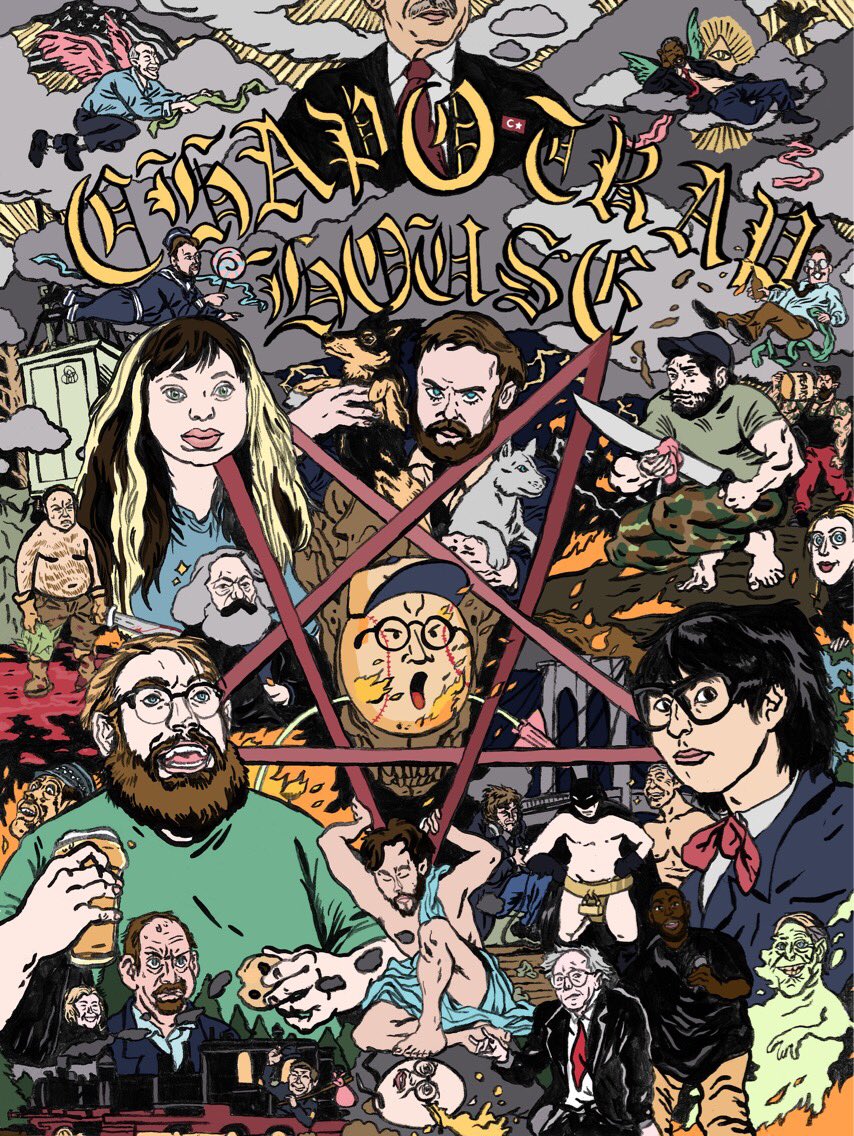
This is cynical thinking, but then again my favorite podcast encourages this level of awareness about the mundane. Chapo Trap House is a Brooklyn based podcast that spins comedy, leftist politics, and obscure cultural references into what could be the most relevant conversation being had*. What sets them apart? They're political without managing to suffer from partisan inconsistencies, their humor punches almost exclusively up without the suggested gentleness of doing so, and their references have a range from the academic or literary to 90s drudgery.
Chapo Trap House, with their fresh perspectives and timely commentary on the material condition of people's lives, helped drive a lot of my worldview leftward. When I saw they had a book coming out I was excited. Since a lot of my interaction with their podcast has been while at work, I thought a book would allow me to engage more thoroughly with their ideas.
The Chapo Guide to Revolution reads like a lot of leftist/Marxist books I've been reading lately. It takes aim at the shortcomings of liberalism and the garishness of conservativism. The key difference is that the Chapo Guide to Revolution is funny and way more accessible. It's written for the terminally online person, the disaffected college student at a state school, and workers entombed in their cubicles. Chapo Traphouse is reaching out to groups of middle Americans who feel ignored by a system who views them as nothing but a block of buying power to market to. What's more important is that they do so effectively.
Academics, critics, or theory jockeys could make a field day out of their complaints. Many have already pointed out that the ideas are oversimplified, the history is onesided, and many concepts are assumed true. None of this fucking matters though, because the Chapo Guide to Revolution isn't speaking to critics or academics or theory jockeys, nor is it speaking their language. Those of us in the crushed middle class have been saddled with student debt and fed lies about buying products or apps that will make our lives better are currently looking to fill a void, even if we don't know it. Alt-right voices are extremely good at filling this void because they're speaking to it in a way that the status quo defending voices cannot by definition. We need more left-wing voices that can do the same thing.
Thursday, September 13, 2018
From #BlackLivesMatter to Black Liberation by Keeanga-Yamahtta Taylor
To many of us, #BlackLivesMatter is a movement we reflexively support. Police brutality and other functions of systemic racism need to be opposed, our nation needs to be transformed from one that adheres to the assumption of white superiority to one of justice and egalitarianism among all people.
Which is all very easy to say, but many of us also seem confused on how to get there. Do we buy Nike shoes to show solidarity with Kaepernick? Do we post Now This videos on social media? Do we show up to anti-racism rallies? Is simply educating ourselves enough? Is this allyship?
To Keeanga-Yamahtta Taylor, destroying white supremacy means liberating ourselves from the systems that most utilize it. She contextualizes the #BlackLivesMatter movement in a way that illuminates what ideologies and methods have hit their limits and which ones can work to dismantle institutions premised on white supremacy.
While From #BlackLivesMatter to Black Liberation reads more like a history book than an instruction manual, it is a very insightful text to guide one towards the sort of activist work that needs to be done. Taylor is a Marxist so the activism she promotes will be steeped in that tradition. However, this is because, as Taylor goes on to discuss at length, the efforts of liberalism (you can just forget about conservatism) have failed to unroot white supremacy and, in many cases, only served to sustain it.
There is a lot of sharp discussion on the concept of "black faces in high places" and Barack Obama. Here, Taylor demonstrates that without radical vision, the liberal ideation of diversity becomes a mere platitude. What could changing the race of the machine operator do if the levers being pulled only produce more racism? Taylor's ensuing chapters are more complex and well evidenced than that, but the point rings true.
Taylor also takes aim at our ability to address systemic white supremacy through merely changing the culture or the law. Communities ravaged by the power of racism are designed to keep people down regardless of how hard the individuals within that community work. Further, even when one accepts the racist premise of a prescriptive, "good" culture, an individual succeeding despite obstacles does nothing to dismantle the obstacles themselves, which would not be true liberation.
Discrimination is illegal in the United States, but clearly still practiced. While it is good to have the law on the side of justice, clearly it has its limits as well. In many cases, now that we have civil rights legislation, the goal is to make the law colorblind. This too is a failure, since the enforcement of laws are subject to the enforcer's biases, and therefore communities of color are more aggressively policed, as we've seen. Taylor's chapter on the country's move from civil rights to color blindness is among one of the most informative things I have ever read.
So where do we go when all the mechanisms for change we were taught in high school civics classes have reached their limits? Taylor's book is so vital a read that I don't want to risk giving you an excuse not to read it by taking a crack at what she feels the movement demands. I will say that it has a lot to do with solidarity over the universal issues of democracy, labor, and dignity in life. If you consider yourself someone who cares about ending racism in this country you have no excuse; you need to read this book.
Sunday, July 1, 2018
All the Pretty Horses by Cormac McCarthy
"In the end we all come to be cured of our sentiments. Those whom life does not cure death will. The world is quite ruthless in electing between the dream and the reality, even where we will not. Between the wish and the thing the world lies waiting"
While reading Cormac McCarthy's All the Pretty Horses on vacation a few of my friends laughed at the title. Having never heard of Cormac McCarthy, they could only assume I was reading a book that a 12-year-old girl with a Lisa Frank folder would be reading in middle school.
This is actually very fitting. Everything about All the Pretty Horses is about managing expectations. Set at the dawn of the age of the cowboy, the protagonist - John Grady Cole - sets out to Mexico with his best friend Rawlins. They hope to work as ranch hands and live like frontiersmen in an age where automation and industrialization have squeezed out the last semblance of a Wild West.
All of which McCarthy refuses to spoon feed you. He is less interested in describing the motivations of his characters than the brutal landscapes they traverse. Employing his excellent craftsmanship as a writer not in bald sensory details, but rather in describing an essence; the very things that inhabit the landscapes themselves. Just read this sentence:
"When the wind was in the north you could hear them, the horses and the breath of the horses and the horses' hooves that were shod in rawhide and the rattle of lances and the constant drag of the travois poles in the sand like the passing of some enormous serpent and the young boys naked on them and the dogs trotting with their tongues aloll and foot slaves following half naked and sorely burdened and above all the low chant of their traveling song which the riders sang as they rode, nation and ghost of nation passing in a soft chorale across that mineral waste to darkness bearing lost to all history and all remembrance like a grail the sum of their secular and transitory and violent lives"One sentence. Not grammatically correct of course, but crafted as such. Leaving a lot of the picture up to the imagination McCarthy only allows his readers what is absolutely necessary to see.
John Grady and Rawlins have a classic and predictable adventure with just a sprinkle of brutal realism. Throughout all of it are horses. The horse comes to represent the vehicle through which our heroes live out their fantasy (without including any spoilers, any time these characters get into an automobile nothing good is about to occur). When you've come to suspect you're reading a classic, maybe even boring adventure novel, McCarthy shakes you awake with a firm reminder that the world does not have any patience for dreaming.
Subscribe to:
Posts (Atom)